
A wish list of spectacular future planetary missions

Steve Squyres of Cornell University and the project scientist of the Mars rovers Spirit and Opportunity spoke today at an astrobiology symposium in Arlington, Virginia. He described several spectacular planetary missions that might be flown in the coming decade. All are being considered. None have yet been chosen or funded.

  • A mission to grab a sample from a comet and return it to Earth.

  • A mission to put a rover or lander on one of the poles of Mars to study the frozen layers of water under the icecap.

  • Mars sample return mission. This mission is so difficult and expensive that it probably would be broken down into three parts:
    • Two rovers on the surface to gather and cache sample material.

    • A lander/rover mission to grab the samples and bring them up to Mars orbit. “Putting into orbit a precious cargo the size of a coconut,” Squyres said.

    • A mission to grab the sample cargo in Martian orbit and return it to Earth.

  • An orbiter to study both Jupiter and its moon Europa.

  • An orbiter to Enceladus, the moon of Saturn, to study the water and organic chemistry in its mysterious plumes.

  • An orbiter to Titan, with balloon to probe the atmosphere as well as a “lake lander, a boat” to study Titan’s lakes.

  • A variety of landers and rovers to go to Venus. One of the more astonishing mission concepts would land, then take off again to visit different places on the surface.

Squyres is the co-chair of a committee of the National Science Foundation that is right now putting together a decadal survey for outlining unmanned planetary research for the next decade. This survey is expected to be released in March, which is when we will find out which of the above missions the planetary science community prefers.
1 comment

Hubble tracks the aftermath of a possible asteroid collision

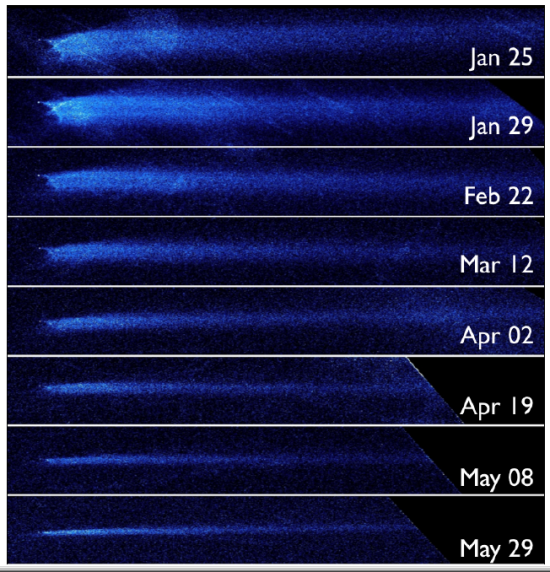
Using the Hubble Space Telescope over the last ten months, astronomers have tracked the decaying aftermath of a possible asteroid collision. Key quote:

Astronomers think a smaller rock, perhaps 10 to 15 feet wide, slammed into the larger one. The pair probably collided at high speed, about 11,000 mph, which smashed and vaporized the small asteroid and stripped material from the larger one. Jewitt estimates that the violent encounter happened in February or March 2009 and was as powerful as the detonation of a small atomic bomb.

The image sequence below, taken from the original paper describing the discovery [pdf], shows the slow changes that have occurred since January. At the moment scientists do not have an satisfactory explanation for the nucleus’s X-shaped pattern in the earliest images.

sequence of images of disrupted asteroid

0 comments

APS responds to Harold Lewis’s resignation letter

The American Physical Society has responded to Harold Lewis’s resignation letter.

It appears from their response that they are feeling some pressure about their past position, which stated “The evidence is incontrovertible: Global warming is occurring.” Compare that with what they say now, in their response to Lewis:

APS continues to recognize that climate models are far from adequate, and the extent of global warming and climatic disruptions produced by sustained increases in atmospheric carbon loading remain uncertain.

How nice. A science organization recognizing the uncertainty of science!

1 comment

Physicist resigns for American Physical Society over climategate

Physicist resigns from the American Physical Society over climategate. Key quote:

It is of course, the global warming scam, with the (literally) trillions of dollars driving it, that has corrupted so many scientists, and has carried APS before it like a rogue wave. It is the greatest and most successful pseudoscientific fraud I have seen in my long life as a physicist.

0 comments

Asteroids of note

At today’s press conference at the 42nd meeting of the AAS Division for Planetary Sciences, the topic was asteroids, including one which holds the possibility of hitting the Earth.

  • 65 Cybele has been found to have water ice and organic molecules on its surface, the second such asteroid so found. Key quote from the abstract:

    We conclude that 65 Cybele is covered by fine anhydrous silicate grains, with a small amount of water-ice and complex organic solids. This is similar to comets where non-equilibrium phases coexist, e.g. water-ice and anhydrous silicates; thus we conclude that this is a very primitive object.

    According to Humberto Campins of the University of Central Florida, this combination of water and organics could become hospitable to life should some form of energy be added, such as an impact to the asteroid.

  • The origin of the asteroid Phaethon, cause of the Geminids meteor shower, has been traced to the Pallas family of asteroids, a family created by the debris thrown out during a crater impact on the large asteroid Pallas. Campins also noted that this proves Phaethon is an asteroid and not a comet, a question that astronomers had been debating beforehand. Read the abstract here.
  • Asteroid 1999 RQ36, which has a 1 in a 1000 chance hitting the Earth in 2182 and is also the prime target of a proposed NASA sample return mission, has now been determined to be a member of the Polana family of asteroids. This makes 1999 RQ36 a very primitive asteroid from the very beginnings of the solar system. Moreover, this suggests that the Polana family could be the “most important” source of many near Earth asteroids. The abstract can be found here.
1 comment
1 709 710 711 712 713 729