
The basic ingredients of life might exist in Titan’s atmosphere

Big news! In a simulation of the upper atmosphere of Titan at about 600 miles altitude, scientists have discovered the basic ingredients of life are quickly synthesized when exposed to the kind of hard radiation found there. Key quote from the press release, issued today at the 42nd meeting of the AAS Division for Planetary Sciences:

The molecules discovered include the five nucleotide bases used by life on Earth (cytosine, adenine, thymine, guanine and uracil) and the two smallest amino acids, glycine and alanine.

For those who don’t remember their high school biology, these nucleotides are the building blocks of DNA.

The abstract of the scientist’s work can be found here.

What the scientists did was recreate the basic ingredients of Titan’s upper atmosphere, comprised of nitrogen, methane and carbon monoxide. Cassini data has shown that within this atmosphere are very large molecules, as yet unidentified.

The scientists then bathed their recreation in the kind of intense radiation expected at that altitude, and amazingly produced the complex organic molecules that are basic to life. Moreover, the experiment was the first to produce these complex molecules without the presence of water, something that scientists have previously thought was required. These results suggest that in addition to forming in the oceans, life could also form in the upper atmospheres of planets.

This result also suggests strongly that it is incredibly easy to produce the basic building blocks of life, almost anywhere in the universe where organic molecules are present.
0 comments

Pluto’s ice: 97% nitrogen, 3% methane

More results from the press conference going on right now at the 42nd meeting of the AAS Division for Planetary Sciences:

Pluto’s surface ice is made up of 97% nitrogen, 3% methane, while the surface of the Kuiper Belt object Eris (which is larger than Pluto) is even more rich in methane, with a make up of 90% nitrogen and 10% methane. Both measurements go down to a depth of about 10 inches. To see the abstract for this result, go here.

1 comment

The atmosphere of Venus is 60% less dense at its poles

By diving into the upper atmosphere of Venus above its north pole, Venus Express has found that the atmosphere there is 60% less dense than predicted. This from a press conference going on right now at the 42nd meeting of the AAS Division for Planetary Sciences. They plan an additional dive campaign during the next month. And they plan more dives, going deeper each time, as they judge the consequences to the spacecraft each time.

To read the abstracts of the Venus Express papers, go here.

Updated: The full press release, with images, can be seen here.

0 comments

The October 2010 sunspot graph

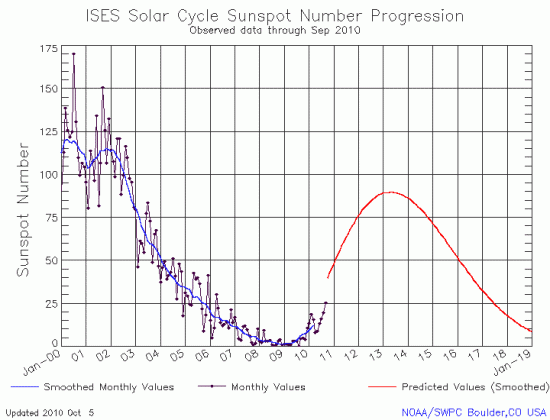
Yesterday NOAA’s Space Weather Prediction Center published its October monthly graph, showing the sun’s developing sunspot cycle in comparison with the consensis prediction made by the solar science community in May 2009.

October Sunspot graph

Sunspot activity in September clearly jumped, though it still remains far below predictions. Prepare for the weakest solar maximum since the 1810s!

Note also that today the Sun is blank, with no sunspots, the first time this has happened since August. At that time I speculated that this might “be the last time the Sun will be blank for years as it continues to ramp up to its next solar maximum.” Obviously not. The question now is whether today will be the finale in blankness for this minimum.

0 comments
1 710 711 712 713 714 729