More cave images from the Moon

James Fincannon of NASA has forwarded me two additional pictures of the same cave on the Moon, taken recently at different times by the camera on Lunar Reconnaissance Orbiter and made available by the Goddard Space Flight Center and Arizona State University.
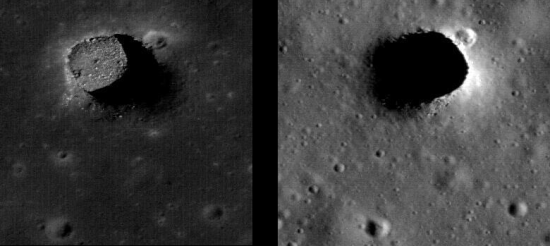
two images of the same pit

These images clearly show that the skylight looks down into a much larger space, with the underground room belling out from the skylight in all directions. This can be seen by how the angle of sunlight hitting the floor of the cave changes over time. Below is a very crude cartoon I have drawn to illustrate what I think we are seeing in the image on the left. The dashed lines indicate unseen walls whose precise location is not yet determined.
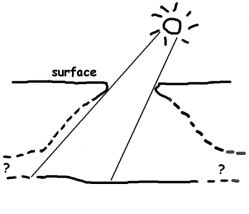
cartoon

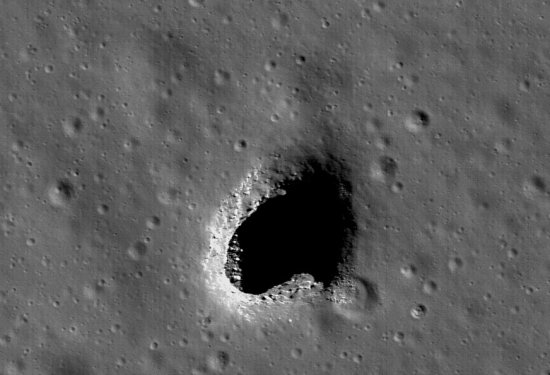
James also forwarded me this link, showing even more images of additional lava tube skylights on the Moon.

15 comments

Lunar conference at Ames

The third annual Lunar Science Forum is being held July 20-22 at the Ames Research Center in California. The list of papers, some of which are quite intriguing, can be found here. Fun quote from one abstract: “Purity levels of the ice suggest a degree of comingling of ice and regolith grains within the permanently shadowed crater.”

0 comments

Greenland icecap is not melting

Steve Goddard has posted on Anthony Watt’s webpage a very detailed update on the state of the icecap covering Greenland. Surprise! There are no signs of it disappearing anytime soon. (Note that you might have to scroll to the right to see the text of Goddard’s post, as on some computers Watts’s webpage is unfortunately far too wide for the screen.)

0 comments

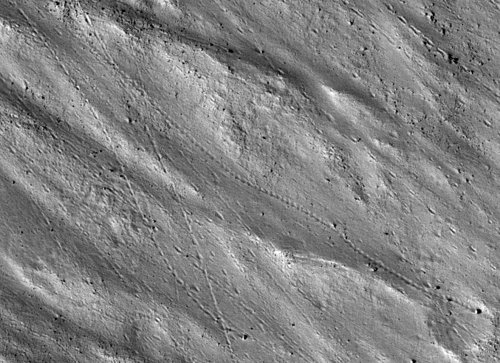
Boulder tracks on Mars

Here’s a nice picture from the HiRISE camera on Mars Reconnaissance Orbiter, released July 7, showing the boulder tracks left by rocks bouncing down the escarpment of Kasei Valles in the low gravity of Mars. Fun quote:

Some of these blocks traveled downhill several hundred meters (yards) as they rolled and bounced, leaving behind a trail of indentations or poke marks in the surface’s fine-grained, light-toned soils. The raised borders in some of these poke marks indicate they are relatively recent features, unaffected by wind erosion, or that this soil has cohesive properties, such as if it was cemented.

Boulder tracks on Mars

0 comments

The state of the polar ice caps, June 2010

On July 6, the National Snow and Ice Data Center (NSIDC) of the University of Colorado published its monthly report on the state of the polar ice caps. The Arctic ice cap, which this winter had been larger and more extensive than seen for many years, also shrank this spring at the fastest rate in years. (This chart, produced by data from the Japanese AMSR instruments on two research satellites, shows these trends very clearly.) Meanwhile, NSIDC reports that the ice cap in Antarctica is far larger than normal. Not unexpectedly, NSIDC immediately argues (quite unconvincingly if you ask me) that more ice in Antarctica is evidence for global warming.

From my perspective, the data continues to be inconclusive. We still do not really understand the long term trends of the Earth’s climate.

1 comment
1 725 726 727 728 729