Angara to fly July 9?

The first test flight of Russia’s new Angara rocket is now tentatively scheduled for July 9.

The story confirms that the problem was a faulty valve, which it appears they can replace at the spaceport, rather than return the rocket to the manufacturer. The story also had this line, which tells us that Russia is still struggling with quality control problems: “The valve’s malfunctioning was a result of sloppy assembly.”

0 comments

Space junk damages ISS coolant radiator?

According to the Russian Interfax news agency, a piece of space junk has hit a coolant radiator on the U.S. portion of ISS.

The source says that no coolant has escaped from the system and that NASA engineers are analyzing images to assess the damage.

Readers should be aware that I have tried without success to find the NASA website the story claims is the source for this information. Moreover, this story is reported nowhere in the U.S. press, and it is strange for a NASA website to report something like this and it not be quickly picked up by the U.S. press.

Thus, I am not entirely convinced yet that this story is accurate.

Update: a commenter below has provided this link to a subsequent post at nasaspaceflight about the impact.

2 comments

ISEE-3 fires its thrusters for the first time since 1987.

The private team resurrecting the 1970s space probe ISEE-3 successfully fired its thrusters for the first time since 1987.

It took several attempts and days to perform the roll maneuver because ISEE-3 was not responding to test commands. But this time, controllers got in touch. They increased the roll rate from 19.16 revolutions per minute to 19.76 RPM, putting it within mission specifications for trajectory corrections.

The spacecraft is now prepped for the big burn that will change its trajectory.

5 comments

Telescope teamwork produces spectacular galaxy image

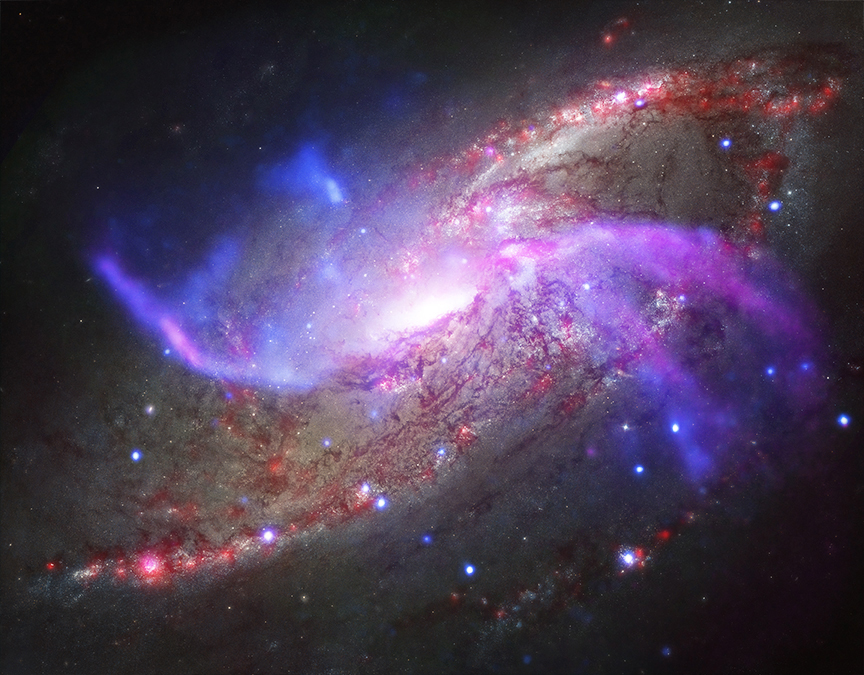
M106

Combining images from a host of space and ground-based telescopes, astronomers have created a spectacular image of the galaxy M106.

This galactic fireworks display is taking place in NGC 4258 (also known as M106), a spiral galaxy like the Milky Way. This galaxy is famous, however, for something that our Galaxy doesn’t have – two extra spiral arms that glow in X-ray, optical, and radio light. These features, or anomalous arms, are not aligned with the plane of the galaxy, but instead intersect with it.

The anomalous arms are seen in this new composite image of NGC 4258, where X-rays from NASA’s Chandra X-ray Observatory are blue, radio data from the NSF’s Karl Jansky Very Large Array are purple, optical data from NASA’s Hubble Space Telescope are yellow and blue, and infrared data from NASA’s Spitzer Space Telescope are red.

A new study of these anomalous arms made with Spitzer shows that shock waves, similar to sonic booms from supersonic planes, are heating large amounts of gas – equivalent to about 10 million Suns. What is generating these shock waves? Radio data shows that the supermassive black hole at the center of NGC 4258 is producing powerful jets of high-energy particles. Researchers thinkthat these jets strike the disk of the galaxy and generate shock waves. These shock waves, in turn, heat some of the gas – composed mainly of hydrogen molecules – to thousands of degrees.

The astronomers also used the Herschel Space Observatory to confirm the data from Spitzer.

0 comments

NASA and Boeing finalize contract to build the SLS rocket

NASA and Boeing today signed a $2.8 billion contract for Boeing to build the core stage of the SLS rocket

Scheduled for its initial test flight in 2017, the SLS is designed to be flexible and evolvable to meet a variety of crew and cargo mission needs. The initial flight-test configuration will provide a 77-ton capacity, and the final evolved two-stage configuration will provide a lift capability of more than 143 tons.

It would be nice for the U.S. to have this heavy-lift rocket, but I fully expect the funds to run out immediately after it makes its inaugural flight, despite the wonderful pork it provides to so many Congressional districts. It just costs too much per launch.

24 comments

Russia abandons Sea Launch

Running from competition: The Russian space agency Roskosmos has decided not to spend the money necessary to buy Sea Launch and make it part of its consolidated United Rocket and Space Corporation (URSC).

Part of the reason the Russians are abandoning Sea Launch is that the rocket the ocean-going platform uses is the Ukrainian-built Zenit rocket, and Russia wants URSC to a wholly Russian operation. Rather than partner with Ukraine for profit, they will let the business die.

10 comments

SpaceX’s Falcon Heavy rocket gets a customer

The competition heats up: The commercial satellite company Inmarsat has booked SpaceX’s Falcon Heavy rocket for one firm launch and two additional options.

The firm contract is for the launch, scheduled perhaps aggressively for late 2016, of a satellite being built for both Inmarsat and Arabsat of Riyadh, Saudi Arabia. Arabsat will use the satellite for conventional telecommunications services for its wholly owned Hellas-Sat fleet operator of Greece. The Inmarsat payload uses S-band to provide mobile communications in Europe as part of a satellite-terrestrial broadband network, which is a new business line for Inmarsat.

Inmarsat’s launch contract is for a rocket that has not even yet been tested once, which tells us something about the faith they have in SpaceX. While I would be shocked if they didn’t have an option to pull out should there be significant delays or problems in launching Falcon Heavy, that they are willing to commit to it now is a convincing endorsement of SpaceX.

16 comments
1 1,120 1,121 1,122 1,123 1,124 1,328