
The launch of China’s first space station module is set for September
The launch of China’s first space station module is now set for September.
The launch of China’s first space station module is now set for September.
Going to see the shuttle launch on Friday? The Space Walk of Fame Foundation Museum in Titusville, Florida needs volunteers to help organize the launch viewing at places like Space View Park.
A photo tour of Launch Complex 37B, level by level.
Mining the moon for water and fuel.
Texas-based Shackleton Energy Company has already begun operations aimed at mining the Moon within the next few years. The company’s plans for mining and refining operations would involve melting the ice and purifying the water, converting the water into gaseous hydrogen and oxygen, and then condensing the gases into liquid hydrogen, liquid oxygen and hydrogen peroxide, all potential rocket fuels.
Shackleton CEO Dale Tietz says the water extracted would be used almost exclusively as rocket fuel to power operations both within Low Earth Orbit (LEO) – such as space tourism and the removal of space-debris – on the Moon, and further out into space. ‘We are a for-profit business enterprise moving forward, and so we are only going there really for one reason and that is to mine, prospect mine and harvest water for rocket propellant production,’ says Tietz.
The first of two ARTEMIS spacecraft has successfully entered lunar orbit.
Dawn’s approach to Vesta continues.
Starting at the beginning of the approach phase on May 3, Dawn interrupted thrusting once a week to photograph Vesta against the background stars. These images help navigators determine exactly where the probe is relative to its target. This technique does not replace other means of navigation but rather supplements them. One of the principal methods of establishing the spacecraft’s trajectory relies on accurately timing how long it takes radio signals, traveling, as all readers know, at the universal limit of the speed of light, to make the round trip between Earth and Dawn. Another uses the Doppler shift of the radio waves, or the slight change in pitch caused by the craft’s motion. These sensitive measurements remain essential to navigating the faraway ship as it sails the interplanetary seas.
Despite the very slow approach, the distance is small enough now that observing Vesta weekly is no longer sufficient. To achieve the navigational accuracy required to reach the intended orbit in early August, last week the frequency of imaging was increased to twice per week. In each session, half of the pictures are taken with long exposures to ensure many stars are detectable, thus overexposing the much brighter disc of the nearby Vesta. The other half use short exposures to ensure that the rocky world shows up correctly so its precise location can be measured. The visible and infrared mapping spectrometer has been commanded to observe Vesta during three of these sessions, each time providing valuable information that will help scientists select instrument settings for when Dawn is close enough to begin its detailed scientific measurements.
Seems a bit long to me: NASA foresees a two year period after the last shuttle lands to retire the program completely.
The families of the Challenger astronauts come out in favor of commercial private manned spaceflight.
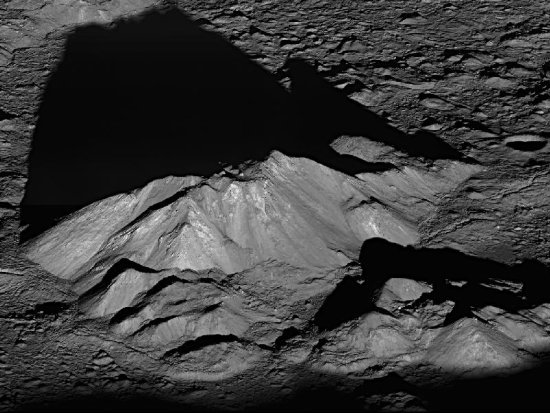
Another astonishing space photograph, this time from lunar orbit, taken by Lunar Reconnaissance Orbiter on June 11, 2011.
The image looks down at the central peak of Tycho crater, with enough detail to make out individual boulders at the summit. Go the link to see some closeups.
Mysterious bubble of light, caused by military suborbital rocket, captured by Hawaii telescopes.