
Tag: spaceflight
The future ups and downs of government spending in space
A new report says that government spending on space will flatten worldwide over the next five years. Some key quotes from the news story however suggest all is not going downhill:
A total of 692 satellites will be launched by governments in the coming decade, up 43% from the previous decade. This is a direct reflection of the increasing number of new space-capable countries across the globe. Civil agencies will launch roughly 75% of these satellites, a significant increase compared to the last decade during which they accounted for 67% of all government satellites launched.
Also, while certain areas will show a decline (the U.S. manned program) others appear robust.
Access to space (launch capability) investments reached $4.6 billion in 2010, and should be sustained in the coming years as more governments see independent access to space as a top priority of their space programs.
In both of the above examples, the areas where space activity will increase is because of the arrival of new space-faring nations (India, Japan, China to name only the most obvious), what I have been calling the new colonial movement. I also believe that as these new countries begin to show their stuff in space, their success will further fuel the competition, and the older space-faring nations will come back to life in order to stay in the game.
A potential landing site for next Mars rover
This week’s release of cool images from Mars Reconnaissance Orbiter included the color image below of a region on the floor of Holden Crater, one of the four possible landing sites for Curiosity, the Mars Science Laboratory planned for launch later this year. (If you want to see the entire image at higher resolution, you can download it here.)
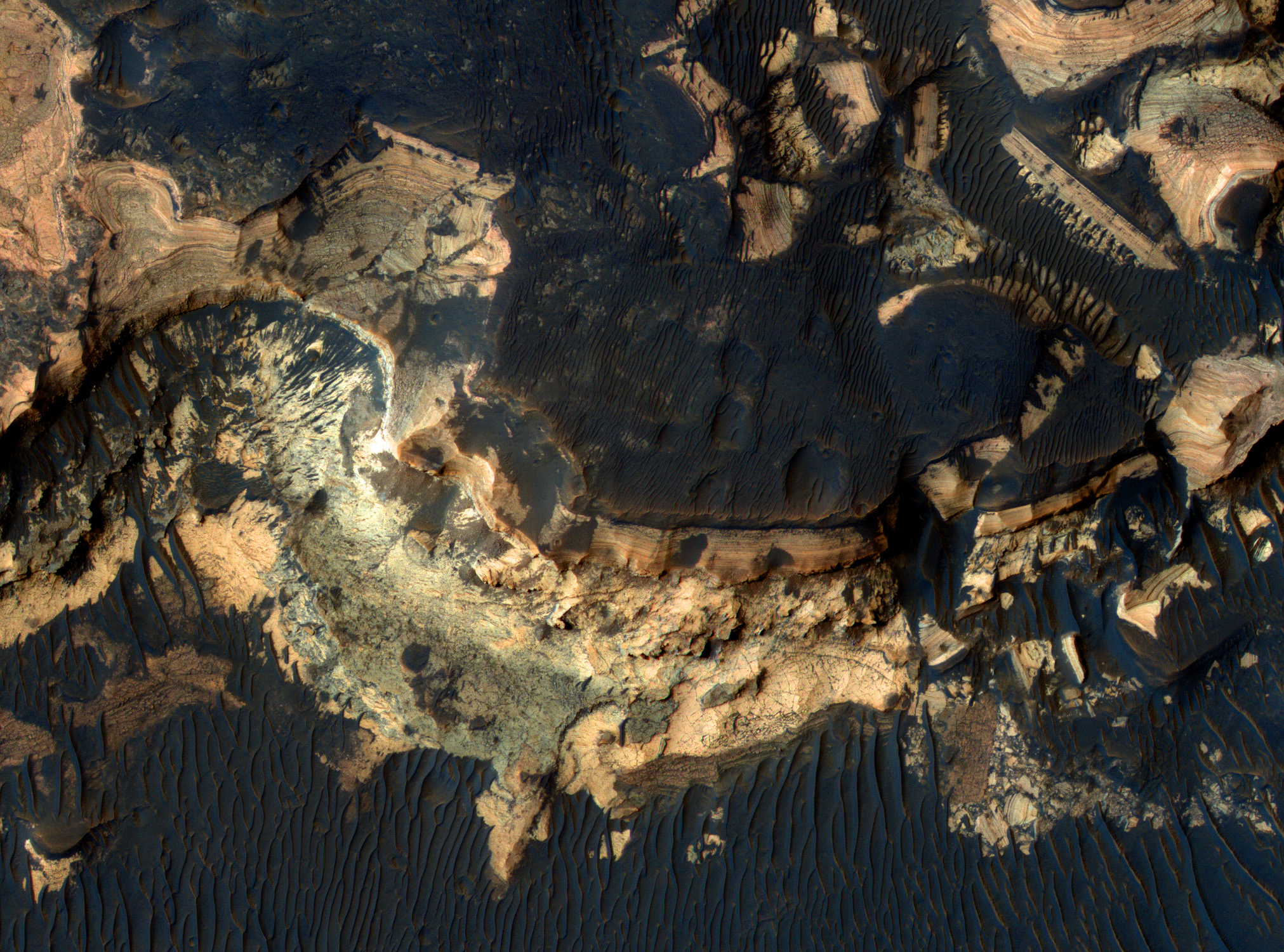
Two things that immediately stand out about this image (other than this looks like an incredibly spectacular place to visit):
A Private Space Shuttle Replacement
Google Lunar X Prize has announced the final roster of teams competing for its $30 Million prize
The Google Lunar X Prize has announced the final roster of teams competing for its $30 Million prize.
Thousands of previously unknown tombs in Saudi Desert spotted from space
Thousands of previously unknown ruins in Saudi Desert spotted from space.
Russian spacewalk finishes early
Meanwhile, up on ISS two Russians have successfully completed a five hour spacewalk, getting all their work done early.
Europe’s ISS freighter launches successfully
Europe’s second ISS freighter, dubbed Johannes Kepler, launched successfully today.
The next flight of the Chinese manned spacecraft could last three weeks
China on the march! The next flight of their Shenzhou manned spacecraft could be a three week unmanned mission designed to test rendezvous and docking with their soon-to-launch Tiangong 1 space laboratory.
The delay in the launch of the European cargo ship could delay the next Shuttle launch
The delay yesterday of the launch of the European cargo ship to ISS might also delay the next Shuttle launch.
Australian space beer ready for micro-gravity test
Australian space beer ready for micro-gravity test.
The launch of Europe’s freighter to ISS delayed one day
The launch of Europe’s freighter to ISS was scrubbed today. They will try again tomorrow.