Russia launches classified military payload; China has a launch failure

There were two additional launch attempts yesterday by China and Russia, with mixed results.

First, the Chinese pseudo-company Space Pioneer attempted the first launch of its Tianlong-3 rocket, designed essentially as a Falcon 9 copy. China’s state-run press provided no details of the failure, but video of the launch appeared to show uneven engine thrust beginning at about 33 seconds after launch, and the rocket terminating its flight about two minutes later.

Next, Russia placed a classified military payload into orbit, its Soyuz-2 rocket lifting off from its Plesetsk spaceport in northwest Russia. It is believed this could be a military communications satellite, but this is also unconfirmed. The rocket dropped its lower stages and fairings at several different places inside Russia.

The leaders in the 2026 launch race:

41 SpaceX
16 China
5 Rocket Lab
5 Russia

SpaceX continues to lead the entire world combined in total launches, as it did in both ’24 and ’25.

2 comments

Amazon responds to SpaceX’s FCC complaint about its last Leo satellite launch

Amazon Leo logo

Amazon yesterday submitted a letter [pdf] to the Federal Communications Commission (FCC) responding to SpaceX’s FCC complaint earlier this week that accused it of using Arianespace’s Ariane-6 rocket to place 32 Leo satellites in a 450 kilometer orbit — 50 kilometers more than its license allowed — causing SpaceX to maneuver 30 of its own Starlink satellites to avoid any collisions.

In its response, Amazon claimed the higher orbit was not a violation, that its original license allowed for orbits “at or above 400 kilometers”, and that the problem was really caused by SpaceX’s decision in the past few months to lower the orbits of its Starlink satellites to a 462 to 485 kilometers. It also accused SpaceX of refusing to compromise when Amazon proposed a solution. Instead, SpaceX demanded Amazon stop launching at this orbit height, a change that Amazon claimed would delay the next few Ariane-6 launches by months.

Despite these claims, Amazon then backed off:

Even so, Amazon Leo has made significant operational changes in response to SpaceX’s concerns. Working with Arianespace, Amazon Leo has committed to lowering its target insertion altitude, beginning with its fourth Ariane mission. Similarly, Amazon Leo is working with its other launch providers to determine if they can lower insertion altitudes without impacting Amazon Leo’s schedule.

In other words, Amazon will do as SpaceX requests, but only do so after it completes three more Ariane-6 launches at this higher orbit.

The FCC now has a choice. If it demands Amazon immediately concede SpaceX’s point, this will likely cause a delay in three Ariane-6 launches of approximately 100 Leo satellites. Amazon’s FCC license requires it to launch 1,616 Leo satellites by July 2026, and at present it only has a little more than 200 satellites in orbit. Because Amazon doesn’t expect to meet this goal, it has already asked the FCC for a time extension.

Thus, it appears this dispute with SpaceX might actually benefit Amazon. If the FCC denies Amazon’s request to launch the next three Ariane-6 missions at this higher orbit, it will also be agreeing to a delay in Leo satellite launches. It will thus be forced to grant Amazon’s request for that time extension. And even if it does allow Amazon to launch at the higher orbit, requiring the two companies to work out any orbital conflicts, that permission will confirm the FCC is going to grant Amazon’s time extension request as well.

7 comments

SpaceX launches 29 more Starlink satellites

The beat goes on: Even as everyone (including myself) was focused on NASA’s Artemis-2 lunar mission, SpaceX remained centered on its own space effort. This evening it placed another 29 Starlink satellites into orbit, its Falcon 9 lifting off from Cape Canaveral Space Force Station in Florida.

The first stage completed its 15th flight, landing on a drone ship in the Atlantic only 23 days after its previous flight.

Below is the leader board for the 2026 launch race, which I had forgotten to include in the previous two launches by SpaceX and NASA. Those posts have now been updated to include it.

41 SpaceX
16 China
5 Rocket Lab
4 Russia

SpaceX continues to lead the entire world combined in total launches, as it did in both ’24 and ’25.

Chinese pseudo-company Space Pioneer was also scheduled today to do the first demo launch of its Tianlong-3 orbital rocket, which appears in many ways to be a Falcon 9 copy. At this moment there are no reports out of China of what happened, though Jonathan McDowell reports on X of speculation that it was a failure. We will know more in a day or so.

Space Pioneer is the pseudo-company that in 2024 had this rocket’s first stage do an unplanned launch during a static fire engine test. That incident delayed this launch attempt by at least one year.

1 comment

Orion fires engines and is now on its way around the Moon

After reviewing the operation of Orion capsule during its first day in orbit, the NASA Artemis-2 management team approved sending the spacecraft to the Moon.

The burn occurred at 7:49 Eastern. The live stream of that burn is embedded below.

At this moment NASA and the crew are committed. No matter what happens, they cannot return to Earth any earlier than about nine days from now. And when they return, they will have to do a direct dive into the atmosphere, heading to splashdown. The Orion heat shield at that point must work.
» Read more

18 comments

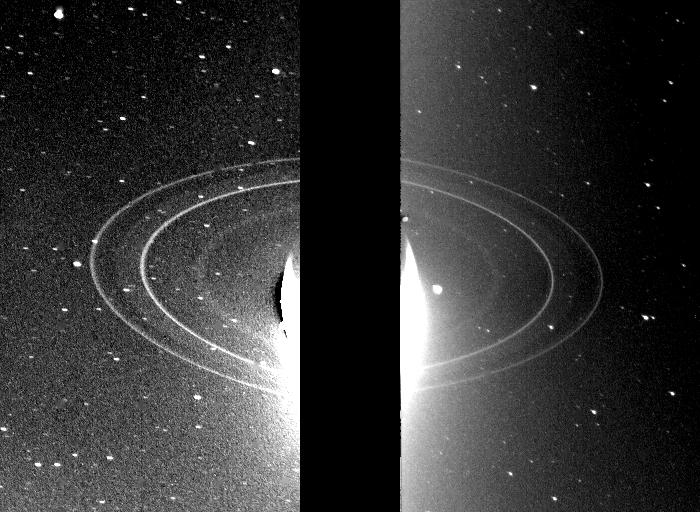
Neptune’s rings, as seen by Voyager-2 in 1989

The rings of Neptune as seen by Voyager-2
Click for original image.

Cool image time! The picture to the right, cropped, reduced slightly, and sharpened to post here, was taken by Voyager-2 on August 26, 1989 shortly after it had completed its close fly-by of Neptune, looking back at the planet from a distance of about 175,000 miles.

The two main rings are clearly visible and appear complete over the region imaged. … Also visible in this image is the inner faint ring at about 25,000 miles from the center of Neptune, and the faint band which extends smoothly from the 33,000 miles ring to roughly halfway between the two bright rings. Both of these newly discovered rings are broad and much fainter than the two narrow rings.

These long exposure images were taken while the rings were back-lighted by the sun at a phase angle of 135 degrees. This viewing geometry enhances the visibility of dust and allows fainter, dusty parts of the ring to be seen. The bright glare in the center is due to over-exposure of the crescent of Neptune. The two gaps in the upper part of the outer ring in the image on the left are due to blemish removal in the computer processing. Numerous bright stars are evident in the background. Both bright rings have material throughout their entire orbit, and are therefore continuous.

While Voyager-2 took other pictures of these rings (here, here, here, here, and here), I think this picture shows the rings best, if not terrible well. Images using the Hubble and Webb space telescopes as well as others have not been better.

The rings were first confirmed to exist in the mid-1980s, shortly before Voyager-2’s fly-by. We now think there are five rings total, all made of dark material, likely a mix of carbon-based molecules, much of it the equivalent of dust and soot.

0 comments

The new Rubin telescope discovers over 11,000 new asteroids in first observations

Rubin's first asteroid discoveries
Click for full animation.

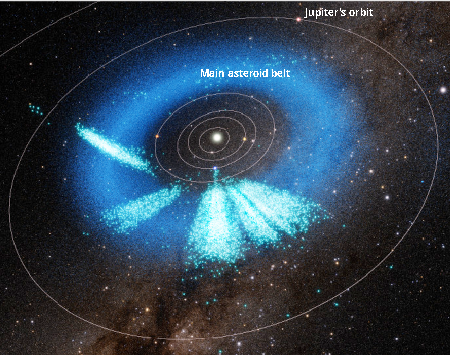
The new Rubin Observatory, a ground-based telescope in Chile, has discovered over 11,000 new asteroids in its first preliminary observations, with most in the main asteroid belt but a large number in the Kuiper Belt beyond Neptune and 33 previously unknown near-Earth asteroids.

The graphic to the right, annotated by me to post here, shows all of Rubin’s asteroid detections in light blue.

The submission to MPC [Minor Planet Center] comprises approximately one million observations, taken over the span of a month and a half, of over 11,000 new asteroids and more than 80,000 already known asteroids, including some that had previously been observed but were later “lost” because their orbits were too uncertain to predict their future locations. You can interact with all of Rubin’s asteroid discoveries in the Rubin Orbitviewer, which uses real data to provide an intuitive way to explore the structure of our cosmic backyard in three dimensions and in real time. Also, visit the Rubin Asteroid Discoveries Dashboard to learn about the new objects Rubin has uncovered.

…Among the newly identified objects are 33 previously unknown near-Earth objects (NEOs), which are small asteroids and comets whose closest approach to the Sun is less than 1.3 times the distance between Earth and the Sun. None of the newly discovered NEOs pose a threat to Earth, and the largest is about 500 meters wide.

Astronomers predict that Rubin will eventually find 90,000 new near-Earth objects, with some expected to pose a risk of hitting the Earth. It does this by repeatedly surveying the southern sky with its large mirror, then identifying new objects with its sophisticated software.

2 comments

SpaceX files initial paperwork for going public

SpaceX logo

SpaceX yesterday filed the first confidential paperwork the the Securities and Exchange Commission (SEC) for its initial public offering (IPO) of public stock, now targeting a June-July time frame.

The filing was reported by Bloomberg, the Wall Street Journal and Reuters, citing unnamed sources familiar with the matter. SpaceX did not immediately respond to a request for comment. The SEC said it had no comment on the matter. The filing will lead to a sale of shares by June or July, according to the published reports. Confidential filings are used by companies to share information with the SEC and investors before they have to disclose to the broader public.

How much SpaceX plans to raise through a sale of some of its shares are not yet available due to the confidential nature. But CEO and principal shareholder Elon Musk is expected to control a majority of voting shares once the details are revealed. And it could make Musk, already the world’s richest person, that much richer.

SpaceX was valued at $800 billion and xAI $230 billion at their most recent funding round in January according to PitchBook, a research firm that tracks the valuation of private companies. That puts the combined companies’ worth at more than $1 trillion.

SpaceX also now includes X (formerly Twitter) that Musk bought for $44 billion, so the combined company is actually even larger. We still do not know any details, such as the number of shares to be sold as well as the initial sale price. One rumor has indicated that SpaceX wants to reserve 30% for sale to individuals, a number much higher than usual. Other rumors say that Musk is designing the sale to make sure he remains the majority stock-holder and thus in control of all three companies.

Stock experts have predicted this stock sale could garner SpaceX as much as $75 billion in cash, which would give it the resources to not only build its proposed million-satellite data center constellation in orbit but also develop the Starship/Superheavy infrastructure to build its own data center on the Moon. And along the way SpaceX would have the funds to do its own space program to settle Mars.

If SpaceX does raise that much, it will truly become America’s space program, doing far more that NASA and much faster — financed voluntarily by the American people.

11 comments

SLS successfully puts Orion into orbit

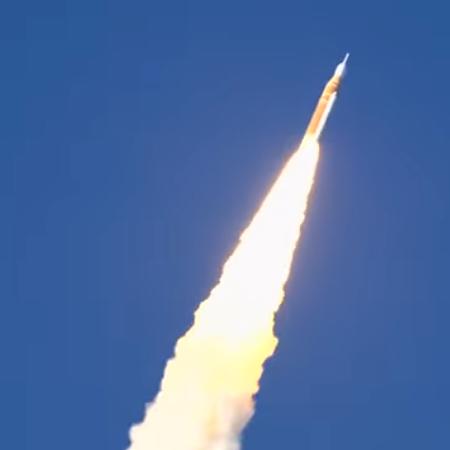
SLS less than a minute after launch

NASA’s SLS rocket today successfully launched the Orion capsule, carrying three Americans and Canadian on a planned ten-day mission swinging around the Moon and back to Earth.

During the countdown there were two minor issues, the second of which causes a slight ten-minute delay in the launch. Both were resolved very quickly, though one wonders if NASA can ever do a launch with this rocket without such issues during countdown.

The crew will remain in Earth orbit until tomorrow, checking out the capsule and its systems. Once they have confirmed these are working as expected, they will then fire their engines to head to the Moon.

The live stream can be viewed here.

As this was the first U.S. government launch this year (and the first since 2022), the leader board for the 2026 launch race remains unchanged:

40 SpaceX
16 China
5 Rocket Lab
4 Russia

SpaceX continues to lead the entire world combined in total launches, as it did in both ’24 and ’25.

22 comments

Watching the launch of the Artemis-2 mission

Artemis-2 mission flight path
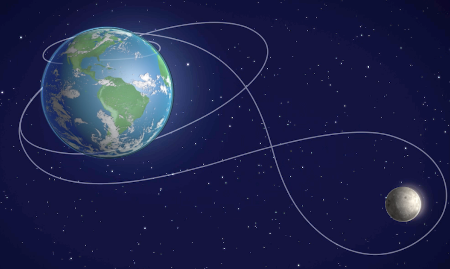
The Artemis-2 flight path. Click for full animation.

The countdown for the launch of the 10-day Artemis-2 manned mission around the Moon continues, with the launch scheduled for 6:24 pm (Eastern) today.

For updates from NASA, go here. So far all is proceeding as planned. A step-by-step outline of the countdown itself can be found here.

A day-by-day detailed description of the planned mission can be found here. For the first day the crew will remain in Earth orbit in order to test the operation of their Orion capsule. To reiterate, the capsule’s life support system has not been flown in space previously, so this first day is critical. If there are any issues, the astronauts are still close to Earth and can return relatively quickly.

If no problems are detected during that first day, on day two the crew will fire the spacecraft’s engines and head to the Moon. At that point everything must function as planned for nine days as they travel out to the Moon, swing around it without going into orbit, and head back to Earth.

The return to Earth remains the most dangerous moment for this flight. During the 2022 unmanned test flight around the Moon, the heat shield design on Orion did not work as planned, with chunks breaking off in a manner that was unexpected and very concerning. NASA spent two years contemplating the issue, and decided to live with the same heat shield design for this mission, since replacing the shield would have delayed the launch at minimum two years. It has adjusted the return flight path in a way it thinks will mitigate the problem. As its engineers are only guessing at what caused the issue and could be wrong — having done no real life tests — we will not know if they are right until Orion splashes down.

We must pray that they are right.

I have embedded NASA’s live stream below.
» Read more

23 comments

Voyager-2 discovered Neptune to be a planet of quickly changing weather

Neptune's fast changing weather
Click for source.

Cool image time! When Voyager-2 flew past Uranus in 1986, the data showed the gas giant’s weather to be relatively sedate and quiet, with little changing during the fly-by. Scientists expected this: Uranus’s distance from the Sun meant it got little energy to fuel an active climate, with any activity produced by internal heating due to the gravitational pressure of its mass. And Uranus did not produce that much heat internally.

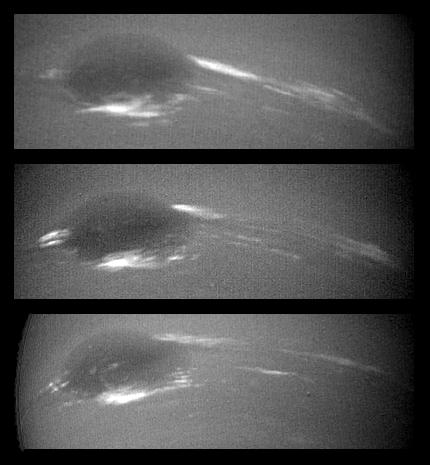
When Voyager-2 passed Neptune three year later, the scientists expected something similar, or even less, due to Neptune’s greater distance from the Sun. Instead, Voyager-2’s data showed Neptune’s weather patterns to be changing constantly and quickly, as illustrated by the three images of the Great Dark Spot to the right, the biggest storm on Neptune at that time and located in the planet’s southern mid-latitudes.

The bright cirrus-like clouds of Neptune change rapidly, often forming and dissipating over periods of several to tens of hours. In this sequence spanning two rotations of Neptune (about 36 hours) Voyager 2 observed cloud evolution in the region around the Great Dark Spot at an effective resolution of about 60 miles per pixel. The surprisingly rapid changes which occur over the 18 hours separating each panel shows that in this region Neptune’s weather is perhaps as dynamic and variable as that of the Earth. However, the scale is immense by our standards — the Earth and the [Great Dark Spot] are of similar size.

In Neptune’s frigid atmosphere, where temperatures are as low as 55 degrees Kelvin (-360 F), the cirrus clouds are composed of frozen methane rather than Earth’s crystals of water ice.

Subsequent observations by the Hubble Space Telescope in 1994 found this Great Dark Spot was gone, replaced by a comparable storm in the northern hemisphere. Further Hubble observations found Neptune’s storms tend to last about two years, fading as they drifted towards the equator. Those observations however also detected storms drifting away from the equator. Other research suggested the storms might be influenced by the Sun’s sunspot cycle.

All of the data post-Voyager-2 remains very coarse and uncertain, as we are looking at Neptune at a great distance. Thus, no theory about what is happening carries much weight, especially because we do not know why Neptune produces so much more internal heat than Uranus, fueling this fast-changing weather. For example, Neptune gets 1/20th of the energy received by Jupiter, yet its atmosphere appears even more active and variable.

2 comments

India’s space agency requests proposals for building landing legs for its next new rocket

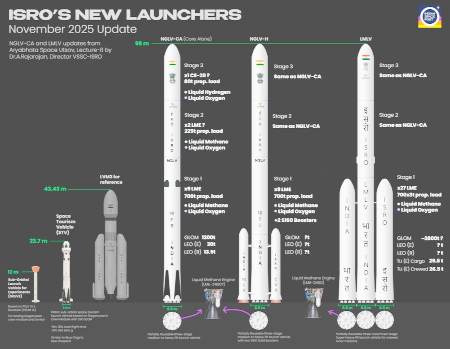
NGLV as proposed in November 2025
NGLV (the two rockets in the middle) as proposed
in November 2025. Click for bigger image.

India’s space agency ISRO has issued a request for bids from the country’s commercial aerospace sector to build landing legs for its next new rocket, dubbed the Next Generation Launch Vehicle (NGLV).

The tender, titled “Fabrication of Landing Leg Hardware with materials for Advanced Development Module for In-situ Reusable Technologies (Admire) VTVL (10 units)”, seeks industry participation in developing critical components for a vertical take-off, vertical landing (VTVL) test vehicle under the ADMIRE programme.

…According to ISRO’s tender documents, the selected vendor will be responsible for end-to-end development, including procurement of raw materials, manufacturing, quality control planning, and final delivery of landing leg hardware. The project has been structured into three distinct phases spanning approximately 12 months.

The NGLV rocket was first approved by the India government in September 2024. Since then ISRO has completed the preliminary design of its methane engine, but has also revised the rocket’s design twice, in October 2024 and again in November 2025. This new landing leg contract suggests the agency hopes to do some test hops of a first stage prototype a year from now.

2 comments

A 2nd Starlink satellite since December fails catastrophically

According to reports from two different companies (here and here) that monitor objects in orbit, a Starlink satellite broke apart for unknown reasons on March 29, 2026.

SpaceX yesterday confirmed the incident.

On Sunday, March 29, Starlink satellite 34343 experienced an anomaly on-orbit, resulting in loss of communications with the satellite at ~560 km above Earth. Latest analysis shows the event poses no new risk to the Space_Station, its crew, or to the upcoming launch of NASA’s Artemis II mission. We will continue to monitor the satellite along with any trackable debris and coordinate with NASA and the USSpaceForce.

This is the second time in just over three months that a Starlink satellite has failed suddenly. In mid-December a Starlink satellite began to tumble when fuel began venting from a tank. It burned up in the atmosphere a month later.

Considering that SpaceX has approximately ten thousand Starlinks in orbit, any failures should not be a surprise. You launch that many, some are going to fail. That the company has only had two such failures indicates instead SpaceX’s incredible quality control in manufacturing, as almost every satellite works as expected with no such failure.

3 comments
1 16 17 18 19 20 1,327