The effect of weightlessness on the spine

New observations of astronauts before and after four to seven month long missions to ISS has found the back pain many astronauts experience appears to be caused by significant muscle atrophy.

The MRI scans indicated significant atrophy of the paraspinal lean muscle mass —which plays a critical role in spinal support and movement—during the astronauts’ time in space. The lean muscle, or “functional,” cross-sectional area of the lumbar paraspinal muscles decreased by an average of 19 percent from preflight to immediate postflight scans. A month or two later, only about two-thirds of the reduction had recovered. There was an even more dramatic reduction in the functional cross-sectional area of the paraspinal muscles relative to total paraspinal cross-sectional area. The ratio of lean muscle decreased from 86 percent preflight to 72 percent immediately postflight. At follow-up, the ratio recovered to 81 percent, but was still less than the preflight value.

In contrast, there was no consistent change in the height of the spinal intervertebral discs. Dr. Chang and coauthors write, “These measurements run counter to previous hypotheses about the effects of microgravity on disc swelling.” Further studies will be needed to clarify the effects on disc height, and whether they contribute to the increase in body height during space missions, and to the increased risk of herniated disc disease.

These results are very encouraging, because they indicate that the back problems seen are mostly attributable to weakened muscles, not actual spinal damage, and can therefore be more easily mitigated by new exercises while in orbit.

7 comments

Clinton campaign outlines its space priorities

In an op-ed today, an adviser to the Hillary Clinton campaign outlined the space policy priorities that her administration would focus upon should she win the election.

Despite attempts to suggest these policies would be significantly different than the policies of Donald Trump, it seems to me that her focus would be quite similar to Trump’s. While the announcements from the Trump campaign have suggested his administration would consider more changes to space policy than Clinton, both candidates appear to be proposing only minor changes. With both, the private-public partnership of commercial space would be continued. With both, SLS/Orion will be reconsidered, and changed depending on the demands of Congress.

The only significant difference, based on today’s op-ed, is that a Hillary Clinton administration will likely devote significant NASA resources to the study of global warming, while Trump appears quite willing to slash this research, based on what appears to be data tampering for political reasons in both NASA and NOAA.

0 comments

Aggressive SETI observations of Tabby’s star upcoming

Breakthrough Listen, an effort to listen for radio signals from alien civilizations that, plans to devote significant time this year observing Tabby’s star to see if an alien mega-structures are causing that star’s unexplained dimming.

While Siemion and his colleagues are skeptical that the star’s unique behavior is a sign of an advanced civilization, they can’t not take a look. They’ve teamed up with UC Berkeley visiting astronomer Jason Wright and Tabetha Boyajian, the assistant professor of physics and astronomy at Louisiana State University for whom the star is named, to observe the star with state-of-the-art instruments the Breakthrough Listen team recently mounted on the 100-meter telescope. Wright is at the Center for Exoplanets and Habitable Worlds at Pennsylvania State University.

The observations are scheduled for eight hours per night for three nights over the next two months, starting Wednesday evening, Oct. 26. Siemion, Wright and Boyajian are traveling to the Green Bank Observatory in rural West Virginia to start the observations, and expect to gather around 1 petabyte of data over hundreds of millions of individual radio channels.

10 comments

Russia and ESA in money dispute

A money dispute between Russia and France could threaten the ESA/Russian ExoMars partnership, as well as the Arianespace deal that launches Soyuz rockets from French Guiana.

In what appears to be an attempt to force France’s European neighbors to apply pressure to Paris, Roscosmos hinted that multiple cooperative space efforts between Russian and the European Union, and with the European Space Agency (ESA), could suffer if the payments are not freed. The payments, which are not disputed by Arianespace, have been one of the collateral effects of the battle by former shareholders of Russia’s Yukos oil company. In 2014, these shareholders won an initial award of $50 billion from an international arbitration panel in The Hague, Netherlands, against the Russian government for dismantling the company.

Since then, the shareholders have been trying to collect Russian government assets wherever they find a sympathetic legal environment outside Russia, including France and Belgium. In France, different shareholder representatives sought seizure of the Eutelsat and Arianespace payments. The same dispute has blocked payments to other Russian companies. Paris-based satellite operator Eutelsat owes Russia’s biggest satellite operator, Russian Satellite Communications Co. (RSCC) of Moscow, around $300 million for services related to Eutelsat use of RSCC satellites.

Russia needs cash, which is why they need their partnership with Arianespace, which has brought them a lot of cash over time. Their problem is that the money owed the Yukos oil company shareholders has allowed those shareholders to put liens on any Russian earnings in Europe, which has only increased Russia’s financial bind. If Russia can’t get its hands on its Arianespace earnings, then it really makes no sense for them to continue the partnership. Better to threaten to pull out with the hope that the threat will maybe force payment.

Moreover, Russia might also be realizing that it cannot at present afford to participate in ExoMars and is looking for a way to get out of that commitment. This money dispute gives them that out.

1 comment

Juno successfully completes engine burn with smaller thrusters

Having successfully left safe mode, engineers had Juno do a 31 minute engine burn on Tuesday to adjust its orbit using its smaller thrusters.

The burn, which lasted just over 31 minutes, changed Juno’s orbital velocity by about 5.8 mph (2.6 meters per second) and consumed about 8 pounds (3.6 kilograms) of propellant. Juno will perform its next science flyby of Jupiter on Dec. 11, with time of closest approach to the gas giant occurring at 9:03 a.m. PDT (12:03 p.m. EDT). The complete suite of Juno’s science instruments, as well as the JunoCam imager, will be collecting data during the upcoming flyby.

That they will definitely collect data during the December 11 flyby means that they are going to delay again the main engine burn that will reduce the spacecraft’s orbit to 14 days, its official science orbit. This also means that they are still uncomfortable firing that main engine. It is also not clear from the press release whether this burn was planned, or was added to compensate for the main engine issues.

The vagueness makes me think that Juno has some serious issues that they haven’t yet told us about.

0 comments

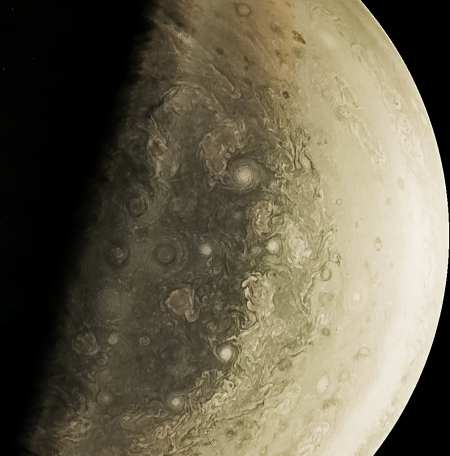
The storms of Jupiter’s south pole

storms on Jupiter

Cool image time! Even though Juno has been unable to gather any additional data since its first close approach of Jupiter in August because of technical problems, the science team has set up its website to allow the public to download the images produced so far, process those images, and then upload them to the site for the world to see.

The image to the right, reduced in resolution to show here, is one example of the many different processed images produced by interested members of the general public. It highlights the seemingly incoherent storms that are raging at Jupiter’s south pole.

close-up of storms

To the left is a cropped section of the full resolution image. It shows the complex transition zone between the darker polar regions and the brighter band that surrounds it. This chaotic atmospheric behavior is something that no climate scientist has ever seen before. It will take decades of research to untangle and even begin to understand what is happening.

1 comment

Schiaparelli failure focuses in on altimeter data

The investigation into the landing failure last week of the ExoMars 2016 lander, Schiaparelli, is now focusing on a failure in the spacecraft’s altitude software.

The most likely culprit is a flaw in the craft’s software or a problem in merging the data coming from different sensors, which may have led the craft to believe it was lower in altitude than it really was, says Andrea Accomazzo, ESA’s head of solar and planetary missions. Accomazzo says that this is a hunch; he is reluctant to diagnose the fault before a full post-mortem has been carried out. But if he is right, that is both bad and good news.

European-designed computing, software and sensors are among the elements of the lander that are to be reused on the ExoMars 2020 landing system, which, unlike Schiaparelli, will involve a mixture of European and Russian technology. But software glitches should be easier to fix than a fundamental problem with the landing hardware, which ESA scientists say seems to have passed its test with flying colours. “If we have a serious technological issue, then it’s different, then we have to re-evaluate carefully. But I don’t expect it to be the case,” says Accomazzo.

0 comments

Russia considers using Ukrainian rocket

For the first time since it annexed Crimea, Russia has opened negotiations with a Ukrainian company to possibly use its Zenit rocket to launch a Russian satellite.

RKK Energia of Korolev, Russia, entered negotiations with KB Yuzhnoe of Dnepropetrovsk, Ukraine, on a potential deal to launch a satellite for Angola on a Ukrainian-built Zenit rocket. Under the proposed plan, the Angosat-1 satellite would ride the last fully assembled Zenit rocket still remaining in Baikonur. The mission is seen by industry insiders as the first step in the resumption of Zenit missions, which if successful, will eventually shift from Baikonur to the Sea Launch ocean-going platform based in Long Beach, California.

The situation here is beyond complicated. Russia remains in many ways in a state of war with Ukraine. Yet, the Sea Launch platform, recently purchased by a Russian airline company, needs the Ukrainian Zenit rocket. It appears that this need is forcing the Russians to once again buy from the Ukraine. At the same time, Sea Launch remains parked in the U.S., and will likely not be available until Sea Launch and Russia settle the lawsuit Boeing has filed against the company. Meanwhile, the Zenit rocket in question however needs refurbishing and was originally built to launch a different satellite, which will have to agree to fly on a different launch vehicle.

0 comments

ISRO begins ground tests of its first lunar lander

The competition heats up: ISRO, India’s space agency, has begun testing the sensors its first lunar lander, Chandrayaan-2, will use to descend safely to the surface.

ISRO Satellite Centre or ISAC, which is the lead centre for the country’s second moon mission, has artificially created eight to ten craters to make the terrain resemble the lunar surface. This terrain is now the test bed for the lunar Lander’s sensors. Between Friday and Monday, a small ISRO-owned aircraft carrying equipment with the sensors flew a few times over these craters to see how well they performed.

0 comments

Musk answers questions on reddit

In a reddit Q&A session yesterday, Elon Musk answered a host of questions about his Mars mission plans.

Key takeaway: They are far away from actually flying this rocket. The engine needs tests, its giant tanks need a great deal of development, and they are only beginning the concept work for the ship itself.

His comments on Falcon 9 re-usability, however, were somewhat more interesting, and far more grounded in present reality.

Musk did not answer any questions submitted about the status of the company’s Falcon 9 rocket, grounded since a Sept. 1 explosion during preparations for a static-fire test destroyed a Falcon 9 and its Amos-6 satellite payload. He did, though, briefly address an upcoming, and “final,” version of the rocket, which he called Block 5, that is designed for frequent reusability. “Falcon 9 Block 5 — the final version in the series — is the one that has the most performance and is designed for easy reuse, so it just makes sense to focus on that long term and retire the earlier versions,” he wrote. That version includes many “minor refinements” but also increased thrust and improved landing legs, he said.

The first of the Block 5 Falcon 9 vehicles will begin production in three months, with an initial flight in six to eight months. With its entry into service, he said he doesn’t expect recovered first stages from the older Block 3 and Block 4 versions of the rocket to be reused more than a few times.

In a speech earlier this month, SpaceX President Gwynne Shotwell said she believed the updated version of the Falcon 9 could be reused up to 10 times. Musk, though, was more optimistic. “I think the F9 boosters could be used almost indefinitely, so long as there is scheduled maintenance and careful inspections,” he said.

11 comments

Changing seasons on Titan

Since entering Saturn orbit in 2004, Cassini has seen the seasons on Titan shift through half a Saturn year.

As Titan approaches its northern summer solstice, NASA’s Cassini spacecraft has revealed dramatic seasonal changes in the atmospheric temperature and composition of Saturn’s largest moon. Winter is taking a grip on the southern hemisphere and a strong vortex, enriched in trace gases, has developed in the upper atmosphere over the south pole. These observations show a polar reversal in Titan’s atmosphere since Cassini arrived at Saturn in 2004, when similar features were seen in the northern hemisphere.

Sadly, there will not be any spacecraft at Saturn during the second half of this Saturn year. After Cassini ends its mission in 2017 it will likely be many decades before another spacecraft arrives, since at this moment none has even been proposed.

9 comments

Saturn’s changing north pole

A comparison of images taken by Cassini in 2012 and then in 2016 of Saturn’s north polar region shows a significant change in color.

Scientists are investigating potential causes for the change in color of the region inside the north-polar hexagon on Saturn. The color change is thought to be an effect of Saturn’s seasons. In particular, the change from a bluish color to a more golden hue may be due to the increased production of photochemical hazes in the atmosphere as the north pole approaches summer solstice in May 2017.

0 comments

Did fueling procedures cause Falcon 9 launchpad explosion?

This Wall Street Journal article today speculates that “problematic fueling procedures” might have caused the September 1 Falcon 9 launchpad explosion.

Company officials have said it is too early to arrive at definitive answers, though one person familiar with the investigation said initial concerns about potentially substandard welds have been relegated to a low priority. If testing bears out early findings focusing on problematic fueling practices instead of hardware flaws, SpaceX likely will avoid a major redesign effort or extensive quality-control checks that could drag on for months.

Caution must be exercised here. The article depends on unnamed sources, and does not provide any details describing how fueling procedures could have caused the explosion.

5 comments

MRO images Schiaparelli on Mars

before and after Schiaparelli

A comparison of images taken by Mars Reconnaissance Orbiter before and after Schiaparelli’s failed attempt to land on Mars have revealed changes that are likely the lander on the surface. The image on the right is a composite that I’ve made showing the two images. The black spot near the top and the white spot near the bottom are not in the first image.

It is thought that the white spot is likely Schiaparelli’s parachute, while the dark spot is thought to be the lander’s impact point.

The larger dark spot near the upper edge of the enlargement was likely formed by the Schiaparelli lander. The spot is elliptical, about 50 by 130 feet (15 by 40 meters) in size, and is probably too large to have been made by the impact of the heat shield.

The large size of the dark spot suggests that the lander hit the ground hard enough to create this large scar.

3 comments

Did Viking discover life on Mars?

Link here. The article provides a very detailed review of the conflicting results from the various 1970s Viking lander experiments, one of which strongly suggested the presence of microorganisms.

Overall, these life-detection experiments produced surprising and contradictory results. One experiment, the Labeled Release (LR) experiment, showed that the Martian soil tested positive for metabolism—a sign that, on Earth, would almost certainly suggest the presence of life. However, a related experiment found no trace of organic material, suggesting the absence of life. With no organic substances, what could be, or seem to be, metabolizing?

In the forty years since these experiments, scientists have been unable to reconcile the conflicting results, and the general consensus is that the Viking landers found no conclusive evidence of life on Mars. However, a small minority of scientists argues that the Viking results were positive for life on Mars.

The contradictory Viking results have never been fully explained. Many theories have been proposed, ranging from the chemical to the biological, but none have satisfied anyone.

2 comments

Virgin Galactic lawsuit against Firefly moves forward

Virgin Galactic last week moved forward aggressively in its lawsuit against Firefly Space Systems, its officers, and its business partners for using stealing trade secrets.

According to the Complaint, Galactic hired Markusic in 2011 as its VP of Propulsion. Markusic’s role gave him intimate knowledge of the Company’s research into liquid rocket propulsion, space vehicle architecture, “aerospike” technology, and other confidential projects. While still employed at Galactic, Markusic allegedly solicited business partners and founded Firefly based on concepts and data he obtained in the course of his work. Galactic maintains that Markusic and Firefly relied on and continues to use the Company’s technical and marketing information, as well as Markusic’s engineering notes from his tenure at Galactic, to develop products such as a recently announced small launch vehicle.

The worst thing about this court battle to me is that if Virgin Galactic has developed worthwhile technology in connection with the aerospike engine, they have done nothing to develop it, and are now acting to squelch someone else’s effort.

3 comments

Two Trump advisers push for National Space Council

In a somewhat vague op-ed today, two Trump space policy advisers, former Congressman Robert Walker and University of California-Irvine professor Peter Navarro, recommend the re-establishment of the National Space Council to coordinate the U.S.’s civilian space effort.

Despite its importance in our economic and security calculations, space policy is uncoordinated within the federal government. A Trump administration would end the lack of proper coordination by reinstituting a national space policy council headed by the vice president. The mission of this council would be to assure that each space sector is playing its proper role in advancing U.S. interests. Key goals would be to would create lower costs through greater efficiencies. As just one example, a Trump administration will insist that space products developed for one sector, but applicable to another, be fully shared.

Here, it makes little sense for numerous launch vehicles to be developed at taxpayer cost, all with essentially the same technology and payload capacity. Coordinated policy would end such duplication of effort and quickly determine where there are private sector solutions that do not necessarily require government investment. [emphasis mine]

This analysis of the op-ed at SpacePolicyOnline.com gives some history of the National Space Council, as well as range of opinions about its usefulness.

Opinions in the space policy community about the value of such a Council run the gamut. Opponents argue it is just one more White House entity that can say “no” to any idea, but without the clout to say “yes” and make something happen. Supporters insist that a top-level mechanism is needed not only to effectively coordinate government civil and national security space programs, but to bring in the commercial sector and develop a holistic approach to space.

Walker and Navarro clearly share the latter opinion. They say the Council would “end the lack of proper coordination” and “assure that each space sector is playing its proper role in advancing U.S. interests.”

I however want to focus on the highlighted text above from the op-ed. This language appears to suggest that these advisers do not think it efficient for NASA to buy rockets and spacecraft from competing private companies, as it is doing with its cargo and crew ferries to ISS. If so, their advice will mean that a Trump administration will eliminate the competition that has been so successful in the past decade in lowering NASA’S costs and getting so much more done.

Yet, in the very next paragraphs Walker and Navarro say this:
» Read more

18 comments
1 578 579 580 581 582 799