
Two launches by SpaceX and China

Two more launches so far today, one by SpaceX in the early morning and a second by China in the evening.

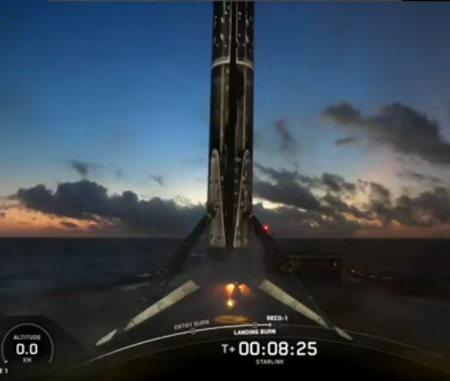
First SpaceX placed 29 more Starlink satellites in orbit, its Falcon 9 rocket lifting off from Cape Canaveral Space Force Station in Florida. The first stage (B1090) completed its 13th flight, landing on a drone ship in the Atlantic.

Next China placed another 20 Qianfan (Spacesail) satellites into orbit, its Long March 8A rocket lifting off from its coastal Wenchang spaceport. Video of the launch can be seen here. China’s state-run press provided no information about the number of satellites, but this site stated it was 20. Previous Long March 8A Qianfan launches had carried 18 however. Either way, this planned 12,000 satellite internet constellation now has approximately 239 satellites in space, with a goal to place 648 in orbit by the end of this year.

The leaders in the 2026 launch race:

80 SpaceX
44 China
10 Rocket Lab (plus two suborbital HASTE launches)
8 Russia

For the third straight year SpaceX leads the entire world combined in total launches, 80 to 76.
0 comments

China launches more satellites for Qianfan internet constellation

China today successfully launched the 13th batch of Qianfan (Spacesail) satellites into orbit, its Long March 6 rocket lifting off from its Taiyuan spaceport in northeast China.

China’s state-run press provided no information about where the rocket’s lower stages (using very toxic hypergolic fuels) crashed within China. Nor did it state how many satellites were launched. Based on previous Qianfan launches using the Long March 6, the number was likely 18, which means this proposed 12,000 satellite constellation now has about 219 satellites in orbit. It hopes in its first phase to have 648 launched by the end of the year.

The leaders in the 2026 launch race:

79 SpaceX
43 China
10 Rocket Lab (plus two suborbital HASTE launches)
8 Russia

For the third straight year SpaceX leads the entire world combined in total launches, 79 to 75.

0 comments

Chinese pseudo-company Landspace launches two satellites

The Chinese pseudo-company Landspace yesterday successfully launched two satellites, its Zhuque-2E rocket lifting off from the Jiuquan spaceport in northwest China.

The Zhuque-2E is an upgraded version of Landspace’s Zhuquie-2 rocket, apparently using a larger fairing with an increased payload capacity. The two satellites were both for communications. One was for the Qianfan (Spacesail) internet constellation, which now has approximately 200 satellites in orbit out of a planned 12,000, with the constellation’s first phase targeting 648 by the end of the year. The second satellite was for a different constellation, and is a experimental satellite testing cell-to-satellite technology.

China’s state-run press provided no information about where the rocket’s lower stages crashed inside China.

The leaders in the 2026 launch race:

68 SpaceX
35 China
8 Russia
7 Rocket Lab

For the third straight year SpaceX leads the entire world combined in total launches, 68 to 60.

0 comments

China completes two more launches

Since yesterday China has successfully completed two launches from two different spaceports using two different types of rockets, with both launches placing more satellites in orbit for its Qiafan (SpaceSail) internet constellation.

First China yesterday placed 18 Qianfan satellites in a polar orbit, its Long March 6B rocket lifting off from its Taiyuan spaceport in northeast China. The state-run press provided no information as to where the rocket’s lower stages (using very toxic hypergolic fuels) crashed.

Next, China today placed another batch Qianfan satellites into orbit, its Long March 8 rocket lifting off from its coastal Wenchang spaceport. Though the state-run press did not specify the number of satellites on this launch, based on past launches the total was likely 18 also.

The constellation presently has roughly 200 Qianfan satellites in orbit, out of a planned constellation of as many as 12,000. The first phase of the constellation however only requires 648, which China hopes to reach before the end of the year.

The leaders in the 2026 launch race:

66 SpaceX
34 China
8 Russia
7 Rocket Lab

For the third straight year SpaceX leads the entire world combined in total launches, 66 to 59.

0 comments

China successfully completes maiden launch of its Long March 12B rocket

China today successfully completed a surprise and unannounced first launch of its new Long March 12B rocket, lifting off from its Jiuquan spaceport in northwest China. Video of the launch (courtesy of BtB’s stringer Jay) can be viewed here.

The launch was unusual in several ways. First, no prelaunch “notices to airmen” were provided to warn them how to avoid the rocket’s flight path. This violates all standard procedures.

Second, this first test flight was also an operational one, placing a batch of Qiafan (SpaceSail) satellites into orbit. This internet constellation is meant to compete with Starlink and Leo, and will eventually have as many as 12,000 satellites in orbit. At present it is aiming to get 648 in orbit by the end of the year. China’s state-run press however did not reveal the number of satellites launched. After the previous launch in mid-May it was estimated there were about 170-180 satellites already in space, suggesting the count has now exceeded 200.

Third, and in line with the first two items, China’s state-run press provided no information about where the rocket’s first stage crashed. Though this rocket uses much less toxic kerosene as its fuel, it is still a big object falling uncontrolled. China says it plans to make the first stage reusable, thus eliminating this problem.

This rocket itself is powerful, designed to put 20 tons in orbit, and gives China an increased capability to put mass into space.

The leaders in the 2026 launch race:

64 SpaceX
32 China
8 Russia
7 Rocket Lab

For the third straight year SpaceX leads the entire world combined in total launches, 64 to 57.

3 comments

China launches another 18 Qianfan internet satellites

China today successfully launched 18 more Qianfan internet satellites (also called SpaceSail), its Long March 8 rocket lifting off from its coastal Wenchang spaceport.

Though Chinaโ€™s state run press did not reveal the number of satellites launched, other sources said the rocket placed 18 satellites into orbit. If so, there are now 173 Qianfan satellites in space, out of a planned constellation of as many as 12,000. The first phase of the constellation however only requires 648, which China hopes to reach before the end of the year.

The leaders in the 2026 launch race:

57 SpaceX
28 China
8 Russia
6 Rocket Lab

For the third straight year SpaceX leads the entire world combined in total launches, 57 to 49.

5 comments

Two overnight launches from SpaceX and China

Both SpaceX and China successfully completed launches since yesterday. First, SpaceX launched a new group of satellites for the National Reconnaissance Office, its Falcon 9 lifting off from Vandenberg Space Force Base in California. For security reasons, the number of satellites launched was not revealed.

The first stage completed its 9th flight, landing on a drone ship in the Pacific.

Next China launched another set of Qianfan (SpaceSail) internet satellites into orbit, its Long March 6A rocket lifting off from its Taiyuan spaceport in northeast China. Though China’s state run press did not reveal the number of satellites launched, past Long March 6A launches of this constellation have placed 18 satellites into orbit. If so, there are now 155 Quinfan satellites in space, out of a planned constellation of as many as 10,000. The first phase of the constellation however only requires 648, which China hopes to reach before the end of the year.

The state-run press also did not reveal where the rocket’s lower stages (using very toxic hypergolic fuels) crashed inside China.

The leaders in the 2026 launch race:

56 SpaceX
25 China
8 Russia
6 Rocket Lab

For the third straight year SpaceX leads the entire world combined in total launches, 56 to 46.

SpaceX hopes to complete another launch later today, carrying a Dragon cargo capsule to ISS (on its sixth flight), but weather might force a scrub. UPDATE: Scrubbed due to weather, rescheduled for May 13, 2026.

0 comments

China launches 18 more Qianfan internet satellites

Earlier today China successfully placed 18 more Qianfan internet satellites into orbit, its Long March 8 rocket lifting off from its coast Wenchang spaceport.

This was the seventh launch for this Starlink competitor, which is also called Spacesail or G60, bringing the total number of satellites launched to 137, out of a planned constellation of as many as 10,000. The first phase of the constellation however only requires 648. Though China hopes to reach that number before the end of this year, it will be a year late, based on the constellation’s international licensing requirement. Moreover, there have been stories suggesting this project is short of cash.

The leaders in the 2026 launch race:

42 SpaceX
17 China
5 Rocket Lab
5 Russia

SpaceX continues to lead the entire world combined in total launches, as it did in both โ€™24 and โ€™25, 42 to 32.

China was supposed to do another launch this afternoon, but as of posting there is no report announcing it.

2 comments

China’s giant Spacesail constellation seeks more funding

Spacesail, one of the largest of China’s planned constellations designed to compete with Starlink, is now seeking more funding to build its full constellation of 10,000 to 14,000 satellites.

Shanghai Spacecom Satellite Technology, or SpaceSail, a satellite communications company developing a massive constellation known as โ€œQianfan,โ€ disclosed plans to bring in new investors through a capital increase, according to a notice published on the Shanghai United Assets and Equity Exchange.

At present, this Chinese pseudo-company has launched only 119 out of the constellation’s first phase of 648 satellites. While it has gotten Airbus to sign a contract to use its constellation on its airplanes, it also appears to be somewhat cash poor, having only about $150 million on hand (much of it government funding), and is not going to meet its international licensing requirement to get those 648 satellites in orbit by the end of this year.

This new funding round announcement suggests it is in need of capital, and is having trouble getting the Chinese government to cough up the additional funds.

6 comments

SpaceX launches 29 more Starlink satellites, sets new record for Falcon 9 reuse, dominates the world in rocketry

First stage after landing for the 32nd time

SpaceX today launched another 29 Starlink satellites, its Falcon 9 rocket lifting off from the Kennedy Space Center in Florida.

The first stage of its Falcon 9 rocket (B1067) flew for its 32nd time, a new record for a Falcon 9 first stage. As shown in the rankings below of the most reused launch vehicles, this stage is now just one flight from tying the space shuttle Atlantis:

39 Discovery space shuttle
33 Atlantis space shuttle
32 Falcon 9 booster B1067
30 Falcon 9 booster B1071
29 Falcon 9 booster B1063
28 Falcon 9 booster B1069
28 Columbia space shuttle

Sources here and here.

Nor will it be long before SpaceX’s fleet surpasses all the shuttles.

Meanwhile in the 2025 launch race SpaceX’s dominance is overwhelming, as shown by the leader board:
» Read more

23 comments

Airbus signs China’s Qianfan or Spacesail constellation to provide internet on its airplanes

In what is a major coup for one of China’s planned large constellations, Airbus yesterday agreed to use the Qianfan or Spacesail constellation to provide Wi-Fi service on its airplanes.

At a satellite internet industry ecology conference in east China’s Shanghai on Thursday, Airbus signed a market cooperation agreement on the satellite internet service with Shanghai Spacesail Technologies Co., Ltd. The Spacesail Constellation will provide high-speed, low-latency broadband satellite services via the high-speed connectivity system on aircraft, enhancing the in-flight experience for passengers.

The two parties will also work together to meet the needs of airlines, and promote the development of intelligent, personalized services based on low-orbit broadband communication technology.

Starsail is a direct competitor to Starlink. China has so far launched 119 satellites out of a planned first phase constellation of 648. Later phases could increase the constellation to as many as 10,000 satellites.

It seems puzzling why Airbus went with this Chinese constellation, rather than either Starlink or Amazon’s Leo (formerly Kuiper). Starlink is far more developed, while Leo has more satellites in orbit (154 to 119) than Spacesail. And both are private companies from the capitalistic west, not pseudo-companies controlled by the Chinese communists.

Maybe this deal is preliminary to a major purchase of Airbus airplanes by China. China wanted its system on those planes, and so Airbus agreed to go along.

Regardless, this deal tells us that this Chinese internet constellation is going to be a major competitor to both Starlink and Leo.

10 comments

Kazakhstan expanding its access to multiple internet satellite constellations

It appears the Kazakhstan government is making multiple internet satellite constellations available to its citizens in an effort to increase competition and lower costs.

Kazakhstan first engaged with Starlink in 2023, following government frustration over the slow pace of domestic telecom expansion. The project initially connected 2,000 rural schools, and by mid-2024 nearly 1,800 had access to satellite internet.

Authorities briefly considered banning satellite internet services operated from abroad late last year, citing national security concerns, but withdrew the proposal after a public backlash.

Meanwhile, competition in the countryโ€™s nascent satellite internet market is heating up. In September 2024, Kazakhstan signed an agreement with Amazon to bring its Project Kuiper satellite network to the country, setting up a future rival to Starlink. Prime Minister Olzhas Bektenov said the move would help improve affordability and service quality. Chinese firm Spacesail Kazakhstan, a subsidiary of Spacesail International, has also registered at the Astana International Financial Centre (AIFC) with $17mn in capital, positioning itself as another potential player in the mega-constellation internet sector.

When Kazakhstan opened Starlink to all its citizens in June 2025, I noted how this deal indicated the country’s move away from Russia. Its willingness now to add Kuiper and Spacesail deals accelerates that move, in numerous ways. It not only wants its citizens to have capabilities that Russia cannot control, it wants to encourage competition to lower costs for those citizens. What a concept!

Like the Ukraine, Kazakhstan is working hard to exceed Russia in technology, in order to make it much harder for its big and very power-hungry neighbor to dominate or even invade it.

0 comments

China launches 18 satellites

China today successfully placed 18 more Spacesail or Qianfan satellites in orbit, its Long March 6A rocket lifting off from Taiyuan spaceport in northeast China. No word on where the rocket’s lower stages crashed inside China.

This was the sixth launch for this internet satellite constellation, intended to provide Chinese citizens service similar to Starlink, but controlled by the Chinese government. At present it has 119 satellites in orbit, out of a planned 648 in the constellation’s first phase. That phase was supposed to be completed by the end of this year, something that now seems very unlikely. The constellation’s final configuration could have as many as 10,000 satellites.

The leaders in the 2025 launch race:

133 SpaceX
62 China
13 Russia
13 Rocket Lab

SpaceX still leads the rest of the world in successful launches, 133 to 103.

0 comments

China launches 6th group of 18 satellites for its Spacesail internet constellation

China late yesterday successfully launched the sixth group of 18 satellites for its Spacesail internet constellation, its Long March 6A rocket lifting off from the Taiyuan spaceport in northeast China.

No word on where the rocket’s lower stages crashed inside China. The state-run report however touted proudly how the rocket uses liquid oxygen and kerosene, both of which are “non-toxic and pollution-free”. Apparently it has recognized the bad press it has gotten from crashing stages inside China that use very toxic hypergolic fuels.

The article noted that China plans at least ten launches in 2025 of the Long March 6A, likely as part of building this constellation of more than 1,200 satellites.

The 2025 launch race:

10 SpaceX
5 China
1 Blue Origin

2 comments

Chinese pseudo-company gets major cash influx for its Starlink copycat constellation

The Chinese pseudo-company Genesat, which is making the satellites for the 14,000 Starlink-type satellite constellation being developed by the Chinese pseudo-company SpaceSail, has been awarded $137 million in cash from a variety of Chinese sources, most of which are government agencies focused on encouraging development by these pseudo-companies.

Superficially everything about these companies appears real. They compete for contracts and investment capital, and can only function if they make a profit. They also compete with other similar Chinese pseudo-companies. The reality however is that they only exist because the Chinese government wants them to. For example, Genesat was formed by a partnership of SpaceSail and the Chinese Academy of Sciences (which is entirely government-run). And SpaceSail was formed earlier with support of both the national and local Shanghai governments. For example, consider today’s story:

Shanghai Gesi Aerospace Technology, also known as Genesat, announced the more than 1 billion yuan (approximately $137 million) funding round Dec. 30. The main investors include Chinaโ€™s National Manufacturing Transformation and Upgrading Fund, China Development Bank Science and Technology Innovation, Guosheng Capital, SIMIC Capital and Shanghai FTZ Fund.

The first two backers are both government agencies created to funnel government cash to these pseudo-companies.

Overall this approach by the communist Chinese government has worked remarkably well. It has created an robust space industry within a competitive and innovative atmosphere. That industry only exists however as long as the present policies of the Chinese government exist. If there is a major change in leadership it all could vanish in a moment, as there are no property rights in China. A new government could do as Putin did in Russia, consolidate all these pseudo-companies into a central government-run agencies in order to more closely control them.

For the present however China’s pseudo-capitalist approach means it will be a major player in space in the coming years. That success might even lead to a positive change in government, throwing the communists out of power eventually. It is not only demonstrating the advantages of freedom and competition over a top-down command economy, it is developing a class of people doing it. They might eventually have enough wealth and power to take over the government and changes things for real.

3 comments

China launches first 18 satellites in a new Starlink-type internet constellation

China today launched the first 18 satellites in a new Starlink-type internet constellation dubbed Spacesail, its Long March 6A rocket lifting off from the Taiyuan spaceport in north China.

No word on where the rocket’s lower stage and four strap-on boosters landed within China. Jay notes that this Chinese constellation is now ahead of Blue Origin’s Kuiper constellation, a pattern that sadly has been repeated over and over again.

The leaders in the 2024 launch race:

77 SpaceX
33 China
9 Rocket Lab
8 Russia

American private enterprise still leads the rest of the world combined in successful launches 91 to 49, while SpaceX by itself still leads the entire world combined, including American companies, 77 to 63.

2 comments