SpaceX successfully launches Spanish radar satellite

Capitalism in space: SpaceX today successfully launched a Spanish radar satellite.

They also intended to try to recover the rocket’s fairing, but they did not telecast this, and there is no word yet whether they were successful. In fact, their low-key approach here suggests a shift in policy. Previously, SpaceX was eager to show off its test programs. Now, this silence suggests a desire to throttle back on that openness, possibly in order to protect their proprietary engineering.

Update: It appears that at least one fairing half landed in the water intact, though that also means they were unable to catch it. According to a Musk tweet at the link, the fairing missed the ship net by “a few hundred meters.” Musk also indicates the need for larger chutes in the future. Either way, I wonder if the fairing in the water can still be reused.

The 2018 launch standings:

7 China
4 SpaceX
2 ULA
2 Russia
2 Japan

As a nation, the U.S. now has 7 launches total, tying China.

14 comments

More details about SpaceX’s fairing recovery plans

Link here. The article has some additional excellent images, but it was this paragraph that I thought was most significant:

To oversimplify, after launch, the payload fairing separates (mechanically) from the second stage once Falcon 9 or Heavy has left behind the majority of Earth’s atmosphere. After separation, each fairing half orients itself for a gentler reentry into the atmosphere with cold nitrogen gas thrusters, likely the exact same thrusters used in part to achieve Falcon 9’s accurate and reliable landings. Due to their massive surface area and comparatively tiny weight, fairing halves effectively become exceptionally finicky and awkward sails falling through the atmosphere at insane velocities, with the goal generally being to orient each half like a boat’s hull to provide some stability. Once they are low enough, assuming they’ve survived the journey from TEN TIMES THE SPEED OF SOUND and 62 MILES above Earth’s surface to a more reasonable ~Mach 0.5 and maybe 5 miles of altitude, the fun parts begin. At this point, each fairing half deploys a GPS-connected parachute system (a parasail, to be exact) capable of directing the massive hunks of carbon fiber and aluminum to a very specific point on the surface of the ocean.

What we don’t yet know is whether SpaceX will have cameras on the fairing, and if so, whether they will make those images available to the public, during launch.

16 comments

Giant net to catch Falcon 9 fairing

This link provides a series of pictures, taken from a distance, of the giant net, and the structures that hold it up, that will be used by the SpaceX barge ship to try to catch the rocket’s fairing during its next launch later this week. (See comments.)

Hat tip reader Kirk Hilliard. The pictures don’t show the barge itself, but they do give a sense of the size of the net. This suggests that SpaceX has equipped the fairing with small jets capable of guiding it to the barge, where it will be caught as it falls at high speed. It could also be that they have found that the fairing itself can act as a parachute and slow itself down as it descends, meaning that impact will not be that intense.

Regardless, I wonder if they will have any cameras on board either the fairing or the barge, and whether they will broadcast them live as it comes down. I wouldn’t be surprised if they didn’t, as it would possibly reveal proprietary information, but the images would certainly be impressive to see.

If they succeed, they will have a rocket that is almost entirely reusable, with only a single 2nd stage engine (out of 10 total) and the second stage itself not reused.

Posted from the Israeli city of Tiberius on the shore of the Sea of Galilee.

10 comments

SpaceX’s Saturday launch will two test smallsats for its planned 11K internet constellation

Capitalism in space: SpaceX will include two test smallsats for its planned internet constellation of more than 11k satellites when launches a Spanish radar satellite in two days.

The FCC gave SpaceX permission for the test in November, and new documents now show that SpaceX will piggyback Microsat-2a and Microsat-2b onto its launch of a Spanish radar satellite called Paz. The mission is set to lift off from the Vandenberg Air Force Base in California on Saturday at 9:14 a.m. ET aboard a Falcon 9 rocket, according to Spaceflight Now.

Ajit Jai, chairperson of the FCC — the government entity which must ultimately approve SpaceX’s plans — endorsed the effort on Wednesday. “Satellite technology can help reach Americans who live in rural or hard-to-serve places where fiber optic cables and cell towers do not reach,” Pai told Reuters in a statement.

A lot of news sources have made a big deal about Jai’s endorsement, as if that endorsement guarantees FCC approval of SpaceX’s gigantic constellation. It doesn’t, though it certainly helps.

5 comments

SpaceX cancels Texas subsidy that required Boca Chica operation in 2018

Capitalism in space: SpaceX has canceled a small Texas subsidy that required it to begin operations at its Boca Chica spaceport by September 2018.

The company terminated a deal reached with the office of then-Gov. Rick Perry in late 2013 that earmarked $2.3 million from the Texas Enterprise Fund for the future spaceport at Boca Chica beach, which is near Brownsville. The project has experienced delays and SpaceX had received about $400,000 of the money, but it now has paid back all of it.

The deal mandated that, to receive the incentives dollars, the spaceport be operational by Sept. 30 this year and employ 180 people by the end of 2018. It appears SpaceX was unlikely to meet either target.

This does not mean that SpaceX is abandoning the spaceport, only that it can’t meet the schedule required by this subsidy. This also might explain why they requested an additional $5 million from Texas. They knew they were going to lose this $2.3 million subsidy and were lobbying to make up for it with other state funds.

Hat tip Robert Pratt of Pratt on Texas.

3 comments

Europe suddenly realizes that reusable rockets are possible and economical

The head of the European Space Agency (ESA) has admitted in his blog that the agency’s future rockets, Ariane 6 and Vega C, are not going to be competitive because they will not be reusable.

The promise to secure autonomous access to space and reduce the price by a factor of 2 proved sufficiently compelling to secure ESA member states’ agreement to finance the development. At that time, I succeeded in placing environmental concerns and the possible development of reusability among the high-level requirements:

  • Maintain and ensure European launcher competence with a long-term perspective, including possibility of reusability/fly-back.
  • Ensure possibility to deorbit upper stage directly

Due to time and cost pressure, however, these aspects did not make it onto the agenda for Ariane 6 and Vega C. Yet in the meantime, the world has moved on and today’s situation requires that we re-assess the situation and identify the possible consequences. In many discussions on the political level, the strategic goal of securing European autonomous access to space has not changed, however there is a growing sense that pressure from global competition is something that needs to be addressed. With Vega C, Ariane 62 and Ariane 64 approaching completion, it seems logical to complete these launchers in order to at least take that major step towards competitiveness. At the same time, it is essential that we now discuss future solutions, including disruptive ideas. Simply following the kind of approaches seen so far would be expensive and ultimately will fail to convince. Totally new ideas are needed and Europe must now prove it still possesses that traditional strength to surpass itself and break out beyond existing borders. In this sense, the process of discussing and deciding on a launcher system that eschews traditional solutions can send a powerful signal out into other areas as well. I therefore intend to invite innovative, really interested European players to come together to define possible ways forward. [emphasis mine]

Let me translate his bureaucratic wording: “We didn’t think reuseable rockets were practical, economical, or even possible. We took a safe route in designing Ariane 6 and Vega C. We screwed up, and now face a competitive market in which our rockets cannot compete. Thus, we need to move fast to copy the private sector, SpaceX and Blue Origin in particular, or face serious financial consequences.

Unless he forces some major cultural changes in ESA, however, I expect that by the time this government-run operation manages to duplicate the achievements of those two private companies, those companies will have marched on to even more innovative successes.

9 comments

Update on Falcon Heavy core stage landing failure

Link here. According to Musk, the reason the core stage hit the water so fast is that some engines did not fire as intended.

He said engineers believed only one of three engines fired during a final burn designed to slow the rocket’s descent before touchdown. The stage only missed the boat by about the length of a football field, but the force of its water impact was enough to “take out” two engines on the nearby drone ship and spray it with debris.

This is proper engineering procedure. They flew a test, and learned something. They now need to figure out why it happened, and fix it.

11 comments

Falcon Heavy reactions post launch

I could provide links to probably a hundred articles, but most simply say the same things, while generally being awed and excited. The handful below sum things up well, plus provide some additional details:

The first two stories provide a good overview of the excitement caused by the launch. The third story, about California’s tax on rocket launches, is really an op-ed opposing the tax. (I don’t expect that state’s leftist legislature to cancel it.) The third story also outlines what happened, but provides this significant quote from Musk, illustrating starkly how revolutionary this rocket is:

Musk said he personally inspected the landed boosters, adding that SpaceX could even reuse them if it wanted. Even after seeing the results of the launch, Musk said he was having difficulty comprehending the magnitude of the flight, saying it was surreal for him to see such success.

“It can launch things direct to Pluto and beyond. Don’t even need gravity assist or anything,” Musk said. “You can go back to the moon.”

He estimated the total SpaceX investment was over $500 million dollars to develop Falcon Heavy. Musk noted those funds were “all internal,” and not from taxpayers or fundraising.

In other words, the taxpayer now has available, at no development cost, the heavy-lift rocket that NASA has been trying and failing to build for tens of billions since 2004.

Finally, the last story isn’t really about Falcon Heavy, but about how SpaceX is in the driver’s seat in the prices it charges. The company is saving quite a lot by reusing its first stage boosters. For the first initial launches reusing these boosters they offered discounts to get customers to use them. Now they no longer have to, because their normal prices beat everyone else anyway. They can pocket the extra profits.

And all this has happened because of freedom, competition, and the vision of one man. Musk deserves all the accolades he is receiving today.

14 comments

Falcon Heavy launch a success!

Capitalism in space: SpaceX has just successfully launched its Falcon Heavy into space.

The key to this launch was to get the three first stage boosters to all work in unison, and for the two side boosters to successfully separate. All worked.

As I write this we are waiting for the two side boosters on their way back to land, and the central core heading back to land at sea.

The two side boosters landed like synchronized swimmers. The core stage barge landing remains unconfirmed. Update: SpaceX has confirmed that the core stage failed to land correctly, crashing into the ocean.
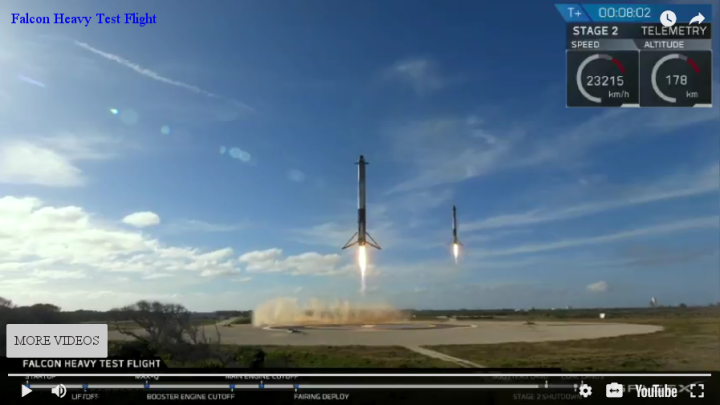
Two Falcon Heavy boosters landing simultanously

Even so, the upper stage and its payload are in orbit. They will fire its engines in about a half hour, and then again in six hours to put the Tesla into solar orbit. Update: The first firing occurred as scheduled, and Musk has now confirmed that the final burn has placed the Tesla in a solar orbit that reaches out into the asteroid belt.

SpaceX has now started a live stream from the Tesla, showing its mannequin dubbed “Starman” sitting in the driver’s seat.

Even if the core stage failed to land successfully, and even if the upper stage fails to send the Tesla towards Mars, this launch is an unqualified success. SpaceX has demonstrated that the Falcon Heavy works. It is now the most powerful rocket in operation, and only matched or beaten in capability by the Saturn 5, Energia, and the Space Shuttle, none of which exist any longer.

The 2018 launch standings:

6 China
3 SpaceX
2 ULA
2 Japan

33 comments
1 164 165 166 167 168 234