
Sabotage?

The competition really heats up: The SpaceX investigation into the September 1 Falcon 9 launchpad explosion has apparently also included looking into the possibility that sabotage could have played a part.

As part of the investigation, SpaceX officials had come across something suspicious they wanted to check out, according to three industry officials with knowledge of the episode. SpaceX had still images from video that appeared to show an odd shadow, then a white spot on the roof of a nearby building belonging to ULA, a joint venture between Lockheed Martin and Boeing. The SpaceX representative explained to the ULA officials on site that it was trying to run down all possible leads in what was a cordial, not accusatory, encounter, according to the industry sources, who spoke on the condition of anonymity because of the ongoing investigation.

The building, which had been used to refurbish rocket motors known as the SMARF, is just more than a mile away from the launchpad and has a clear line of sight to it. A representative from ULA ultimately denied the SpaceX employee access to the roof and instead called Air Force investigators, who inspected the roof and didnโ€™t find anything connecting it to the rocket explosion, the officials said.

To quote Sherlock Holmes, “When you have eliminated the impossible, whatever remains, however improbable, must be the truth.” In this case, it appears that they have eliminated this impossibility, though it is interesting that SpaceX felt compelled to consider it.
27 comments

SpaceX targets November 17 as next launch date

Though its investigation into the September 1 Falcon 9 launchpad explosion is not yet complete, and no launch has actually been scheduled, SpaceX and the Air Force 45th Space Wing that supervises the launch range at Cape Canaveral have penciled November 17 as the target date for SpaceX’s next launch.

The date has been chosen merely for “planning purposes” and I would not be surprised it no launch happens.

0 comments

Republican Congressmen question SpaceX’s investigation

The knives are out: Ten Republican House members have sent a letter to the Air Force, FAA, and NASA questioning whether SpaceX should lead the investigation into its September 1 launchpad explosion.

The Congress members said the investigation responses raised โ€œserious concerns about the authority provided to commercial providers and the protection of national space assets…. Although subject to FAA oversight, it can be asserted the investigation lacked the openness taxpayers would expect before a return-to-flight,โ€ the letter says. โ€œWe feel strongly that the current investigation should be led by NASA and the Air Force to ensure that proper investigative engineering rigor is applied and that the outcomes are sufficient to prevent NASA and military launch mishaps in the future.โ€

…The letter also includes a list of questions for each agency including whether the Air Force will reconsider certification of the Falcon 9 rocket for national security launches; whether NASA will reevaluate the use of the Falcon 9 rocket for its commercial resupply and upcoming commercial crew missions; and whether the FAA would reconsider issuing licenses to SpaceX after its September launch pad explosion.

More details here, including the letter’s full text. Congressman Mike Coffman (R-Colorado), whose district interestingly includes ULA’s headquarters, is heading this attack.

I find this a typical example of why conservatives are disgusted with the Republican Party. It claims it stands for private enterprise and less regulation, but the first chance these guys get, they demand more government control in order to benefit the crony companies they support. Nothing in this letter will make SpaceX’s operations safer. The only thing any of its demands will accomplish if enforced will be to damage the company, thus aiding its competitor ULA.

8 comments

Musk’s Mars plan

Musk's Mars plan

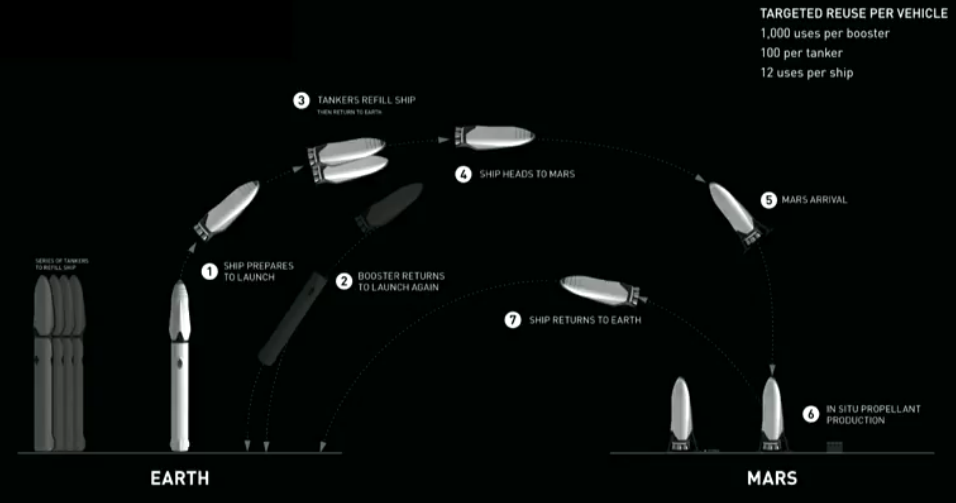
Today Elon Musk gave a speech at the International Astronautical Congress in Guadalajara, Mexico. The speech laid out SpaceX’s proposed architecture for building what he presently calls his interplanetary transport system. The image on the right is one of his talk slides, showing the basic concept, which is built around using the company’s new Raptor engine — still under development — which only got its first test firing this past week.

The plan is ambitious and visionary, which from Musk is not surprising. It is also aimed to be as practical and as cost effective as possible, which also is not surprising coming from Musk. The rocket itself will be larger than both the Saturn 5 and SLS, but not significantly more. Compared to those government rockets however it will be far cheaper and faster to build, though Musk’s hope that they will be launching their first test flights in four years is almost certainly too optimistic. The concept is to use what they have learned with the Falcon 9 to build a bigger rocket with a reusable first stage that launches a large second stage that is either the spaceship taking people to Mars or a giant tanker for refueling that spaceship.

In one of Musk’s early slides he noted something that I have been arguing for decades. “Speading the required lift capacity across multiple launches substantially reduces development costs and compresses schedule.” Though he is still proposing a heavy-lift rocket, he is also following in the footsteps of Wernher Von Braun by proposing that any Mars mission will require some assembly in orbit.

The plan is also aimed at making space travel as affordable as possible. Musk structured the design in as many ways as possible to make it as efficient and as inexpensive as possible. It still won’t be cheap, at about $140K per ton, but at that price it will be affordable to a lot of people. He also mentioned that it include free passage back to Earth.

I doubt we will see this system built as outlined today in the time span predicted by Musk. At the same time, I would not be surprised if we do see some variation of it, and see it built within the near future. In 2011 Musk proposed recovering his Falcon 9 first stages by landing them vertically. The idea seems radical. He got it done in four years. There is every reason to believe he will make this Mars proposal happen as well.

14 comments

SpaceX update on launchpad explosion investigation

On September 23, SpaceX released an update outlining the status of its investigation into the September 1 Falcon 9 launchpad explosion.

The report noted the following:

  • The data points to “a large breach in the cryogenic helium system of the second stage liquid oxygen tank” as the source of the explosion, though what caused the breach remains as yet unknown.
  • The cause of this failure and the previous launch failure in June 2015 are not related.
  • The report summarized some of the launchpad damage, noting that while the pad itself needs extensive repairs,

    …the Falcon Support Building adjacent to the pad was unaffected, and per standard procedure was unoccupied at the time of the anomaly. The new liquid oxygen farm โ€“ e.g. the tanks and plumbing that hold our super-chilled liquid oxygen โ€“ was unaffected and remains in good working order. The RP-1 (kerosene) fuel farm was also largely unaffected. The padโ€™s control systems are also in relatively good condition.

  • The report also noted that, “pending the results of the investigation, we anticipate returning to flight as early as the November timeframe.”

While this report suggests they have made some progress, the fundamental cause of the explosion remains unknown.

3 comments

Federal agencies question establishment of SpaceX spaceport and three liquefied natural gas plants in Brownsville

Two federal agencies are questioning the safety of establishing three liquefied natural gas (LNG) plants near SpaceX’s new spaceport in Boca Chica, Texas.

The Federal Energy Regulatory Commission is reviewing the applications for the LNG export terminals, which plan to take natural gas from the Eagle Ford south of San Antonio, liquefy it and export the LNG to overseas customers.

The Federal Aviation Administration hosted an Aug. 18 meeting to discuss space launch activities near the proposed LNG facilities, according to a FERC filing released on Thursday. During the meeting, FAA officials discussed their role and regulations regarding commercial space launches, as well as the agency’s licensing and public safety requirements prior to the launch of any future mission.

While it makes perfect sense to keep a rocket launchpad safely away from large amounts of liquefied natural gas, I found the article’s concluding paragraphs to be most revealing:

Meanwhile, environmentalists, who were critical of the SpaceX project and oppose the LNG plants, said the launch site is too close to the proposed export terminals. “This announcement should be a wake-up call and warning that putting LNG terminals within six miles of the SpaceX launch site is a bad idea,” Lower Rio Grande Valley Sierra Club Chair Jim Chapman told the Business Journal. “Furthermore, Annova LNG wants to put its facility within the SpaceX launch closure area. You don’t have to be a rocket scientist to know that idea won’t fly.” [emphasis mine]

Note how the environmentalists are essentially against everything. They really aren’t opposed to having these two facilities being placed too close to each other, what they really want is that nothing gets built at all. Most instructive.

1 comment

SpaceX explosion will not effect its Air Force certification

The competition heats up: An Air Force official today said that, based on its ongoing experience with SpaceX during the investigation of its September 1 Falcon 9 launchpad explosion, they do not expect any change in SpaceX’s certification that allows it to bid on Air Force satellite contracts.

The Air Force official also noted that the damage to the launchpad was “moderate” and was “definitely repairable.”

1 comment

ULA announces new plan to speed up launches

The competition heats up: ULA today announced a new system for shortening the time from a customer’s initial launch contract to the actual launch of their payload.

The priorities of all of our customers include ensuring their spacecraft launches on schedule, securing the soonest possible manifest date and completing the mission with 100 percent success,โ€ said Tory Bruno, ULA CEO and president. โ€œTo address these priorities, we have been working on this offering for more than a year, which allows our customers to launch in as few as three months from placing their order.โ€

It is very clear that this new system was inspired by the competition with SpaceX. It is also pretty obvious that they are making the announcement now in the hope they can grab some of SpaceX’s customers who are once again faced with delays because of the September 1 Falcon 9 launchpad explosion. It is also likely that SpaceX is pushing to get its next launch off by November in an effort to beat back ULA’s effort here.

Ain’t competition wonderful? It is so good, it will even get us to the stars.

0 comments

SpaceX aims for November launch

The competition heats up: Despite the admitted difficulty of its investigation into its September 1 Falcon 9 launchpad explosion, SpaceX today said that they are aiming to resume launches as soon as November.

โ€œWeโ€™re anticipating getting back to flight — being down for about three months — and getting back to flight in the November time frame,โ€ Chief Operating Officer Gwynne Shotwell said Tuesday at an event in Paris. โ€œWeโ€™ll obviously take another look at the rocket, focus on the ground systems.โ€

They have not said yet what payload they will launch, though it is clear that first launch will not be the Falcon Heavy demo launch, which has now been rescheduled for the 1st quarter fo 2017.

0 comments

Some uncomfortable but valid thoughts about SpaceX

In the heat of competition: Doug Messier has written an excellent essay today raising some serious questions about SpaceX and its methods of operation.

The issues he raises go the heart of the company’s future. Moreover, he notes the unusual nature of the September 1 launchpad explosion that, unless explained, threatens the company business model.

The rarity of a satellite launch vehicle exploding during fueling had people racking their brains and scouring the Internet to find out the last time something like this happened. At least in the United States, that turned out to be more than 50 years ago when rocketry was in its infancy and accidents were much more frequent.

The lack of any modern precedents and the speed of the accident โ€” Musk tweeted that engineers were reviewing around 3,000 channels of telemetry and video data that cover only 35-55 milliseconds โ€” are making the investigation challenging. Musk has said it is the most difficult of the six failure investigations the company has conducted since it was founded in 2002.

Messier also takes a close look at SpaceX’s overall approach to innovation and development, and notes its unusual and somewhat risky nature.

Read it all. It provides valuable information for anyone who wants to understand honestly the state of the American launch industry.

7 comments

Do you have video of the Falcon 9 explosion? SpaceX needs it!

In a series of tweets today Elon Musk put out a call for any videos anyone might have of last week’s Falcon 9 launchpad explosion.

“Still working on the Falcon fireball investigation. Turning out to be the most difficult and complex failure we have ever had in 14 years,” Musk wrote. “Important to note that this happened during a routine filling operation. Engines were not on, and there was no apparent heat source. Particularly trying to understand the quieter bang sound a few seconds before the fireball goes off. May come from rocket or something else,” he said.

Musk also answered questions and responded to comments from the public. When Twitter user @ashwin7002 tweeted at Musk that “there are some videos on YouTube claiming something hit the rocket. Any reality there?” Musk replied, “We have not ruled that out.”

38 comments
1 180 181 182 183 184 234