Two orbital launches today by China and SpaceX, plus a suborbital hypersonic launch by Rocket Lab

The beat goes on! Since last night both China and SpaceX successfully completed orbital launches.

First, China used its most powerful operating rocket, the Long March 5, to place what its state-run press called “a new communication technology test satellite” into orbit, the rocket lifting off from its coastal Wenchang spaceport. As the Long March 5 can haul very large payloads into orbit, it suggests this one satellite is unusually heavy.

Next, SpaceX successfully placed another 24 Starlink satellites into orbit, its Falcon 9 rocket lifting off from Vandenberg Space Force Base in California.

The first stage (B1071) successfully completed its 34th flight (38 days after its previous flight), landing on a drone ship in the Pacific. With this flight the stage moved past the space shuttle Atlantis, putting it in third place in the rankings for the most reused launch vehicle:

39 Discovery space shuttle
35 Falcon 9 booster B1067
34 Falcon 9 booster B1071
33 Atlantis space shuttle
32 Falcon 9 booster B1063
31 Falcon 9 booster B1069
28 Columbia space shuttle
28 Falcon 9 booster B1077
28 Falcon 9 booster B1078

Sources here and here.

Though it was not an orbital launch and thus isn’t added to my launch totals, Rocket Lab also launched last night, using its HASTE suborbital version of its Electron rocket to do a suborbital hypersonic test for the War Department, as part of its $190 million contract to do twenty such test flights. This appears to be the first of those launches.

The leaders in the 2026 launch race:

69 SpaceX
36 China
8 Russia
7 Rocket Lab (plus three suborbital HASTE launches)

For the third straight year SpaceX leads the entire world combined in total launches, 69 to 61.

0 comments

SpaceX launches 29 Starlink satellites, uses 1st stage for record 35th time

SpaceX early this morning successfully launched another 29 Starlink satellites into orbit, its Falcon 9 rocket lifting off from Cape Canaveral Space Force station in Florida.

The first stage (B1067) successfully completed its 35th flight (70 days after its previous flight), landing on a drone ship in the Atlantic. This flight was a new record for the reuse of a Falcon 9 first stage, placing it only four behind the space shuttle Discovery in the rankings for the most reused launch vehicle:

39 Discovery space shuttle
35 Falcon 9 booster B1067
33 Atlantis space shuttle
33 Falcon 9 booster B1071
32 Falcon 9 booster B1063
31 Falcon 9 booster B1069
28 Columbia space shuttle
28 Falcon 9 booster B1077
28 Falcon 9 booster B1078

Sources here and here.

Expect these rankings to see some newer Falcon 9 first stages in the near future The older stages listed here seem to take about two months generally to turn-around after each launch. The younger stages are instead turning around much faster, in one month or less.

The leaders in the 2026 launch race:

68 SpaceX
34 China
8 Russia
7 Rocket Lab

For the third straight year SpaceX leads the entire world combined in total launches, 68 to 59.

10 comments

SpaceX launches 21 Starlink and 2 Starshield satellites

SpaceX last night successfully launched another 21 Starlink and two Starshield satellites, its Falcon 9 rocket lifting off from Vandenberg Space Force Base in California.

Starshield is SpaceX’s military version of Starlink. The first stage completed its 10th flight, landing on a drone ship in the Pacific.

The leaders in the 2026 launch race:

67 SpaceX
34 China
8 Russia
7 Rocket Lab

For the third straight year SpaceX leads the entire world combined in total launches, 67 to 59.

2 comments

SpaceX launches 29 more Starlink satellites

SpaceX this morning successfully placed another 29 Starlink satellites into orbit, its Falcon 9 rocket lifting off from Cape Canaveral Space Force station in Florida.

The first stage completed its 12th flight (78 days after its previous flight), landing on a drone ship in the Atlantic.

The leaders in the 2026 launch race:

66 SpaceX
32 China
8 Russia
7 Rocket Lab

For the third straight year SpaceX leads the entire world combined in total launches, 66 to 57.

China has two launches scheduled for today, with one supposedly having already taken place. When both are confirmed I will post a new launch update.

0 comments

SpaceX launches 24 more Starlink satellites

SpaceX this morning successfully placed another 24 Starlink satellites into orbit, its Falcon 9 rocket lifting off from Vandenberg Space Force Base in California.

The first stage completed its 16th flight (37 days after its previous flight), landing on a drone ship in the Pacific.

The leaders in the 2026 launch race:

65 SpaceX
32 China
8 Russia
7 Rocket Lab

For the third straight year SpaceX leads the entire world combined in total launches, 65 to 57.

0 comments

SpaceX launches more Starlink satellites

SpaceX this morning successfully placed another 24 Starlink satellites into orbit, its Falcon 9 rocket lifting off from Vandenberg Space Force Base in California.

The first stage completed its 22nd flight, landing on a drone ship in the Pacific.

The leaders in the 2026 launch race:

64 SpaceX
30 China
8 Russia
7 Rocket Lab

For the third straight year SpaceX leads the entire world combined in total launches, 64 to 55.

12 comments

SpaceX launches another 29 Starlink satellites

SpaceX this morning successfully placed 29 more Starlink satellites into orbit, its Falcon 9 rocket lifting off from Cape Canaveral Space Force station in Florida. The first stage completed its 16th flight (57 days after its last flight), landing on a drone ship in the Atlantic.

The leaders in the 2026 launch race:

63 SpaceX
30 China
8 Russia
7 Rocket Lab

For the third straight year SpaceX leads the entire world combined in total launches, 63 to 53.

ULA has an Atlas-5 launch scheduled for this evening to launch 29 Leo satellites for Amazon, but at the moment the weather does not look promising.

2 comments

SpaceX launches another 24 Starlink satellites

SpaceX this morning successfully launched 24 more Starlink satellites, its Falcon 9 rocket lifting off from Vandenberg Space Force Base in California.

The first stage completed its sixth flight (32 days after its previous flight), landing on a drone ship in the Pacific.

The leaders in the 2026 launch race:

62 SpaceX
29 China
8 Russia
7 Rocket Lab

For the third straight year SpaceX leads the entire world combined in total launches, 62 to 52.

1 comment

SpaceX launches 29 more Starlink satellites

SpaceX early this morning successfully placed another 29 Starlink Satellites into orbit, its Falcon 9 rocket lifting off from Cape Canaveral Space Force Station in Florida.

The first stage (B1078) completed its 28th flight, landing on a drone ship in the Atlantic, 64 days after its previous flight. With this flight, the booster moves into a tie for seventh place with the Columbia shuttle and another Falcon 9 booster in the rankings of the most reused launch vehicles:

39 Discovery space shuttle
34 Falcon 9 booster B1067
33 Atlantis space shuttle
33 Falcon 9 booster B1071
32 Falcon 9 booster B1063
31 Falcon 9 booster B1069
28 Columbia space shuttle
28 Falcon 9 booster B1077
28 Falcon 9 booster B1078

Sources here and here.

The leaders in the 2026 launch race:

61 SpaceX
29 China
8 Russia
7 Rocket Lab

For the third straight year SpaceX leads the entire world combined in total launches, 61 to 52.

5 comments

SpaceX completes a largely successful 12th orbital test flight of Starship/Superheavy

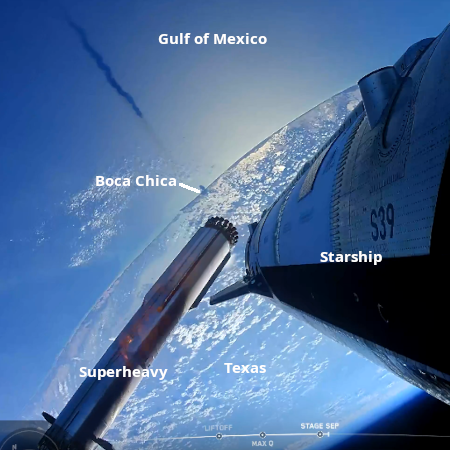
Starship and Superheavy in flight

SpaceX today successfully completed its 12th orbital test flight of Starship/Superheavy, with Superheavy lifting off and getting Starship into its preliminary flight path and Starship then firing its engines and getting into a workable orbit that naturally decayed over the Indian Ocean.

There were issues with several Raptor-3 engines, being used in flight on both Superheavy and Starship for the first time. During launch one Superheavy Raptor-3 engines cut off prematurely, forcing the other 32 engines to compensate for the loss. Then, after stage separation (shown in the screen capture to the right) Superheavy’s boost back burn cut off prematurely. As a result, the booster did not come down off the coast for a soft vertical splashdown as planned, but came down in the Gulf, mostly uncontrolled. It did successfully fire some engines for the landing burn, but that splashdown was hard.

As for Starship, it also had one engine shut down prematurely, requiring the other five engines to burn about 90 seconds longer to get the ship up to an acceptable orbit. Because of these engine issues, the engineering team decided to forgo a test restart of one Raptor-3 engine.

Starship then successfully deployed 20 dummy Starlink satellites, followed by two operational Starlink satellites that were modified expressly to provide visual observations of Starship and its heat shield while it is space. Only a few minutes later engineers were able to broadcast those observations, showing Starship as seen from nearby.

Starship then successfully executed its planned maneuver leading to a soft splashdown in the Indian Ocean.

Overall this sets the stage for a quick follow-up. Expect new test flights over the summer and fall, coming almost monthly. The company has made it clear it wants to do a two-week refueling mission with two Starship before the end of the year, as well as begin using Starship to deploy the bigger upgraded Starlink version 3 satellites.

Though this flight did not complete a full orbit, the rocket got Starship into an acceptable orbital path, allowing it to do most of the orbital testing desired. I consider this a success for the 2026 launch race:

60 SpaceX
28 China
8 Russia
7 Rocket Lab

For the third straight year SpaceX leads the entire world combined in total launches, 60 to 51.

40 comments

SpaceX launches 29 more Starlink satellites

SpaceX early today successfully placed another 29 Starlink satellites into orbit, its Falcon 9 rocket lifting off from Cape Canaveral Space Force Station in Florida.

The first stage (B1077) completed its 28th flight, landing on a drone ship in the Atlantic, 64 days after its previous flight. With this flight, the booster moves into a tie for seventh place with the Columbia shuttle in the rankings of the most reused launch vehicles:

39 Discovery space shuttle
34 Falcon 9 booster B1067
33 Atlantis space shuttle
33 Falcon 9 booster B1071
32 Falcon 9 booster B1063
31 Falcon 9 booster B1069
28 Columbia space shuttle
28 Falcon 9 booster B1077
27 Falcon 9 booster B1078

Sources here and here.

The leaders in the 2026 launch race:

59 SpaceX
28 China
8 Russia
6 Rocket Lab

For the third straight year SpaceX leads the entire world combined in total launches, 59 to 50.

1 comment

SpaceX launches 24 Starlink satellites

SpaceX in the early morning hours today successfully placed another 24 Starlink satellites into orbit, its Falcon 9 rocket lifting off from Vandenberg Space Force Base in California.

The first stage completed its second flight, landing on a drone ship in the Pacific.

The leaders in the 2026 launch race:

58 SpaceX
28 China
8 Russia
6 Rocket Lab

For the third straight year SpaceX leads the entire world combined in total launches, 58 to 50.

0 comments

Several major American satellite companies release a joint guide on “orbital safety”

Working with the American Institute of Aeronautics and Astronautics (AIAA), the American satellite companies building large orbital constellations — SpaceX, Amazon, Iridium, and Eutelsat — have now released a joint reference guide for building and operating their satellites, dubbed “Satellite Orbital Safety Best Practices 3.0.”

  • Emphasizes the design phase for improved orbital safety
  • Stresses pre-launch coordination and collision avoidance analysis, especially near crewed vehicles, mitigating hazards during post-launch identification and cataloging of new orbital objects
  • Provides guidance on data sharing across design and operations emphasizing the critical importance of sharing and screening high quality ephemeris with covariance from deployment through disposal
  • Includes an Appendix with data exchange recommendations to mitigate conjunctions

The companies have apparently decided they needed to get together to make sure they were not stepping on each other’s toes. I would expect other companies to soon join this cooperative effort, as it is in no one’s interest to have satellites colliding in orbit.

12 comments

SpaceX launches 24 more Starlink satellites

SpaceX tonight successfully launched another 24 Starlink satellites, its Falcon 9 rocket lifting off from Vandenberg Space Force Base in California.

The first stage completed its 24th flight, landing on a drone ship in the Pacific.

The leaders in the 2026 launch race:

55 SpaceX
23 China
8 Russia
6 Rocket Lab

For the third straight year SpaceX leads the entire world combined in total launches, 55 to 44.

0 comments

SpaceX launches 29 more Starlink satellites

SpaceX today successfully placed another 29 Starlink satellites into orbit, its Falcon 9 rocket lifting off from Cape Canaveral Space Force Station in Florida.

The first stage (B1069) completed its 31st flight, landing on a drone ship in the Atlantic, 63 days after its previous flight. It remains in 6th place in the rankings of the most reused launch vehicles:

39 Discovery space shuttle
34 Falcon 9 booster B1067
33 Atlantis space shuttle
32 Falcon 9 booster B1071
32 Falcon 9 booster B1063
31 Falcon 9 booster B1069
28 Columbia space shuttle
27 Falcon 9 booster B1077
27 Falcon 9 booster B1078

Sources here and here.

The leaders in the 2026 launch race:

53 SpaceX
23 China
8 Russia
6 Rocket Lab

For the third straight year SpaceX continues to lead the entire world combined in total launches, 53 to 44.

2 comments

FCC approves new spectrum rules to give new constellations more capacity

The Federal Communications Commission (FCC) yesterday approved new spectrum rules proposed by SpaceX that will increase the capacity of all the new low-Earth-orbit constellations by as much as seven times.

The commission introduced the new rules earlier this month before approving them at a Thursday meeting. The revamp targets the Equivalent Power Flux Density (EPFD) rules, which were developed in the late 1990s and limited the amount of energy satellite systems could transmit to and from ground equipment. The regulations were also designed to prevent radio signal interference between higher-orbiting geostationary satellites and lower-orbiting systems. But during the vote, Carr said the decades-old existing rules were “holding back” newer satellite internet offerings.

“Modern satellite designs make it far easier to share spectrum than what yesterday’s regulations assumed. We can do a lot better,” he said. Carr touted the 7x increase when the commission found the revamped rules could enable “eight satellites to provide service simultaneously in a given geographic area and frequency band, instead of being effectively limited to one satellite under current EPFD limits.”

The FCC was sold on this change after SpaceX conducted its own tests in orbit, using Starlink satellites, to demonstrate it could work. The rule change will benefit all the new constellations, which is why Amazon’s Leo constellation supported the change as well.

The speed in which the FCC acted on this matter must also be noted. It did not bother with long studies of its own. It quickly reviews SpaceX’s work, realized it made sense, and scheduled the vote at its very next meeting. This constrasts starkly with the FCC during the Biden administration, which routinely slow-walked or even opposed such suggestions.

4 comments

Two launches yesterday

Both SpaceX and Arianespace successfully completed orbital launches yesterday. First, SpaceX placed another 24 Starlink satellites into orbit, its Falcon 9 rocket lifting off from Vandenberg Space Force Base in California. The first stage completed its 13th flight, landing on a drone ship in the Pacific.

Next, Arianespace placed 32 more Amazon Leo satellites in orbit, its Ariane-6 rocket lifting off from France’s French Guiana spaceport in South America. The expendable Ariane-6 launched for the second time in its most powerful configuration, with four side boosters. This was also Arianespace’s second launch this year, so it remains off the leader board below. It is also the second launch in Arianespace’s 18-launch contract with Amazon to launch Leo satellites. The satellites were placed at an orbit of 465 kilometers, which SpaceX has claimed violates its Starlink orbital territory. Amazon has agreed what it is doing is a violation, but says it will continue to do so for this and two more launches.

With this launch, Amazon now has 302 Leo satellites in orbit, out of the 1,616 it needs to launch by July to meet its FCC license requirement. The company’s request for a time extension is presently pending at the FCC.

The leaders in the 2026 launch race:

52 SpaceX
23 China
8 Russia
6 Rocket Lab

For the third straight year SpaceX continues to lead the entire world combined in total launches, 52 to 44.

Russia was also supposed to do a test suborbital launch of its new Soyuz-5 rocket. As of posting I have not been able to confirm whether the launch took place.

8 comments

Starlink returns to Papua New Guinea after court ruling

SpaceX’s Starlink internet service will once again be available in Papua New Guinea after its court this week overturned a ban that had been imposed by a government bureaucracy.

In early 2024, the [Ombudsman] Commission blocked licensing efforts for Starlink, arguing that existing regulations may not be adequate to manage potential risks to public interest and safety.

But in her National Court ruling last week, Judge Susan Purdon-Sully strongly criticised the Ombudsman Commission for its move to halt Starlink’s license process. Finding no breach of PNG’s leadership code, nor evidence of corruption, the judge said the Ombudsman’s concerns were more administrative, meaning its directive to NICTA had been “an unconstitutional exercise of power”.

Meanwhile, the prime minister again urged Starlink to work collaboratively with state-owned Telikom PNG to “ensure a coordinated rollout that complements national infrastructure priorities”.

The article describes in detail several recent natural disasters where the lack of Starlink was a critical component in rescue and repair operations. The country also has large rural areas where Starlink is the only method for reaching the rest of the world quickly. There was thus apparently great political pressure to end this ban.

4 comments

SpaceX launches 25 more Starlink satellites

SpaceX this morning successfully placed another 25 Starlink satellites into orbit, its Falcon 9 rocket lifting off from Vandenberg Space Force Base in California.

The first stage completed its 15th flight, landing on a drone ship in the Pacific.

The leaders in the 2026 launch race:

50 SpaceX
23 China
8 Russia
6 Rocket Lab

For the third straight year SpaceX continues to lead the entire world combined in total launches, 50 to 42.

4 comments

SpaceX launches 24 more Starlink satellites

SpaceX this evening followed up Rocket Lab with its own launch of 24 more Starlink satellites, its Falcon 9 rocket lifting off from Vandenberg Space Force Base in California.

The first stage completed its fifth flight, landing on a drone ship in the Pacific.

The leaders in the 2026 launch race:

49 SpaceX
21 China
6 Russia
6 Rocket Lab

For the third straight year SpaceX continues to lead the entire world combined in total launches, 49 to 38.

3 comments
1 2 3 29