Initial price for Starlink: $99 per month?

According to a CNBC article today, SpaceX is now offering a beta version of its Starlink internet service to customers as the price of $99 per month, plus a $499 charge for equipment.

SpaceX is expanding the beta test of its Starlink satellite internet service, reaching out via email on Monday to people who expressed interest in signing up for the service.

Called the “Better Than Nothing Beta” test, according to multiple screenshots of the email seen by CNBC, initial Starlink service is priced at $99 a month – plus a $499 upfront cost to order the Starlink Kit. That kit includes a user terminal to connect to the satellites, a mounting tripod and a wifi router. There is also now a Starlink app listed by SpaceX on the Google Play and Apple iOS app stores.

“As you can tell from the title, we are trying to lower your initial expectations,” the emails said, signed Starlink Team. “Expect to see data speeds vary from 50Mb/s to 150Mb/s and latency from 20ms to 40ms over the next several months as we enhance the Starlink system. There will also be brief periods of no connectivity at all.”

SpaceX did not confirm this story with CNBC. If it is real, the price is disappointingly high, and might very well limit Starlink’s potential. Then again, this is only the beta version. Later versions when under full operation and available to many more customers might bring that price down.

11 comments

SpaceX launches 60 more Starlink satellites

Capitalism in space: SpaceX today successfully launched another sixty Starlink satellites, bringing the total in orbit to over 800.

The company also recovered the first stage, completing its third flight. The fairings were to be picked up in the ocean, rather than caught in a ship’s net, as the last launch one fairing broke the net. SpaceX engineers might have determined ocean recovery is now safer and sufficient for reuse.

This was also the company’s 100th successful launch and its 63rd successful first stage recovery.

The leaders in the 2020 launch race:

26 China
18 SpaceX
11 Russia
4 ULA
4 Europe (Arianespace)

The U.S. now leads China 28 to 26 in the national rankings.

6 comments

SpaceX wins partial approval to provide Starlink service in Canada

Capitalism in space: Though SpaceX has obtained permission to provide its Starlink internet service from Canada’s Radio-television and Telecommunications Commission, similar to the U.S.’s FCC, it still has not gotten full government approval to begin offering its service to customers.

It appears a different Canadian regulatory body, dubbed Innovation, Science and Economic Development Canada (ISED), has still not given its okay of the “satellite spectrum” SpaceX requires. From the second link:

SpaceQ had previously contacted ISED in June about SpaceX. ISED wouldn’t comment directly on any application, but did tell SpaceQ that the applications and approved website pages were up to date at that time. The website had last been updated in May. Since then, the website was updated in July. And yet there’s still no mention of SpaceX. It’s my understanding that the specific pages with applications and approvals is updated pretty quickly when there is new information to post. Though it took 3 weeks for changes to appear after Kepler submitted their application in June of this year.

With respect to how long it takes to get approval, ISED said the “service standard for the processing of satellite applications, including for those for foreign satellites, is 130 calendar days.” It’s quite possible that it could take longer.

This description carries all the hallmarks of a typical government bureaucracy whose only purpose is to block new companies and new technology. The political swamp of Canada might also be using it as a means of extortion for campaign funds from SpaceX. “Nice business you got there. Sure would be a shame if it didn’t get that license approval.”

I don’t think SpaceX needs to bow to these games. In the end ISED will back down and give approval, especially when the company begins offering its services just over the border in the U.S. The competitive and political pressure to give its okay will then be too great.

4 comments

SpaceX launches another 60 Starlink satellites

Capitalism in space: SpaceX today successfully launched another 60 Starlink satellites, raising the constellation to more than 800 satellites.

The first stage successfully landed, for the sixth time, on a drone ship. The company also recovered both fairings, which were making their third flight. With one fairing’s recovery however the net broke on the ship, which might have damaged it this time.

The leaders in the 2020 launch race:

26 China
17 SpaceX
11 Russia
4 ULA
4 Europe (Arianespace)

The U.S. had regained the lead over China, 27 to 26, in the national rankings.

7 comments

Musk: Starlink about to roll out commercial service

Capitalism in space: With the launch earlier this week of another 60 Starlink satellites, Elon Musk has revealed that they now have enough satellites in orbit to soon begin commercial operations.

After yesterday’s launch of 60 Starlink satellites, SpaceX CEO Elon Musk wrote on Twitter that “[o]nce these satellites reach their target position, we will be able to roll out a fairly wide public beta in northern US & hopefully southern Canada. Other countries to follow as soon as we receive regulatory approval.”

Musk did not say when the satellites will reach their target position. SpaceX has over 700 satellites in orbit after yesterday’s launch.

It will like take a few months to get these satellites into position. Regardless, the speed at which SpaceX operates once again has put them ahead of their competitors. OneWeb, the only other similar constellation with satellites in orbit, was once far ahead of SpaceX but has been stalled as it recovers from bankruptcy. Amazon’s Kuiper satellite constellation is so far only a proposal, and like most everything else the company said it would build, has moved forward with the speed of a glacier.

1 comment

Radio astronomers claim negative impact from satellite constellations

Put them on the Moon! Radio astronomers have released a paper claiming that the coming large communication satellite constellations, such as Starlink and OneWeb, will seriously impact observations with the Square Kilometer Array (SKA) of radio telescopes being built in the remote western outback of Australia.

Saturation of the instruments: very strong interfering signals can saturate the receiver systems and thereby drown out all other signals seen by the Band 5b receivers. As a consequence, all data in that frequency band would be lost, rendering these receivers useless for a portion of the time. For the first phase of the constellation deployments (about 6,400 satellites in total), saturation is predicted to occur for a few percent of the time assuming there is no direct illumination of the dishes by the satellites. For significantly larger constellation sizes (up to more than 100,000 satellites), saturation would be essentially continuous without significant mitigation measures implemented by the satellite operators.

Based on this conclusion, the astronomers estimate that for observations in this particular band they will need to look about 70% longer to get the same data, thereby cutting the number of observations by about half.

The astronomers propose this solution:

One of these mitigation techniques is for the satellite transmitters not to point their beams near the SKAO dishes. SKAO would require operators to steer their satellites’ beams away from the telescope site, a measure which would require a simple software modification with no repercussion on the constellation’s deployment, positioning or hardware. While a cost-effective implementation of this solution does depend on the hardware and software deployed on the satellites, operators already use this technique to comply with international regulations when their satellites cross the path between geostationary satellites in higher orbit and their receiving ground stations, for example to avoid affecting telecommunications and TV transmissions.

This mitigation could reduce the impact on the SKA by a factor of 10 over that noted previously and result in a 7% increase of integration time for SKA observations within the satellite transmission range 4. While any loss of sensitivity is regrettable, SKAO recognises the need for compromise between the competing scientific and commercial drivers.

The solution seems reasonable, but in truth it is only a temporary one. The permanent and smart solution for the astronomical community is to move their telescopes, in all wavelengths, off the Earth. For radio astronomy the far side of the Moon would be ideal.

And with SpaceX now developing a reusable big rocket, Starship, to put such payloads in orbit at low cost, the astronomers need to start thinking about taking advantage of this engineering. The situation for ground-based astronomer will only get worse.

3 comments

SpaceX launches another 60 Starlink satellites

After a number of weather delays, SpaceX this morning finally launched another 60 Starlink satellites into orbit, using its Falcon 9 rocket.

They also successfully landed the 1st stage, on its third flight, the 61st time they have done this. One fairing half was also making its third flight, and was also recovered. I have embedded the live stream of the launch below the fold.

The leaders in the 2020 launch race:

25 China
16 SpaceX
10 Russia
4 ULA
4 Europe (Arianespace)

The U.S. has retaken the lead from China, 26 to 25, in the national rankings.
» Read more

4 comments

The first Starlink user test results

Capitalism in space: The first Starlink test results by actual users are finally coming out, and they suggest that the constellation will deliver very fast internet speeds indeed.

The article however reveals this tidbit that up until now SpaceX has managed to keep nicely obscured:

While Starlink will provide the kind of speeds and latency that should work for many services and games, Musk said the company simply won’t have the capacity to compete in major metro markets—a caveat often left unmentioned in Starlink coverage. “It’s not good for high-density situations,” Musk said. “We’ll have some small number of customers in LA. But we can’t do a lot of customers in LA because the bandwidth per cell is simply not high enough.”

As a result, Starlink won’t do much for the estimated 83 million Americans stuck under a broadband monopoly (usually Comcast), or the millions more whose only options are a duopoly; usually either the cable company or a sluggish DSL line from the local phone company.

In other words, the service will likely not be made available in dense urban areas, at least not initially.

8 comments

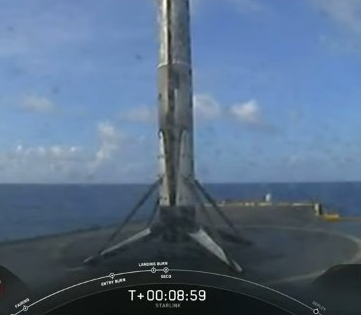
SpaceX’s Falcon 9 successfully launches 60 Starlink satellites

Falcon 9 1st stage after landing

Capitalism in space: SpaceX’s Falcon 9 rocket this morning successfully launched another 60 Starlink satellites into orbit.

It also successfully landed its first stage, the second time this stage has done so.

The leaders in the 2020 launch race:

20 China
15 SpaceX
9 Russia
4 ULA
4 Europe (Arianespace)

The U.S now leads China in the national rankings 24 to 20.

1 comment

Delta 4 Heavy launch scrubbed

Tonight’s launch of ULA’s Delta 4 Heavy was scrubbed due to a variety of technical problems. They have not set a new launch time, though they say they are aiming for the early morning hours of August 28.

This was to have been the first of four American launches in the next four days. The next, a Falcon 9 launch of an Argentinian radar Earth observation satellite, was scheduled for tomorrow, August 27th, at 7:19 pm (Eastern). No word on whether it is going forward as planned, though it might be since the ULA launch has shifted after it, to August 28th.

The third, by Rocket Lab, is presently scheduled also for August 28rd at 11:05 pm (Eastern), launching out of New Zealand.

The fourth, another SpaceX launch of more Starlink satellites, had been scheduled for 10:30 am (Eastern) on August 29th. Once again, this schedule could change due to tonight’s ULA scrub.

Stay tuned. I suspect all three companies are going to aggressively work to get all four launches off as fast as possible, even if not exactly as presently scheduled.

2 comments

SpaceX launches three commercial plus more Starlink satellites

Capitalism in space: SpaceX today successfully launched three commercial Earth reconnaissance satellites plus another 58 Starlink satellites.

They have now put 653 Starlink satellites into orbit.

The first stage, which was flying a record sixth time, successfully landed on its platform in the Atlantic. They also caught one of the fairing halves, and are retrieving the second half out of the ocean. Both fairings were also reused.

The leaders in the 2020 launch race:

19 China
13 SpaceX
9 Russia
4 ULA

The U.S. now leads China 21 to 19 in the national rankings.

9 comments

SpaceX ups fund-raising effort from one to two billion

Capitalism in space: SpaceX has apparently raised $2 billion during an on-going investment capital round, double what the company had initially expected.

This means that SpaceX has now raised $4 billion in private investment in the last year, the bulk of which the company says it is devoting to Starship. However, they have also said that for this most recent round some of the monies will go to making their Starlink satellite internet constellation operational. With 595 satellites already in orbit, and good testing ongoing, it appears a lot of investors want to get in on the game.

8 comments
1 43 44 45 46 47 48