Musk: Starlink to go public once operational

Capitalism in space: According to a tweet by SpaceX founder Elon Musk, once the Starlink internet satellite constellation is operational and has a “reasonable well” cash flow it will issue and IPO and become a publicly traded stock.

“SpaceX needs to pass through a deep chasm of negative cash flow over the next year or so to make Starlink financially viable,” Musk wrote in another tweet. “Every new satellite constellation in history has gone bankrupt. We hope to be the first that does not.”

Based on the company’s pace of launching satellites and rolling out service, this moment could occur as early as late this year. More likely it will occur in mid-22.

I would also expect that stock to quickly rise in value, and based on the history of all of Musk’s companies, will continue to rise thereafter. Expect also that a significant portion of the investment capital that Starlink will raise will be used to finance the development of Starship and Super Heavy, because Starlink will need that larger rocket to maintain its satellite constellation.

9 comments

Starlink now has over 10,000 users

Capitalism in space: SpaceX revealed yesterday that its Starlink internet constellation now has over 10,000 users in both the U.S. and elsewhere.

The update on Starlink’s customer base came in a petition to the FCC, with SpaceX asking that Starlink be designated an “Eligible Telecommunications Carrier” or ETC. The company noted that receiving this designation is necessary for Starlink to provide service to regions in “Alabama, Connecticut, New Hampshire, New York, Tennessee, Virginia and West Virginia.”

SpaceX was awarded access to those regions under the FCC’s Rural Digital Opportunities Fund, an auction to bring broadband services to rural areas. The FCC in December awarded SpaceX with nearly $900 million in federal subsidies in the first phase of the auction.

“Designating Starlink Services as an ETC is in the public interest because it will enable the company to receive support that will facilitate rapid deployment of broadband and voice service to the Service Areas at speeds and latency comparable to terrestrial systems in urban locations,” SpaceX wrote in the filing on Thursday.

One of my readers, Steve Golson, emailed me yesterday to tell me he is one of those rural customers, as he is located in Maine.

We are at latitude 43.2°N which was too far south for their early beta program, but they’ve just opened it up to us. I signed up back in June 2020, when the Starlink beta signup first went live. Yesterday I received this email:

“Starlink is now available in limited supply in your service area. … Availability is limited so orders must be completed within 15 minutes of landing on the order page. If you are not able to order at this time, the Starlink team will continue to send updates as more capacity becomes available.”

I ordered right away, and I was notified that the dish shipped today, with delivery late next week by FedEx Ground. Cost is $500 for the dish, WiFi router, power supply, cables, mounting tripod. Monthy cost is $99. That’s the beta cost, but I suspect their final costs will be similar.

Now I’m getting a roof mount ready. You *really* need an unobstructed view of the whole sky. The very cool Starlink app (iOS and Android) shows you how much of your sky needs to be unobstructed.

He promises to give further updates as his service rolls out.

2 comments

SpaceX competitors lobbying to kill FCC subsidy for Starlink

A lobbying effort instigated by some of SpaceX competitors in the rural internet service business is now working to kill the $886 million subsidy the FCC had awarded the company for developing its Starlink internet constellation.

The losers in the awards process apparently are teaming up with the Democrats to challenge all the awards, with SpaceX their main target.

The [award to SpaceX was] made when Trump administration appointees still controlled the FCC and now the agency is led by Biden appointees who could cut off applicants it considers dubious. Last month, 160 House and Senate members urged the FCC to scrutinize recipients, in part because network construction takes time. “We fear that we will not know whether funds were improperly spent for years to come,” said the lawmakers.

There is a “a need for proper upfront assessment,” Representative Jim Clyburn, of South Carolina, the No. 3 House Democrat, said in an email. He said many applicants claim to be able to deliver faster service to new customers than they are delivering to current subscribers.

This is a fight for government hand-outs, period. The losers are now using political pressure to change the decision. And since the Democrats generally hate SpaceX (and Elon Musk) because it is so successful at actually achieving what it sets out to do, they are glad to help them. Not only will it bring these politicians campaign donations (called bribes if you are honest), it will destroy the one space company that is proving that capitalism and freedom works.

From my perspective, no one, including SpaceX, should get these funds. SpaceX is proving they aren’t necessary to get the job done (bringing fast internet service to rural communities). Moreover, the federal government really doesn’t have the cash, deep in debt as it is.

But then, my perspective is now considered quaint, even “raaaaaaacist”, in our modern corrupt Marxist society.

3 comments

SpaceX launches another 60 Starlink satellites

Capitalism in space: SpaceX tonight successfully launched another 60 Starlink satellites using its Falcon 9 rocket.

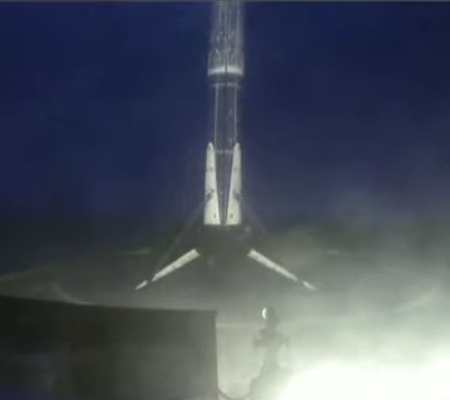
The first stage completed its fifth flight, landing successfully on the drone ship in the Atlantic. Both fairings were also used.

The 2021 launch race:

4 SpaceX
2 China
1 Rocket Lab
1 Virgin Orbit
1 Russia

The U.S. now leads China 6 to 2 in the national rankings. SpaceX had planned another launch later this morning, but they have delayed that launch one day until tomorrow.

5 comments

SpaceX and Amazon in cat-fight over internet satellite constellations

Capitalism in space: Even as SpaceX is rolling out the internet service from its growing Starlink satellite constellation while Amazon’s own Kuiper constellation languishes in development, the two companies are in a battle over the orbits of their respective constellations.

SpaceX CEO Elon Musk took to Twitter on Tuesday, as his company works to persuade Federal Communications Commission officials that it should allow SpaceX to move some of its Starlink satellites to lower altitudes than originally planned.

Jeff Bezos’ Amazon has been among companies that have disputed SpaceX’s request, on the grounds that the modification would interfere with other satellites.

“It does not serve the public to hamstring Starlink today for an Amazon satellite system that is at best several years away from operation,” Musk said in a tweet.

Amazon responded to Musk’s comment in a statement to CNBC. “The facts are simple. We designed the Kuiper System to avoid interference with Starlink, and now SpaceX wants to change the design of its system. Those changes not only create a more dangerous environment for collisions in space, but they also increase radio interference for customers. Despite what SpaceX posts on Twitter, it is SpaceX’s proposed changes that would hamstring competition among satellite systems. It is clearly in SpaceX’s interest to smother competition in the cradle if they can, but it is certainly not in the public’s interest,” an Amazon spokesperson said.

SpaceX in its own response to the FCC has noted “that Amazon representatives have had ’30 meetings to oppose SpaceX’ but ‘no meetings to authorize its own system,’ arguing that the technology giant is attempting ‘to stifle competition.'”

Both companies appear to have a point. Amazon is planning its system under an agreed-to arrangement where its orbits would not conflict with SpaceX’s. To permit SpaceX to change the deal and expand its orbital territory into Amazon’s threatens their system.

At the same time, that Amazon has been so slow to launch its system is something the FCC will not take kindly to. Companies get FCC licensing approval on the condition that they deliver within a certain time frame. Amazon appears to be taking a bit too much time, and SpaceX is trying to take advantage of this fact.

I suspect the FCC will deny SpaceX’s request, but will also tell Amazon that it had better start launching its satellites soon, or else the FCC will change its mind and give SpaceX that orbital territory.

Overall, the slowness of Amazon to launch Kuiper seems to fit the operational pace of Jeff Bezos’ other space company, Blue Origin. Lots of talk, but relatively little action. At some point the talk has to stop and Bezos’ companies have got to start delivering.

20 comments

SpaceX and Rocket Lab complete launches

Capitalism in space: Two successfully launches this morning.

First Rocket Lab used its Electron rocket to launch a German cubesat thought to be a prototype for a Chinese communications constellation, though no information has been publicly released. No recovery attempts were made on the rocket’s first stage.

Then SpaceX successfully completed its 17th Starlink launch and second launch in 2021. This puts about 950 Starlink satellites in orbit. The booster for this flight landed on the drone ship, completing its record eighth flight.

The 2021 launch race:

2 SpaceX
1 Virgin Orbit
1 China
1 Rocket Lab

The U.S. now leads China 4 to 1 in the national rankings.

3 comments

Starlink begins rollout in United Kingdom; blocked in Russia

Capitalism in space: SpaceX’s Starlink internet service has now begun providing its service in the United Kingdom, following approval by the government there.

Because the British government is now also an owner of Starlink’s direct competitor, OneWeb, this creates an interesting conflict of interest that fortunately has so far not impeded SpaceX. We shall have to see whether this changes with time.

Meanwhile, in Russia a similar conflict of interest has resulted in some government action against Starlink.

Russia’s legislative body, the State Duma, is considering fines for individuals and companies in the country that use Western-based satellite Internet services. The proposed law seeks to prevent accessing the Internet by means of SpaceX’s Starlink service, OneWeb, or other non-Russian satellite constellations under development.

…In the Russian-language article, translated for Ars by Robinson Mitchell, members of the Duma assert that accessing the Internet independently would bypass the country’s System of Operational Search Measures, which monitors Internet use and mobile communications. As part of the country’s tight control on media and communications, all Russian Internet traffic must pass through a Russian communications provider.

It is not surprising that Russia would take steps to block Starlink service—the country’s space chief, Dmitry Rogozin, views SpaceX as a chief rival in spaceflight. Rogozin has been critical of both NASA and the US Department of Defense for subsidizing SpaceX through government contracts. (While it is true that SpaceX has received launch contracts from the US government worth several billion dollars, it has also provided launch services at a significant discount compared to other providers.) More recently Rogozin has said Starlink is little more than a scheme to provide US Special Forces with uninterrupted communications.

That the legislation is also aimed at blocking OneWeb however is strange, considering that OneWeb is quite literally Rogozin’s only remaining commercial customer for Roscosmos’s launch services.

In the end, such laws will only end up doing more damage to Russia than to SpaceX. When you don’t allow competition you basically don’t allow any achievements at all. Russia will sink into a second-class status, not because its people are second-class but because its government is.

Tragically it appears the U.S. federal government is now in a race with Russia to the bottom.

1 comment

SpaceX in preliminary negotiations for another big fundraising round

Capitalism in space: According to this report, SpaceX is now in preliminary negotiations with investors prior to beginning another big fundraising round, even though the company just raised $1.9 billion in private investment capital in August.

The talks are still in early phases, and exact pricing for the fundraising round has not yet been determined, one of the people said. Terms could still change, and it could take several weeks to decide and firm up allocations, the person added. SpaceX also may not be able to convince investors to give it the lofty valuation it desires. Allocations refer to which investors will be authorized to buy shares and how much they will pay for those shares.

“It’s a pretty big shock to me, honestly,” one of the people said. “What company jumps to double its valuation in six months? I don’t care at what scale you’re operating, it’s kind of crazy,” they added. “If you look at the series, every single valuation is a 10 to 20% bump.”

It appears that the company is trying to leverage its successes with Dragon, Starship, and Starlink to obtain more funding. The story also suggests that SpaceX now has a better sense of what it will cost to get Starship built, and thus is looking to obtain those funds now, when they are in a good position to get them.

5 comments

Starlink dark coating reduces reflectivity by half

Astronomers in Japan have now confirmed that the dark coating SpaceX has been putting on its more recent Starlink satellites has successfully reduced their reflectivity by half.

They looked at the satellites across a range of wavelengths.

Observations conducted from April to June 2020 revealed for the first time in the world that artificial satellites, whether coated or not, are more visible at longer wavelengths, and that the black coating can halve the level of surface reflectivity of satellites. Such surface treatment is expected to reduce the negative impacts on astronomical observations.

Knowing this detail will allow commercial satellite companies such as SpaceX to further refine their coatings to better hide their satellites from ground-based telescopes.

While good news, it doesn’t change the fundamental lesson that astronomers need to learn. They must move their telescopes off the Earth and into space. In the long run ground-based astronomy is a dead-end.

10 comments

SpaceX’s Starlink constellation wins $885 million in federal subsidies

Capitalism in space: In awarding $9.2 billion in subsidies to providers of rural high-speed internet to rural customers, the FCC gave $885 million of this allocation to SpaceX’s Starlink constellation.

SpaceX was not the biggest beneficiary, however.

Most of the RDOF Phase I subsidies are going to terrestrial broadband service providers, led by LTD Broadband with an award of $1.32 billion. CCO Holdings, a subsidiary of Charter Communications, is due to serve 1.05 million sites around the country, leading the list for that metric.

The FCC said 85% of the 5.2 million sites to be served would get gigabit-speed broadband. SpaceX is due to serve nearly 643,000 sites with download speeds of 100 megabits per second or more.

Regardless of its good intentions, this distribution of federal cash sickens me. These companies don’t need it to do what they are doing, and are all sure to make plenty of profit without it. The federal government meanwhile is trillions in debt. It has to print money to give this away, something that is not going to go well in the long run.

11 comments

SpaceX sets numerous launch records in placing 60 more Starlink satellites in orbit

Falcon 9 booster landing for a record 7th time

Capitalism in space: SpaceX tonight broke a whole bunch of new launch records in launching another sixty Starlink satellites into orbit using its Falcon 9 rocket.

First, the leaders in the 2020 launch race:

31 China
22 SpaceX
12 Russia
5 ULA
5 Rocket Lab

The US now leads China 35 to 31 in the national rankings.

For SpaceX, this launch established the following landmarks for the company:
» Read more

9 comments

Canada’s government approves Starlink service

Capitalism in space: Canada’s government yesterday announced that it has given final approval to SpaceX’s Starlink internet service to offer those services in that country.

More here.

This final approval came from the Innovation, Science and Economic Development Canada (ISED) agency, which appears designed to protect Canadian businesses from foreign competition. It had appeared initially that they had been stalling giving their approval (maybe for political reasons). The delay however could simply have been the slowness of operation which is typical of such government bureaucracies. As noted at the first link above, however “Clearly, the government heard the demand from consumers to get this service approved.” And since there are no Canadian companies that can offer this service, it was absurd not to okay SpaceX’s operation.

This approval means that Starlink is now posed to begin commercial operations, actually selling its internet service to the public, and doing it ahead of its primary competitor, OneWeb. Considering that OneWeb had started development and satellite launching first, this achievement illustrates again SpaceX’s nimble and fast approach to business. The company does not waste time in anything it does. It might not meet all of its scheduling goals, but not for want of trying.

SpaceX has already been offering the service in its test market in the northern U.S. for the price of $99 per month plus an initial fee of $499 for equipment, with the initial user reports very positive.

6 comments
1 42 43 44 45 46 48