
Leonardo da Vinci: An art director, a painter, and a man whose life epitomized the uncertainty of existence
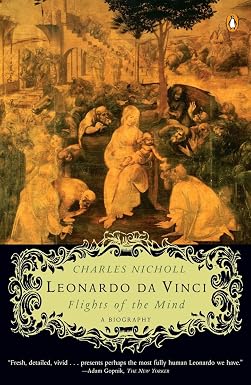
Leonardo da Vinci: Flights of the Mind

I recently have finished reading two books on the life and work of Leonardo da Vinci. One is not worth mentioning, as it was poorly written but had the benefit of including a lot of da Vinci’s drawings from his many manuscripts. There are many such books, and the internet makes this work even more accessible, so why plug a bad book?

The other book, however, is very much worth recommending. Charles Nicholl’s 2005 biography, Leonardo da Vinci: Flights of the Mind, is a finely detailed work that carefully documents what is know, and what is not know, about da Vinci’s life.

And there are endless uncertainties. Nicholl’s makes these clear, and then provides a lot of good background information to give the reader a good sense of where reality lies, while recognizing much of what we know about Leonardo and his life remains guesswork that can never be resolved.

What Nicholl does best however is give a much more accurate portrayal of da Vinci as an artist and scientist. The myth that exists today is that da Vinci was mostly a failed painter and sculptor who repeatedly failed to finish his projects. This is wrong. In life he was actually quite successful as a painter, his work well admired and in demand. He only failed to complete a handful of projects, and in each case the failure was not his but his client. In one case, the Sforza Horse, he was unable to cast the giant sculpture because his client sold the bronze to make war weapons. In another, The Adoration of the Magi, he failed to finish the painting because his client simply paid him too little. And in a third, the Battle of Anghiari, the client decided to make it a competition between dueling frescos by da Vinci and Michelangelo. and after learning this da Vinci chose not to participate.

In between he completed many great works, such as the Mona Lisa and the Last Supper. And in fact, even the three incomplete works above made him famous, because all three were completed enough to show their unique originality and beauty. Da Vinci had style, and his work was always stunning to the eye.

Even so, like those unfinished works, almost everything da Vinci did hold mysteries and questions that today cannot be answered. » Read more

5 comments

Another da Vinci discovery

A historian doing a detailed study of Leonardo da Vinci’s research on the nature of friction has discovered his first notes on the subject, where da Vinci outlined the laws of friction two hundred years before they were finally documented by a French scientist.

“The sketches and text show Leonardo understood the fundamentals of friction in 1493,” says Hutchings. “He knew that the force of friction acting between two sliding surfaces is proportional to the load pressing the surfaces together and that friction is independent of the apparent area of contact between the two surfaces. These are the ‘laws of friction’ that we nowadays usually credit to a French scientist, Guillaume Amontons, working 200 years later.”

It is an unfortunate thing that da Vinci lived and worked in Italy. Though this was where the Renaissance blossomed, it is also the place where some scientists at the time were persecuted for being too honest about their research. To protect himself da Vinci confined his scientific genius to his private diaries, written in a backwards script he created so that no one could easily understand what he wrote. Thus, while his brilliance as a painter was recognized in his lifetime and after, the discoveries he had made about engineering and science were lost for literally centuries.

I wonder if there are individuals, especially in the climate field, who are now experimenting with similar techniques to hide their work.

4 comments

Have researchers found Leonardo da Vinci’s lost “The Battle of Anghiari” fresco, hidden for the past six centuries behind a wall?

Have researchers found Leonardo da Vinca’s lost “The Battle of Anghiari” fresco, hidden for the past six centuries behind a wall?

The painting, considered a masterpiece by contemporaries, had never been finished by da Vinci because he had used an experimental technique to paint it, and that technique had failed. Thus, the painting was painted over fifty years later. The only reason we have a good idea of what the painting looked like is that several artists were so impressed by it that they produced copies while it was still visible.

The research suggests the painting was not painted over, but that a false wall was built in front of it. If so, this would be truly exciting discovery. The painting would probably not be in very good shape, but to actually see it would be wonderful.

0 comments