
Flight to test the taste of beer in microgravity delayed until February
The first flight to test the taste of beer in microgravity has been delayed until February due to poor weather.
The first flight to test the taste of beer in microgravity has been delayed until February due to poor weather.
Resisting the power grab: Automakers sue the EPA over its new ethanol regulations allowing the sale of gasoline with 15% ethanol.
Power grab! FCC votes 3-2 to regulate the internet via net neutrality.
There’s a mini ice age coming, says a man whose predictions the last few winters have been better than the British weather service.
Who says the healthcare bill didn’t nationalize the healthcare industry? Under the new law, the Obama administration will be reviewing all health insurance rate increases next year, approving only those it agrees with.
Repeal the damn bill!
Power grab! Eight former park superintendents are pressing the U.S. and Canadian governments to expand government control over lands adjacent to Glacier National Park in Montana and Waterton Lakes National Park.
Your tax dollars at work: Twenty idiotic things the U.S. government is spending money on. My favorite, #8, also happens to be one of the most expensive:
The U.S. Department of Veterans Affairs spent $175 million during 2010 to maintain hundreds of buildings that it does not even use. This includes a pink, octagonal monkey house in the city of Dayton, Ohio.
Ho! Ho! Ho! The members of an informal high school “Christmas Sweater Club” have been punished by their school for spreading Christmas cheer. Key quote:
Mother Kathleen Flannery said an administrator called her and explained “not everyone wants Christmas cheer. That suicide rates are up over Christmas, and that they should keep their cheer to themselves, perhaps.”
A TSA worker gets probation after being convicted of using TSA surveillance equipment to steal travelers’ laptops.
Want to trim the federal debt? Here’s a place to start: Federal paychecks in the San Diego area are one third higher than private pay, according to census numbers. The pay raises were also more than three times higher.
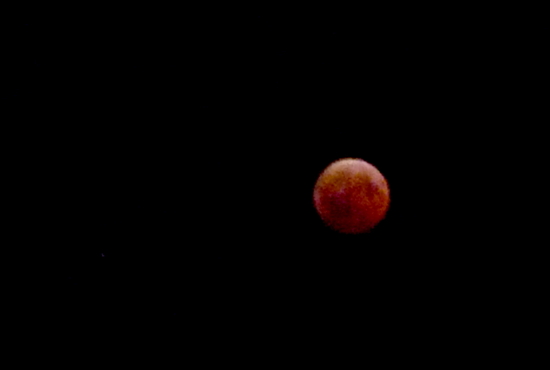
Last night’s lunar eclipse, as photographed by Jeff Bliss in Pleasanton, California.
A law student at Syracuse University is facing possible expulsion for “harassment,” but the university won’t tell him who his accusers are or even the details of his offense.
New Jersey Governor Chris Christie has commuted the sentence of man who was serving seven years for the possession of two legal handguns.
An evening pause: For those who remember the 1969 Miracle Mets (Happy birthday Lloyd!), here is a tribute compilation of newsclips, celebrating Tom Seaver’s Hall of Fame career. Ya gotta believe! (Though Tug McGraw said it, it was Seaver more than anyone else who made it happen.)
The space war over NASA continues: The continuing resolution being offered by the Senate would freeze NASA’s budget at 2010 numbers through March. Also,
NASA would be prohibited from initiating new programs, and could be required to continue spending about $200 million per month on the Moon-bound Constellation program.
As I’ve said repeatedly, the whole thing is a mess.
Good intentions strikes again! Automakers are suing the EPA over its decision to allow a higher ethanol mixture in gasoline. Key quote:
Automakers say they are worried the EPA decision would eventually lead to motorists unknowingly filling up their older cars and trucks with E15 and hurting their engines. The problem could be exacerbated if E15 fuels are cheaper than more conventional blends, prompting owners of older vehicles to use the fuel despite the potential engine problems.
Bat researchers have concluded that the fungus seen on the dying bats in the northeast United States these past four years is far more deadly than any fungus previously studied, and is increasingly believed to be the primary cause of the bat deaths. Key quote:
“This fungus is amazingly destructive — it digests, erodes, and invades the skin — particularly the wings — of hibernating bats,” said Meteyer. “The ability of this fungus to invade bats’ wing skin is unlike that of any known skin fungal pathogen in land mammals.”
Apropos my post yesterday on the sunspot cycle: A Dalton Minimum repeat is shaping up.
The electricity produced from a proposed wind plant will be so expensive the company can’t find customers. They do have one customer, however, but one wonders why:
In its 15-year deal, National Grid agreed to pay 18.7 cents per kilowatt hour for Cape Wind power beginning in 2013, with a 3.5 percent annual increase. The starting price is twice what National Grid pays today for power from fossil fuels, and regulators say the contract will add about 1.7 percent to its residential customers’ bills.
Read the whole article. It explains a lot about the failures of renewable energy, and how the efforts of the government and environmentalists to force it on us is misguided and downright foolish.
This research has a bearing on NASA’s plans to subsidize the new space companies: Research has found that subsidies to the Spanish film industry had no effect on its productivity, while giving awards did, increasing “internal and external distribution demand.”