
Curing cancer using DNA and drugs
Curing cancer using DNA and drugs.
Curing cancer using DNA and drugs.
The Soyuz capsule with three astronauts has successfully docked with ISS.
The Patient Protection and Affordable Care Act offers “premium assistance”—tax credits and subsidies—to households purchasing coverage through new health-insurance exchanges. This assistance was designed to hide a portion of the law’s cost to individuals by reducing the premium hikes that individuals will face after ObamaCare goes into effect in 2014. (If consumers face the law’s full cost, support for repeal will grow.)
The law encourages states to create health-insurance exchanges, but it permits Washington to create them if states decline. So far, only 17 states have passed legislation to create an exchange.
This is where the glitch comes in: ObamaCare authorizes premium assistance in state-run exchanges (Section 1311) but not federal ones (Section 1321). In other words, states that refuse to create an exchange can block much of ObamaCare’s spending and practically force Congress to reopen the law for revisions.
The Obama administration’s solution? Ignore the law as written.
I have a better idea: Repeal the damn thing!
Is Newt Gingrich America’s Churchill?
As the author himself says, “The thought startles.” However, it is quite a fascinating read, founded strongly in history.
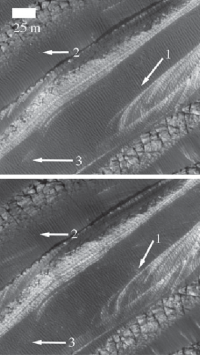
Images taken 1363 days apart.
In two different papers published in two different journals in the past month, scientists have concluded that — despite the thinness of the planet’s atmosphere — the dunes and sands of Mars are being continually shaped and changed by its winds. In both papers the data from which this conclusion was drawn came from high resolution images taken by the HiRISE camera on Mars Reconnaissance Orbiter.
What is especially interesting about this conclusion is that the climate models that had been developed for the Martian atmosphere, combined with wind measurements gathered by the various Martian landers, had all suggested that the kind of strong winds necessary to move sand were rare. To quote the abstract of the paper published on Monday in the journal Geology, Bridges, et al,
Prior to Mars Reconnaissance Orbiter data, images of Mars showed no direct evidence for dune and ripple motion. This was consistent with climate models and lander measurements indicating that winds of sufficient intensity to mobilize sand were rare in the low-density atmosphere.
Similarly, the second paper, Silvestro, et al, published on October 22 in Geophysical Research Letters, stated that
results from wind tunnel simulations and atmospheric models show that such strong wind events should be rare in the current Martian atmospheric setting.
Yet, both studies found significant evidence that such winds do occur on Mars, and are moving sand in many different places.
» Read more
An evening pause: Let’s relax with some good music and nature photography. Music by Ray Lynch.
The Senate/House final deal for the White House Science Office has slashed its budget by one third.
Frustrated that White House officials [i.e. John Holdren] have ignored congressional language curtailing scientific collaborations with China, legislators have decided to get their attention through a 32% cut in the tiny budget of the Office of Science and Technology Policy (OSTP).
See this story for more background.
We’re here to help you: A government inspector arrives during a meal and forces private citizens on private property to destroy the home-grown food.
Susan [the inspector] deemed our food unfit for consumption and demanded that we call off the event because:
1. Some of the prepared food packages did not have labels on them. (The code actually allows for this if it is to be consumed within 72 hours.)
2. Some of the meat was not USDA certified. (Did I mention that this was a farm to fork meal?)
3. Some of the food that was prepared in advance was not up to temperature at the time of inspection. (It was being prepared to be brought to proper temperature for serving when the inspection occurred.)
4. Even the vegetables prepared in advance had to be thrown out because they were cut and were then considered a “bio-hazard”.
5. We did not have receipts for our food. (Reminder! This food came from farms not from the supermarket! I have talked with several chefs who have said that in all their years cooking they have never been asked for receipts.)
I don’t actually agree with most of the ideas of the organic farm-to-fork movement. However, I find it beyond disgusting that our government thinks it has the right tell us what we can eat.
The Wisconsin doctors who issued fake sick notes during the labor protests earlier this year will face disciplinary hearings on Wednesday.
A wonderful example of why government does such a poor job: Firing incompetent employees “would harm the agency’s work,” according to the head of the Securities and Exchange Commission. More here.
No surprise here: NASA has extended the Messenger mission at Mercury for one more year.
A bronze artifact, resembling the remains of a buckle and a thousand years older than the house being excavated, has been found by archeologists in Alaska.
One Asia archaeologist suggested the piece may have been part of a harness or horse ornament. The researchers are looking for an East Asia expert to confer with on the bronze piece. Mason said it’s not likely the bronze piece was washed ashore after being dropped by a Russian explorer or a whaler. “That’s totally unlikely, in fact nearly impossible, considering where it is,” he said.
The mystery of the Moon’s ionosphere.
Congress has come up with a NASA budget compromise. More details here.
Overall, the NASA budget is cut by about a half billion dollars, the total matching what the agency got in 2009. The key figures are $406 million for commercial manned space, $3 billion for NASA’s in-house heavy-lift rocket and capsule, and $529 million to finish the Webb telescope.
I predict that the $3 billion will be a waste of money, the project getting cancelled before completion.
Voyager 2, 9 billion miles away, has successfully switched to using its backup thrusters in an effort to extend the spacecraft’s life at least another decade.
An evening pause: In China they are building a tourist footpath on the side of Shifou Mountain. For additional information as well as video of the work, go here.
A plank path along cliffs is taking shape in a scenic spot in Yuyang city, South China’s Hunan Province. The path zigzags several hundred meters long but is only one meter wide along cliffs, without guardrail. The path builders walk on it as if in an ordinary street.
Let’s be blunt: the federal government is broke. With deficits running in the billions per day, there simply is no spare cash for any program, no matter how important or necessary. Nothing is sacrosanct. Even a proposal to cure cancer should be carefully reviewed before it gets federal funding.
Everything has got to be on the table.
Thus, no one should have been surprised when word leaked two weeks ago that the Office of Management and Budget in the Obama administration was proposing cutting the entire unmanned planetary program at NASA, while simultaneously eviscerating the space agency’s astronomy program. No more missions to Mars. No probes to Europa or Titan. Further and longer delays before the James Webb Space Telescope is completed. And Kepler’s mission to find Earth Like planets orbiting other stars would end mid-mission.
The Obama administration has to find ways to trim the budget, and apparently it is considering eliminating these programs as a way to do it.
Yet, the money spent on space astronomy and planetary research is a pinprick. Considering that the federal government overspends its budget by approximately $3.5 billion per day, and the total amount of money spent on these two science programs equals about $2.4 billion per year, it seems senseless at first to focus on these kinds of cuts. Quite clearly, even eliminating them entirely will not put the federal budget into the black.
Now I am not one to say, “Cut the budget, but please leave my favorite programs alone!” I recognize the serious financial state of the nation, and realize that any budget suggestions I make must include significant total cuts to NASA’s budget.
As a space historian and science journalist who knows a great deal about NASA, however, I also know that there is plenty of room for cuts in NASA’s budget. By picking our priorities carefully at a time when our options are limited, NASA might even be able to accomplish more, not less, with a smaller budget.
Moreover, if I, as a space junky, think it is possible to continue NASA’s most important programs and still trim its budget by 15% to 20%, in real dollars, doesn’t that suggest that the same could be done across the entire federal government?
All it takes is a little knowledge, some common sense, and the courage to say no.
» Read more
The Supreme Court has agreed to hear a challenge to Obamacare during this term, with an expected decision to occur prior to next year’s elections.
No matter how the court rules, the timing here is not good for Obama and the Democrat Party. If the court kills the law, it will illustrate how misguided it was. If they uphold it, it will only fire up the voter base that wants it repealed to vote against the party that passed and still supports the law. And that voter base has consistently been made up of large majorities of the population, based on every poll taken since the law was first proposed.
The Chinese have successfully completed today a second test docking between the unmanned Shenzhou space capsule and their space station Tiangong 1.