
Former astronaut calls for the dismantling of NASA
Former astronaut calls for the dismantling of NASA.
Former astronaut calls for the dismantling of NASA.
This week there was a bit of a political kerfuffle during House hearings over a House report [pdf] that stated that the cost per pound for launching cargo to ISS was much cheaper using the shuttle versus the new commercial companies under the COTS program. This is shown in this table from page 5 of the report:
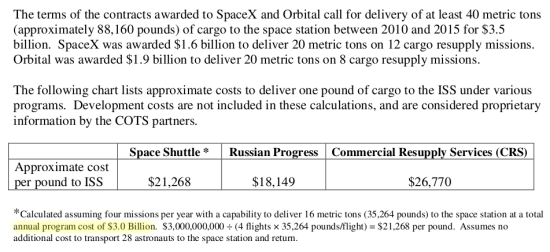
The problem is that these numbers are a complete lie, as they are based on a yearly cost of $3 billion to operate the shuttle (highlighted in yellow). I have been following NASA budget battles now for decades, and the shuttle operational budget has never, ever been that low. Routinely, NASA figures the cost to operate the shuttle per year, regardless of number of flights, to be about $4 billion per year.
» Read more
Government in action: A bureaucratic fight stalls an oil drill project in Alaska.
The project has put two federal agencies at odds. The Environmental Protection Agency has maintained that a roadless alternative, which would route the pipeline under the Nigliq Channel and use an airstrip instead of a road and bridge, would be less damaging to the reserve’s environment. The Interior Department backs Conoco’s proposal as environmentally preferable.
Freedom dies: A student was banned from graduation for criticizing his school on Facebook.
In a letter to [the student], [Vice President for Student Development and Services Eric W.] Jackson explained that the reason for his prohibition was the Facebook comments, adding that “[a]ll students enrolled at Saint Augustine’s College are responsible for protecting the reputation of the college and supporting its mission.”
In other words, the students at this hack of a school are required to promote the school at all times. What idiocy.
More government stupidity: Because California’s gold-mining environmental rules cost five times more than what they earn in fees, the state legislature can’t afford to fund the process. The result: an end to all gold-mining in California.
First Texas, now Alaska: Pressure from legislators there has forced TSA officials to consider the use of common sense profiling.
To the museum: Endeavour will not arrive in at its Los Angeles retirement home until late 2012.
Lockheed Martin buys the first commercial quantum computer. More here on the science of quantum computing.
Quantum computers could revolutionize the way we tackle problems that stump even the best classical computers, which store and process their data as ‘bits’ — essentially a series of switches that can be either on or off. The power of quantum bits — or qubits — is that they can be on and off simultaneously. Connect enough qubits together using quantum entanglement and a computer should be able to zip through a multitude of calculations in parallel, at astonishing speed.
NASA lunar lander test sparked a grass fire yesterday.
Good news for trout fisherman: A new study of the evasive algae Didymo has figured out why the algae blooms in places it shouldn’t.
The result may help managers identify water bodies susceptible to Didymo blooms, and develop management strategies. “It also has the potential to lead to discoveries that may stem this organism’s prolific growth in rivers around in the world,” says [P.V. Sundareshwar of the South Dakota School of Mines and Technology in Rapid City].
An evening pause:: Christopher Lloyd at his best.
The Russian greenhouse on ISS underwent an upgrade today.
The onboard greenhouse was dismantled in April last year, as a need arose to replace the outdated control unit, recalled head of the Rasteniya-2 (Plants-2) experiment, chief of the laboratory of the Institute of Medico-Biological Problems (IMBP) of the Russian Academy of Sciences (RAS) Vladimir Sychev. In early 2010, the crop area of the orbital garden was extended twice – the second leaf chamber was delivered to the ISS in which the crew managed to harvest the Mizuna lettuce, before the greenhouse was dismantled. Now, the cosmonauts will plant in these two chambers different cultures – super-dwarf wheat and dwarf tomatoes.
As I described in detail in Leaving Earth, the Russians have decades of experience in growing plants in space, with the goal of not only providing a natural system to recycle the station’s atmosphere, but also giving the astronauts a morale-boosting activity (gardening) that also gives them something tasty to eat. Though the engineering has still not made it possible to germinate seeds in weightlessness and then have grow there, this will be an absolute requirement if humans are ever to travel to the planets and beyond to the stars.
The last shuttle mission: Atlantis has now begun its journey to the launchpad.
Bigelow expands its space station factory. Via Clark Lindsey.
Endeavour lands safely, for the last time.
Fossil fuels to the rescue! A liberal discovers the value of natural gas and fracking.
The arguments for converting the U.S. economy to wind, solar and biomass energy have collapsed. The date of depletion of fossil fuels has been pushed back into the future by centuries — or millennia. The abundance and geographic diversity of fossil fuels made possible by technology in time will reduce the dependence of the U.S. on particular foreign energy exporters, eliminating the national security argument for renewable energy. And if the worst-case scenarios for climate change were plausible, then the most effective way to avert catastrophic global warming would be the rapid expansion of nuclear power, not over-complicated schemes worthy of Rube Goldberg or Wile E. Coyote to carpet the world’s deserts and prairies with solar panels and wind farms that would provide only intermittent energy from weak and diffuse sources.
Good news indeed: The House tonight overwhelmingly voted down an unconditional hike to $14.3 trillion debt ceiling.
The vote was 318-97, with 82 Democrats joining every Republican in rejecting legislation that would have authorized $2.4 trillion in additional borrowing by the federal government. Seven Democrats voted present on the legislation.
Now comes the business of tying the increase in the debt ceiling to some real spending reduction.
An evening pause: Dancing telescopes.