Solar minimum to limit interplanetary manned flights?

A new study suggests that the increased cosmic radiation reaching the inner solar system because of the Sun’s weak sunspot activity will increase the exposure to dangerous radiation levels for interplanetary astronauts, thus limiting mission lengths to about one year.

The new research finds that, during periods of low solar activity, a 30-year-old astronaut can spend roughly one year in space—just enough time to get to Mars and back—before the constant bombardment by cosmic rays pushes the risk of radiation-induced cancer above current exposure limits.

If the sun’s activity continues to weaken as many scientists predict, the number of days humans could spend in deep space before reaching their exposure limit could decrease by about 20 percent, making future crewed space flight more dangerous, according to the new study accepted for publication in Space Weather, a journal of the American Geophysical Union.

The numbers were worse for women, whose exposure would become dangerous in only 300 days, according to the study.

2 comments

China to launch two payloads to the Moon

The competition heats up: On Thursday China plans to send a capsule on a mission around the Moon and back to Earth to test its heat shield.

The rocket’s upper stage, which will also round the Moon but not return to Earth, will also carry a privately funded cubesat designed to study the radiation levels during the entire journey.

Twenty minutes after launch on October 23, (at 1:59 p.m. U.S. Eastern time), the Long March’s upper stage will separate from the test capsule, and both will continue on a trajectory that takes them around the moon. The capsule will return to re-enter Earth’s atmosphere on October 31. In early discussions with the Chinese, LuxSpace was told that the upper stage [carrying the private cubesat] would re-enter the atmosphere as well, but it’s now expected to enter a wide, looping orbit around Earth. The main battery is only designed to last 10 days, although it may go longer.

Radio receivers on Earth will be able to tune in to 4M’s signal shortly after separation, and will be able to follow it as it rounds the moon, coming as close as 7,500 miles to the surface. The payload also includes a radiation sensor that will take measurements throughout the journey into Earth-moon space. Anyone with the proper equipment will be able to receive the compressed radiation data and decode it.

Though this private mission is definitely breaking new ground by sending a small payload to lunar space for very little money, the article is incorrect when it states that this is the first privately funded Moon mission. In 1997-1998 HGS 1, a Hughes commercial communications satellite that was placed in an incorrect orbit by a Russian rocket, was sent on a wide elliptical orbit to fly past the Moon twice and thus use this sling shot effect to get the satellite into a usable orbit.

0 comments

Mars Reconnaissance Orbiter photographs Comet Siding Spring

During Comet Siding Spring’s flyby of Mars on Sunday Mars Reconnaissance Orbiter was able to capture an image of the comet’s nucleus.

Prior to its arrival near Mars astronomers estimated the nucleus or comet’s core diameter at around 0.6 mile (1 km). Based on these images, where the brightest feature is only 2-3 pixels across, its true size is shy of 1/3 mile or 0.5 km.

0 comments

Snowcaps of metal on Venus?

A new look at old data of Venus has added weight to the theory that the planet’s higher elevations are coated with a frost of heavy metals.

The research not only confirmed a radar brightening at higher altitudes, thus suggesting a frost coating of some kind, it also showed many dark spots whose cause remains completely unknown. As the article notes,

Years ago it was proposed that some sort of ferro-electric compound might be the cause of the brightening and the dark spots, but so far no specific compound has been identified which does the trick. Then again, with the surface of Venus being at almost 900 °F (500 °C) under more than 90 times the air pressure of Earth’s atmosphere at sea level, with occasional showers of acid, it’s not easy to test the properties of materials under Venusian conditions. “No one knows what explains the sudden darkness,” said Harrington, who will be presenting the work at the meeting of the Geological Society of America in Vancouver, B.C., on Monday, Oct. 20.

0 comments

Send your sermons to Houston

This is good: Mike Huckabee on Saturday suggested that every pastor in America send their sermons to the mayor of Houston.

Former Arkansas Gov. Mike Huckabee said pastors from across the United States should send “thousands and thousands” of Bibles and sermons to the Houston mayor who demanded pastors turn over their sermons to the government due to their objection to an LGBT discrimination city ordinance.”I hope she gets thousands and thousands of sermons and Bibles,” Huckabee said on his Fox News show Saturday, referring to Mayor Annise D. Parker.”It ought to make you mad that the mayor thinks she can turn in her pastors. And so I got an idea,” Huckabee explained. “If she wants a sermon, here is my suggestion. I would like to ask every pastor in America, not only the ones in Houston, to send her your sermons and go ahead. Obviously she could use a few. And everybody watching the show ought to send her a Bible.”

As always, the best answer to bad speech is more speech!

3 comments

Ebola’s rate of growth

The journal Science provides a detailed analysis of the infection rate of ebola, as well a reasonable estimate of the present and future number of cases.

The article makes two key points. First, the trends “…clearly show that the number of cases has roughly doubled every 3 to 4 weeks and that this trend is continuing. If underreporting gets worse, however, it may be even more difficult to discern such trends.”

Second, there is some good news in the worst effected countries.

The number of new cases in some areas at the epicenter of the outbreak– Kenema and Kailahun districts in Sierra Leone and Liberia’s Lofa county–has been dropping, and that’s not a result of underreporting, says Dye. “It has happened for a sufficiently large number of weeks now that we are confident that it’s a real reduction in incidence on the ground, probably related to control measures,” he says. “Our colleagues working on the ground believe it is too.”

One important factor has been the increase in safe burials, Dye says. (The bodies of Ebola victims are very infections.) People in the affected areas have resisted abandoning traditional burial practices that carry a high risk of infection, but in these three areas, local leaders, supported by WHO and others, have come to advocate a change. If that happens elsewhere, says Dye, “we expect to be able to cut out a substantial amount of infection in the community.”

0 comments

Mars orbiters survive comet fly-by

Press releases from science teams for Mars Reconnaissance Orbiter, MAVEN, and Mars Odyssey confirm that all three spacecraft are functioning properly after Comet Siding Spring’s fly-by of Mars today.

All three spacecraft also did observations of the fly-by, the data of which will take a few days to download. Stay tuned.

Update: Europe’s Mars Express and India’s Mangalyaan orbiters are also reported to have escaped damage during the fly-by.

1 comment

The X-37B goes to Mars

After 675 days in space, the Air Force’s reusable X-37B mini-shuttle successfully returned to Earth today, completing its second flight in space.

There has been a lot of speculation about the secret payloads that the two X-37B’s have carried into space. The Air Force has been very tight-lipped about this, though they have said this:

“The primary objectives of the X-37B are twofold: reusable spacecraft technologies for America’s future in space, and operating experiments which can be returned to, and examined, on Earth,” Air Force officials wrote in on online X-37B fact sheet. “Technologies being tested in the program include advanced guidance, navigation and control; thermal protection systems; avionics; high-temperature structures and seals; conformal reusable insulation, lightweight electromechanical flight systems; and autonomous orbital flight, re-entry and landing,” they added.

The obvious advantage of the X-37B is that it allows the Air Force to test these new technologies in space, then bring them back to Earth for detailed analysis.

However, I think the most important engineering knowledge gained from this flight will not be from the payload, but from the X-37B itself.
» Read more

9 comments

Virgin Galactic outlines near term test flight schedule

The competition heats up: In a newspaper interview, the CEO of Virgin Galactic has outlined the company’s flight plans for SpaceShipTwo in the coming months, leading hopefully to its first commercial flights.

“We expect to get to space altitude in a short number of flights, assuming the rocket performs as expected,” Whitesides told the Journal. “Scaled made it to space in four flights with SpaceShipOne. I believe it will be a little more than that for us, but not dramatically so.”

Once SpaceShipTwo successfully reaches space, Scaled Composites will turn over the rocket to Virgin Galactic for its commercial operations based in New Mexico. Virgin has already taken control of the mothership, which it flew to Spaceport America for some initial test operations in September. “Once we take control of SpaceShipTwo, we expect to do some more testing here in New Mexico, but that will primarily be efficiency testing rather than technology testing,” Whitesides said. “It will give pilots an opportunity to train at this airfield after Mojave to practice things like coming in on final approach.”

As much as I have expressed strong skepticism in recent months of Virgin Galactic’s promises, I truly hope this happens, and soon.

4 comments

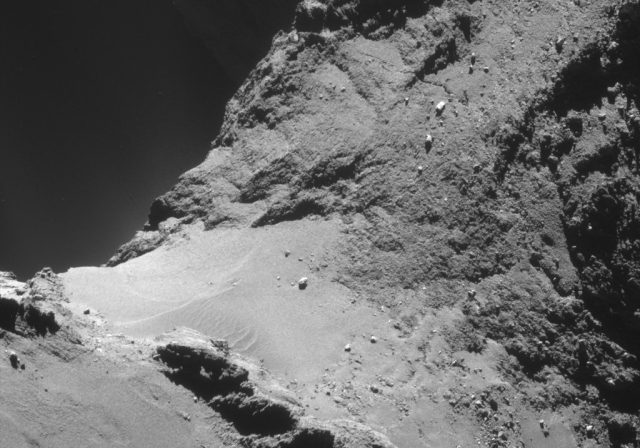
Comet 67P/C-G at 2 feet per pixel

New images from Rosetta, now about 6 miles from the surface of Comet 67P/C-G, show details as small as 2 feet across.

Go to the link to see some images. If you were hiking there, these images would see you.

In related news, the Rosetta team is asking the public to help name the landing site for its Philae lander.

As the location of the first soft landing of a human-made object on a comet, the site, currently identified as Site J, deserves a meaningful and memorable name that captures the significance of the occasion. The rules are simple: any name can be proposed, but it must not be the name of a person. The name must be accompanied by a short description (up to 200 words) explaining why this would make the ideal name for such an historic location. A jury comprising members of the Philae Steering Committee will select the best name from the entries, and the winning proposer will be invited to follow the landing in person from ESA’s mission control centre in Darmstadt, Germany on 12 November.

2 comments

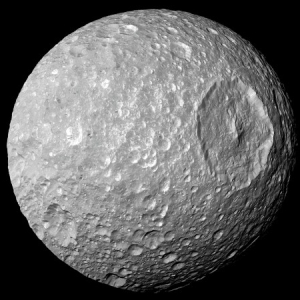
The mysterious interior of Saturn’s moon Mimas

Mimas

The uncertainty of science: Using data from Cassini scientists have found that Saturn’s weird moon Mimas might have either an underground ocean or a misshapen inner core.

Tajeddine and his team relied on pictures taken by NASA’s Cassini spacecraft, which has been exploring the Saturn system since 2004. They built a 3D model of the moon and found that it rotates with an extra wobble, like a misshapen top spinning slightly askew. Because Mimas is nearly spherical, the wobble hinted that something lumpy, or perhaps sloshy, lay beneath the surface. The scientists tested several models of the moon’s interior to see what might give rise to the observed wobble.

It could be the core is lumpy and not spherical. It could be that there is a liquid ocean under the crust that sloshes about as the moon moves through space. Or it could be that a massive impact, the one that produced Mimas’s Death Star look with its one gigantic single crater, could have caused the wobble.

At the moment the data is not sufficient to favor any of these theories. I guess we will just have to go there to find out.

0 comments
1 3 4 5 6 7 10