September 27, 2016 Zimmerman/Batchelor podcast
Embedded below the fold. This was another double length appearance lasting 39 minutes. Talked about a lot of commercial space stuff, including Musk’s speech.
» Read more
Embedded below the fold. This was another double length appearance lasting 39 minutes. Talked about a lot of commercial space stuff, including Musk’s speech.
» Read more
The competition heats up: A Russian airline owner has signed a deal with the Russian government to buy Sea Launch.
Whether this guy can make the company viable again is a big question. He has to settle the court suit with Boeing and he also has to settle with either Russia or Ukraine about what rocket to use.

For the overall context of Curiosity’s travels, see this post, Pinpointing Curiosity’s location in Gale Crater.
In the past week Curiosity finally left Murray Buttes and began moving south towards Mount Sharp, and, for at least one day, I thought tracking the rover’s movements might become easier. Early in the week the science team published an updated overhead traverse map that not only showed the topographical elevation contour lines for the surrounding terrain, but also included a blue line roughly indicating the rover’s future route. For reasons I do not understand, however, they only did this for one day, and then went back to the un-annotated traverse maps they had been using previously. I have therefore revised the most recent traverse map, shown on the right, to include these contour lines as well as the planned future route. The contour lines are hard to read on the full image, but below the fold on the right is a zoomed in view of Curiosity’s position as it left Murray Buttes, which shows the rover’s elevation at about 4376 meters below the peak of Mount Sharp. This means the rover has gained about 1,150 meters, or about 3,775 feet, since its landing, but only 50 meters or about 150 feet since March of this year. It is still not on the mountain but in the low foothills at its base.
» Read more
An evening pause: Hat tip Lee Stevenson.
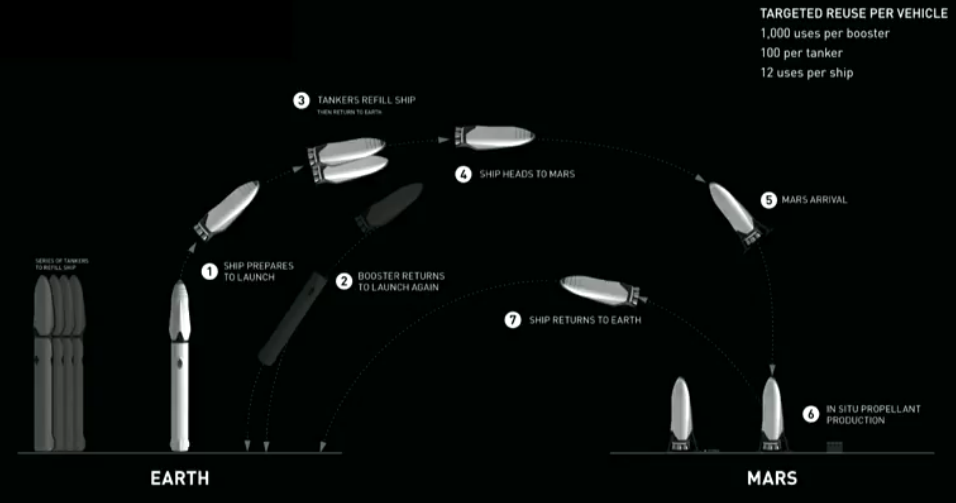
Today Elon Musk gave a speech at the International Astronautical Congress in Guadalajara, Mexico. The speech laid out SpaceX’s proposed architecture for building what he presently calls his interplanetary transport system. The image on the right is one of his talk slides, showing the basic concept, which is built around using the company’s new Raptor engine — still under development — which only got its first test firing this past week.
The plan is ambitious and visionary, which from Musk is not surprising. It is also aimed to be as practical and as cost effective as possible, which also is not surprising coming from Musk. The rocket itself will be larger than both the Saturn 5 and SLS, but not significantly more. Compared to those government rockets however it will be far cheaper and faster to build, though Musk’s hope that they will be launching their first test flights in four years is almost certainly too optimistic. The concept is to use what they have learned with the Falcon 9 to build a bigger rocket with a reusable first stage that launches a large second stage that is either the spaceship taking people to Mars or a giant tanker for refueling that spaceship.
In one of Musk’s early slides he noted something that I have been arguing for decades. “Speading the required lift capacity across multiple launches substantially reduces development costs and compresses schedule.” Though he is still proposing a heavy-lift rocket, he is also following in the footsteps of Wernher Von Braun by proposing that any Mars mission will require some assembly in orbit.
The plan is also aimed at making space travel as affordable as possible. Musk structured the design in as many ways as possible to make it as efficient and as inexpensive as possible. It still won’t be cheap, at about $140K per ton, but at that price it will be affordable to a lot of people. He also mentioned that it include free passage back to Earth.
I doubt we will see this system built as outlined today in the time span predicted by Musk. At the same time, I would not be surprised if we do see some variation of it, and see it built within the near future. In 2011 Musk proposed recovering his Falcon 9 first stages by landing them vertically. The idea seems radical. He got it done in four years. There is every reason to believe he will make this Mars proposal happen as well.
Engineers have restored the first recording of computer-generated music from 1951.
The oldest recording of computer music was made in late 1951 by a BBC outside broadcast unit at the University of Manchester for the BBC Home Service program Children’s Hour. The rough two-minute recording is of the Ferranti Mark I computer playing “God Save the King”, “Baa Baa Black Sheep”, and the popular swing-band hit “In the Mood.” The recording was made on mobile recording equipment and etched into a 12-inch, single-sided acetate disc, as was normal for the time.
The restoration determined that the record, one of only two in existence, played the music at the wrong speed. To make it sound correct, “it had to be sped up, extraneous noise filtered out, and digitally pitch-corrected to remove wobbles.”
You should definitely listen to it. Quite fascinating, especially since it includes the candid commentary of the technicians as they tried to get the computer to play.
The competition heats up: In a series of tweets Jeff Bezos on Monday released the first images Blue Origin’s next rocket, New Glenn, showing a scale-model being during wind tunnel tests.
They were testing the rocket’s aerodynamics during launch and return, and were apparently happy with the results.
OSIRIS-Rex’s instruments have been successfully turned on and are all operating perfectly.
Using data from Mars Odyssey scientists have determined that a mountain chain on Mars was likely created as a chain of volcanoes.
They analyzed the geography and mineralogy of this area they termed Greater Thaumasia, which is about the size of North America. They also studied the chemistry of this area based on Gamma Ray Spectrometer data collected by the Mars Odyssey Orbiter, which was launched in 2001. What they found was the mountain ridge that outlines Greater Thaumasia was most likely created by a chain of volcanoes.
Their research also looked to see if water influenced the mountains’ formation and found no evidence for it. The mountain chain itself is south of the giant Valles Marineris canyons and southeast of the Tharsis region where Mars’ biggest four volcanoes are located.
Work has stalled again on Russia’s Multipurpose Laboratory Module (MLM), threatening its presently scheduled launch to ISS by the end of 2017.
According to industry sources, most of replacement components for the MLM’s faulty propulsion system had already been manufactured, except for the pipelines, which would have to be bent based on their particular situation on the module. Still, military quality control officers, who now certify all space industry manufacturing operations, refused to give the green light for the final assembly of the propulsion system for the MLM.
Work on MLM began in 2008, and has been delayed repeatedly in the past eight years.
The Rosetta team has released a step-by-step outline on what will happen this week as Rosetta is sent crashing into Comet 67P/C-G, including details on how the public can watch.
More information here. Coverage will begin at 6:30 am (Eastern) on September 30 and end a little over an hour later.
The competition heats up: One of the smallsats launched by India’s PSLV rocket this weekend, Pathfinder 1, has successfully begun communicating with the ground as well as transmitting data.
This is a test demonstration flight of this new smallsat Earth observation imaging satellite. As the company notes,
The on-orbit demonstration of the BlackSky Pathfinder spacecraft validates the future vision of real-time global observation and understanding. Specifically, BlackSky’s Pathfinder spacecraft is unique and revolutionary in its size, cost and performance. By comparison, Digital Globe’s WorldView 4 spacecraft — which has truly impressive resolution and spectral diversity — weighs 2,500 kg and costs $750M to put on orbit. Pathfinder represents the pinnacle in rethinking spacecraft design and economics. Our spacecraft, complete with propulsion system and high gain communications, can provide high resolution (1 meter) imagery in a 50 kg package that will fit in a middle seat on a commercial airplane – all for less than $7.5M on orbit. It’s this unique combination of size, cost and performance that enables us to orbit a constellation of 60 spacecraft for less than the cost of a single Digital Globe spacecraft.
As I’ve mentioned several times in the past year, the space industry is diverging into two streams, smallsats for unmanned communications and research satellites, and big spacecraft for human exploration. Tomorrow, Elon Musk will give us his vision of the big spacecraft stream in his much hyped speech at the International Astronautical Congress.
The competition heats up: Rocket Lab today announced the completion of its first launch complex at its launch site in New Zealand.
Air traffic near the launch complex site is fairly sparse, which the company says will allow it to achieve the “highest frequency of launches in history,” according to a statement from the company obtained by Space.com. Peter Beck, Rocket Lab’s CEO, told Space.com in an interview that the complex is licensed to conduct a launch as frequently as every 72 hours. However, the company expects to carry out a launch about four to five times per month, he said.
The statement from Rocket Lab declared its new facility “the world’s first private orbital launch complex.” The private spaceflight company Blue Origin operates a private launch facility in Texas, but has only used that facility for suborbital flights. The private spaceflight company SpaceX has not yet completed construction on its private orbital launch facility in Texas.
They say they will begin test launches before the end of the year.
<An evening pause: Recorded live on television sometime in the 1960s. Paul Desmond (alto sax), Joe Morello (drums), Eugene Wright (bass) and Dave Brubeck (piano).
Hat tip Willi Kusche.
Trump today named a climate skeptic from the conservative Competitive Enterprise Institute to lead his EPA transition team .
Myron Ebell, director of energy and environment policy at the conservative think tank Competitive Enterprise Institute, is heading Trump’s EPA transition preparation, E&E Daily reported Monday. Ebell is an outspoken, longtime skeptic of the scientific consensus that human activity is dramatically changing the climate. He often refers to warnings about global warming as climate “alarmism” and is a vocal critic of President Obama’s climate change regulations. Ebell has argued that the Clean Power Plan is illegal and that the Paris climate change agreement is unconstitutional.
As those who have been reading Behind the Black know, I have been looking closely at the people Trump is looking at to be part of his administration, should he win the election. His choices will tell us two things: One, the political positions of his appointees will provide an indication of Trump’s own political preferences at this time. Two, his choices will tell us the nature of people that will be advising Trump in the future.
So far, his choices have leaned right, with a few exceptions. This choice for leading the transition at EPA is significantly to the right, and indicates that a Trump administration would work aggressively to dismantle the global warming cartel that presently runs things in the climate field, using government money as their hammer.
Most of you and the media will be glued to your televisions tonight, watching the silly debate show. I am more interested in what Trump might actually do. For example, I was somewhat impressed by the immigration speech Trump gave August 31. Unlike most political speeches by him and every other modern politician, it was not a litany of emotional attack soundbites and cute jokes. Trump outlined in great detail the overall policy plans to deal with the federal government total failure to do its job controlling the border. I did not agree with all of his proposals, but I found the overall thoughtfulness of the speech encouraging.
New data from the Hubble Space Telescope suggests that there might be active water plumes issuing from Europa that are fed by the planet’s underground ocean.
In 10 separate occurrences spanning 15 months, the team observed Europa passing in front of Jupiter. They saw what could be plumes erupting on three of these occasions.
This work provides supporting evidence for water plumes on Europa. In 2012, a team led by Lorenz Roth of the Southwest Research Institute in San Antonio, detected evidence of water vapor erupting from the frigid south polar region of Europa and reaching more than 100 miles (160 kilometers) into space. Although both teams used Hubble’s Space Telescope Imaging Spectrograph instrument, each used a totally independent method to arrive at the same conclusion.
These results are very very uncertain. As the lead scientist noted twice during the press conference, the data is at the very limits of Hubble’s capabilities. I would not be surprised at all if later observations find that it is in error.
In fact, the press conference itself was more a PR event to lobby for Hubble as well as the James Webb Space Telescope than it was a description of a new discovery. The discovery itself was given a much bigger tease than it really deserves, considering the very uncertain nature of its data. I am a big fan of Hubble, as anyone who has read anything I have written in the past two decades. Nonetheless, I find this blatant lobbying very annoying. Also very annoying will be the naive willingness of many in the press to buy into this story. Expect a lot of silly stories today and tomorrow screaming that water jets coming from Europa have been definitely photographed by Hubble.
Using data from MESSENGER, scientists have found evidence that Mercury might still be tectonically active.
It appears that the last close-up images taken by the spacecraft before the mission ended discovered small thrust fault scarps that appeared very very fresh, suggesting they were formed recently, in geological time.
The competition heats up: Though details remain vague, SpaceX has announced that it has successfully completed the first static test firing of its Raptor engine.
The competition heats up: India’s space agency ISRO has successfully used its PSLV rocket to launch eight satellites into two different orbits.
After the successful separation of SCATSAT-1, the PSLV-C35 mission continued. Still carrying the seven co-passenger satellites, the fourth stage of PSLV coasted over the South polar region and then started ascending towards the Northern hemisphere. A safe distance between the orbiting SCATSAT-1 and PSLV-C35 fourth stage was maintained by suitably manoeuvring the stage.
At 1 hour 22 minutes and 38 seconds after lift-off as the fourth stage was in the North polar region, the two engines of PSLV fourth stage were reignited and fired for 20 seconds. As a result of this, it entered into an elliptical orbit measuring 725 km on one side of the Earth and 670 km on the other. And 50 minutes later, as the PSLV fourth stage was again coasting near the south pole, its engines were fired for another 20 seconds. This second firing made the fourth stage to enter into a circular orbit of 669 km height inclined at an angle of 98.2 degree to the equator. 37 seconds later, the Dual Launch Adapter was successfully separated from the PSLV-C35 fourth stage. 30 seconds after this event, ALSAT-1N was the first co-passenger satellite to be separated successfully. Following this, the NLS-19, PRATHAM, PISAT, ALSAT-1B, ALSAT-2B, and Pathfinder-1 were separated from the PSLV fourth stage in a predetermined sequence thereby successfully completing PSLV-C35 mission.
This launch was also the 36th successful PSLV launch in a row.
Though the major wildfire at Vandenberg Air Force Base is now 90% contained, launches remain suspended due to additional wildfires on base.