
Asteroid breaks in two, each piece develops a tail

Astronomers have discovered a main belt asteroid that six years ago broke in two, after which both pieces developed tails resembling comets.

“The results derived from the evolution of the orbit show that the asteroid fragmented approximately six years ago, which makes it the youngest known asteroid pair in the Solar System to date,” says Fernando Moreno, researcher at the Institute of Astrophysics of Andalusia (IAA-CSIC), in charge of the project.

P/2016 J1 presents another important peculiarity, which makes it very unusual. “Both fragments are activated, i.e., they display dust structures similar to comets. This is the first time we observe an asteroid pair with simultaneous activity,โ€ says Fernando Moreno (IAA-CSIC).

Analyses revealed that the asteroids were activated near their perihelion โ€“ the point on the orbit nearest to de Sun โ€“ between the end of 2015 and the beginning of 2016, and that they remained for a period of between six and nine months. The span of time between the moment of fragmentation and their bout of activity implies that the two events are not related. In fact, the data suggests that the fragmentation also happened near the perihelion but during the previous orbit (it takes P/2016 J1 5.65 years to spin around the Sun). “In all likelihood, the dust emission is due to the sublimation of ice that was left exposed after the fragmentation,” says Moreno (IAA-CSIC).

I suspect that the more we learn about asteroids and comets the more we will blur the line that separates them.
1 comment

The tampering of climate data at NOAA and NASA

data tampering at NASA

Last week there was the another Conservative Political Action Conference (CPAC) in Washington. One presentation there by several important climate skeptics outlined in detail the data tampering that has been going on at an increasingly outrageous manner at both NOAA and NASA in recent years. The slides presented by Tony Heller (available here [pdf]), many of which I have highlighted previously here at Behind the Black, are especially educational and damning.

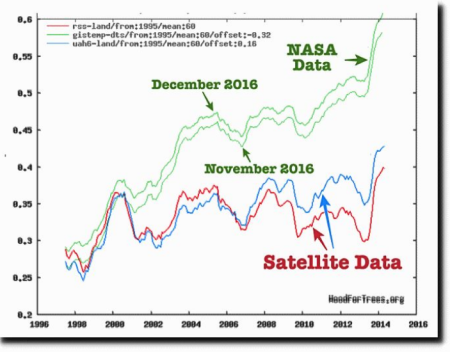
To the right is just one of Heller’s slides, the one that I find the most damning of all. It shows how the surface data issued by NASA’s Goddard Institute of Space Studies (GISS), the two green lines, does not match the satellite data at all. While the satellite data shows no warming this entire century, the GISS data shows steady rising in the surface data. Other slides by Heller show that this rise comes solely from data adjustments and the extrapolation of imagined temperature data in places where no data exists, neither of which has been explained in any manner by the scientists at GISS.

What is most damning however is the change Heller documents between GISS’s November 2016 and December 2016 data sets. For reasons that are simply unjustified by any scientific measure, GISS somehow found it necessary to adjust its entire data set upward in one month about 0.03 of a degree. The only reason I can find for such a change in such a short period of time is a desire by the scientists at GISS to create the illusion that the climate is warming, and warming fast. They don’t have any real data to show this, so they make it up.

Make sure you look at all of Heller’s slides [pdf]. It is also definitely worthwhile to spend the time to watch the entire CPAC presentation, available at the first link above.

42 comments

Bigelow advocates his space stations for lunar missions

The competition heats up: Robert Bigelow today advocated using his privately built inflatable space station modules as a tool for launching future American lunar missions.

Bigelowโ€™s company is eager to put a space station depot in lunar orbit, from which such activities and others can be initiated, as well as support onboard research. โ€œWe do not have the technologies, and there is zero business case for Mars. We do have a business case for the moon. And thatโ€™s why the moon absolutely makes the best sense,โ€ Bigelow said. โ€œAnd we can do the lunar activities far sooner than we can with Mars, which stretches out to, NASAโ€™s views are Mars may be in the 2040s.โ€

His โ€œNew Spaceโ€ company, Bigelow Aerospace of Las Vegas, designs space habitats, including a fully self-contained space station with 330 cubic meters of living and working space, which he said is ready for a lower-Earth orbit or, in about three years given the expected advancements in rocketry, for lunar orbit.

The key statement above is the comparison between lunar missions and Mars missions, at this time. The Moon has the chance to be profitable in the near future. Mars does not. If you had money to invest (even if it is taxpayer dollars) which would you invest it in?

2 comments

The winds of Mars

New data from Curiosity has confirmed that the winds of Mars have been the primary force shaping the red planet’s landscape for billions of years.

The new data suggests that Mount Sharp once filled Gale Crater, and it was the winds that eroded it away to create the impression that it is the crater’s central peak. Instead it appears that it is the crater’s original floor!

Below the fold is the video from the link showing a number of dust devils imaged by Curiosity.

This link provides a gif animation showing the surprisingly significant changes to the ripples in the sand dunes directly below Curiosity that take place in only one day. The changes are astonishing, and show that even though Mars’ atmosphere is far thinner than Earth’s, it is capable of moving things quickly across the Martian surface.
» Read more

0 comments

The oldest fossils ever?

Scientists think they have found the oldest fossils ever in Canada.

Scientists say they have found the worldโ€™s oldest fossils, thought to have formed between 3.77bn and 4.28bn years ago. Comprised of tiny tubes and filaments made of an iron oxide known as haematite, the microfossils are believed to be the remains of bacteria that once thrived underwater around hydrothermal vents, relying on chemical reactions involving iron for their energy.

If correct, these fossils offer the oldest direct evidence for life on the planet. And that, the studyโ€™s authors say, offers insights into the origins of life on Earth. โ€œIf these rocks do indeed turn out to be 4.28 [bn years old] then we are talking about the origins of life developing very soon after the oceans formed 4.4bn years ago,โ€ said Matthew Dodd, the first author of the research from University College, London.

This discovery reminds me of the Mars fossils discovered in the late 1990s. There were enormous uncertainties with that discovery, all of which eventually caused most scientists in the field to reject the result. The same thing could be the case here.

Still in Dallas. I hope to get caught up tomorrow.

14 comments

China considering multi-asteroid mission

The competition heats up: China is considering an unmanned probe to visit three different asteroids, including Apophis.

According to details that have previously emerged, one proposal is for a launch via Long March 3B rocket to take place in early 2022, with rendezvous with Apophis a year later and spend 220 days in orbit.

Then the probe would depart Apophis for a flyby of 2002 EX11 in 2025, and finally landing on 1996 FG3 in 2027, where it would, in Ji’s words, “conduct in-situ sampling analysis on the surface”.

The proposal is only in the design stage, but it should definitely be taken seriously. China is committing more and more of its resources to its space program, as that program is giving that government a big payoff in international recognition.

Posted in the airport in Dallas, where I have to wait an extra three hours because American Airlines practically shut the door to my connecting flight in my face. Their flight from Belize was late, and then Customs and the TSA conspired to create giant lines for no reason. Even though I had a friend at the gate with whom we were in contact by text who could tell them I was only a minute away, they shut the door anyway.

I have avoided American for more than a decade because they did something as obnoxious to me before. I think it might be a decade before I fly them again.

2 comments

NASA buys Soyuz seats from Boeing

NASA has purchased two additional seats from Boeing on a Russian Soyuz capsule and rocket to get astronauts to ISS beyond 2019.

The reason Boeing was able to sell Russian Soyuz seats is because they have obtained them from the Russians in a deal to settle Boeing’s $320 million lawsuit over ending the Russian/Boeing Sea Launch partnership.

4 comments

Heading Home

Today we completed our last caving trip in Belize. I and many of the expedition’s participants head home tomorrow.

Because our cave trips take so much time, I have not had time to post anything these last few days. I will try to post tomorrow during my return home, but expect full posting to resume on Thursday.

Also, though I will comment then in greater length about SpaceX’s announcement on Monday that they plan on sending two tourists around the Moon by 2018, I want to note here that this announcement is clearly Elon Musk’s response to the effort by NASA to delay the launch of commercial crew because of so-called safety issues so that SLS/Orion might fly first. Musk is telling the world that NASA’s safety concerns are crap (to which I generally agree) and he intends to prove this with his own lunar manned mission.

11 comments
1 135 136 137 138 139 164