Capitalism in Space to be released early next week

After several months of delay for a variety of reasons that I do not need to go into, my policy paper for the Center of New American Security has gone to the printers will be released to the public early next week. The title: Capitalism in Space: Private Enterprise and Competition Reshape the Global Aerospace Launch Industry.

I will have the pdf of this paper available here on Behind the Black the instant it is available. To give everyone a taste, here are my concluding words:

A close look at these recommendations will reveal one common thread. Each is focused on shifting power and regulatory authority away from the federal government and increasing the freedom of American companies to act as they see fit to meet the demands of the market. The key word that defines this common thread is freedom, a fundamental principle that has been aspired to since the nation’s founding. Political leaders from both parties have made the concept a central core tenet of American policy. Democrat John Kennedy stated that his commitment to go to the Moon was a “stand for freedom” in the Cold War. Republican Ronald Reagan proposed “Freedom” as the name for the new space station, and viewed it as a platform for promoting private enterprise in space.

Freedom is actually a very simple idea. Give people and companies the freedom to act, in a competitive environment that encourages intelligent and wise action, and they will respond intelligently and wisely.

The United States’ history proves that freedom can work. It is time that it prove it again, in space.


11 comments

Freedom Caucus to push for swift Obamacare repeal

In a direct clash with the Republican leadership that increasingly wants to slow down a repeal of Obamacare, the conservative House tea party group dubbed the Freedom Caucus announced today that they will push for an immediate repeal of the law.

The House Republican leadership is made up of a bunch of cowards. They fear the polls. They fear the press. They fear the astroturf demonstrations paid for by the left. They fear everything. And they believe in nothing, because if they did believe in freedom and restricting the power of government they would move quickly to repeal Obamacare and let the chips of freedom fall where they may.

6 comments

Maybe the Earth’s magnetic field is not weakening

The uncertainty of science: New data using date-stamped jars covering the period from the 8th to the 2nd century BC suggest that the 8th century BC was a period when the Earth’s magnetic field was particularly strong, leading the scientists doing the research to conclude that the Earth’s magnetic field might not be weakening and that the recent field strength decline detected in the past two hundred years might simply be part of the field’s normal fluctuations.

This new data is certainly worthwhile, but the press release surely doesn’t reveal how the scientists were able to extrapolate future magnetic field strength from 8th century BC fluctuations. At a minimum, I would need to see a graph showing the measured field strength from the 8th century BC to the present time to see how today’s field strength compares with the past. Unfortunately, the press release does not provide this.

0 comments

Mars rover update: February 14, 2017

Curiosity

Ireson Hill, Sol 1604

Dune fields

For the overall context of Curiosity’s travels, see Pinpointing Curiosity’s location in Gale Crater.

Taking a close look at rock

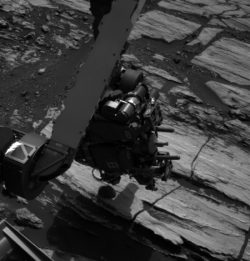
Since my last update in January, Curiosity done more or less what I predicted. It headed southwest through the dune area and then made a side trip to the small mesa there, dubbed Ireson Hill by the Curiosity science team and shown on the right. They then made an additional side trip past the hill to get a close look a the large sandy dune field beyond, also shown on the right. After getting some nice closeups as well as scooping up some sand for observation, they have now gone back to Ireson Hill to get another close look at the dark rocks that have rolled off the top of the hill and are now in reach at its base. The image on the left shows the arm positioned above one of those rocks.

The drill remains out of commission, with no word when they will try using it again. In addition, there had been a problem with the ChemCam laser that does spectroscopic analysis, but as of this week it is back in action, and is being used to analysis the small rock above.

Below is an overview of their route so far as well as my annotations on where I think they will be heading in the future.
» Read more

1 comment

The international government effort to come up with a cis-lunar ISS

The competition heats up: In the past five years the various international partners and their space agencies have been conducting studies for developing a new international space station, this time based not in Earth orbit but located near the Moon.

Following initial approval in the fall of 2014, the five space agencies formed the ISS Exploration Capabilities Study Team, IECST, which was tasked with reviewing how the ISS experience could be used to build the cis-lunar infrastructure, with determining its possible architecture and with drafting its flight plan and possible mission. Specialists also had the task of looking at all the necessary technologies, logistics and maintenance which would be required for building and operating a small habitat near the Moon. This man-tended outpost could serve as a way station to the lunar surface and as a springboard for the exploration of the Solar System, including asteroids, Mars and its moons. In fact, the outpost itself could eventually embark on a journey toward a deep-space destination. Representatives of the various space agencies also tried to see what contributions each country could make, based on their technical capabilities and realistic budgets.

All the work was conducted within the ISS program and covered by its budget.

Initially, the IECST group included representatives from space agencies only, for the exception of Russia, with Roskosmos officials needed help from the nation’s prime contractor in human space flight — RKK Energia. For the final few meetings in 2016, ESA also brought representatives from the European space industry. However NASA did not directly involve its key human space flight contractors into the IECST activities. (Instead, the US aerospace companies Boeing and Lockheed Martin continued parallel studies in cooperation with RKK Energia in Russia, EADS Astrium in Europe and Mitsubishi in Japan.) [emphasis mine]

Read the whole article. Lots of interesting details.

In a sense, this international effort is a political lobbying effort by these space agencies to come up with a single project to follow ISS that will continue the funneling of government money to them all. It is also an effort by them to structure future space exploration so all efforts will be contained within this single program, rather than allowing for many different competing efforts, both private and public. In addition, it is an attempt by NASA to come up with some long-term mission for SLS/Orion, which at present has no operational purpose and no funding beyond its first manned flight in 2021.

Finally, note the highlighted sentence above. This effort — which will benefit not just NASA but the space agencies of Russia, Europe, and Japan as well as the old big space companies like Boeing, Lockheed Martin, and Mitsubishi — is been paid entirely by American tax dollars. Something about this to me seems wrong. Shouldn’t the cost here be shared? And doesn’t it seem inappropriate for NASA to be picking the companies it wants to work with, without open bidding?

5 comments

Short circuit caused launch failure of Japanese mini-rocket

Japanese engineers now believe that the cause of the failure of that country’s test launch of a mini-rocket on January 15 was because of the failure of wiring insulation.

The agency said it believes the cladding of electric cables was damaged by the vibration and heat of nearby metal parts, leading the cables to directly touch the metal parts. As a result, a short circuit occurred and a data transmission device lost power, it said.

It is remarkable how much the language of this story reminds me of Soviet era press releases. Everything about it is designed to obscure the problem so that it will be difficult for outsiders to understand what happened.

From what I gather, the cables were not properly secured so that during launch they rubbed violently against some nearby sharp metal parts, which then cut the insulation and caused the short circuit. That they were not properly secured, a basic engineering requirement for any rocket, and that this announcement is written to obscure this fact, suggests once again that Japan’s space agency has some serious quality control problems that it is still not facing.

0 comments

Countdown begins on India’s record-setting launch of 104 satellites

The competition heats up: ISRO has begun the countdown for Wednesday’s launch of India’s PSLV rocket, carrying a record-setting 104 satellites.

he Polar Satellite Launch Vehicle would be carrying a 714 kilogram main satellite for earth observation and 103 smaller “nano satellites” which would weigh a combined 664 kilograms. Nearly all of the nano satellites are from other countries, including Israel, Kazakhstan, The Netherlands, Switzerland, United Arab Emirates and 96 from United States, said the state-run ISRO.

If successful, India will set a world record as the first country to launch the most satellites in one go, surpassing Russia which launched 39 satellites in a single mission in June 2014.

Obviously, all these different satellites got a cut-rate launch deal by sharing the launch, which helps make their launch affordable. The disadvantage here is that they do not have much flexibility in choosing their orbits, which is why there is also a market now for small rockets aimed at launching single smallsats, such as Rocket Lab’s Electron.

1 comment

A comet breaks apart

On February 12 members of the amateur astronomy organization Slooh actually viewed the break-up of Comet 73P/Schwassmann-Wachmann into two large fragments.

On the night of February 12th, Slooh members using the company’s telescopes in Chile were able to view the comet as it broke into two pieces. This seems to be the continuation of a process that was first witnessed in 1995, then again in 2006.

Slooh members were among the first to confirm that the nucleus of comet 73P/Schwassmann-Wachmann had split into at least two large pieces. “They immediately pointed Slooh’s telescopes to capture the event,” says Slooh Astronomer, Paul Cox. “Members will continue to monitor the comet live over the coming weeks – assuming the comet survives that long.”

They have created an animation from their images, but it appears that they only started taking images after the actual breakup, so the animation shows the two fragments, but not the moment they broke apart.

0 comments
1 140 141 142 143 144 164