How the “internet of things” robs us of our rights

Link here. Key quote:

One key reason we don’t control our devices is that the companies that make them seem to think – and definitely act like – they still own them, even after we’ve bought them. A person may purchase a nice-looking box full of electronics that can function as a smartphone, the corporate argument goes, but they buy a license only to use the software inside. The companies say they still own the software, and because they own it, they can control it. It’s as if a car dealer sold a car, but claimed ownership of the motor.

This sort of arrangement is destroying the concept of basic property ownership. John Deere has already told farmers that they don’t really own their tractors but just license the software – so they can’t fix their own farm equipment or even take it to an independent repair shop. The farmers are objecting, but maybe some people are willing to let things slide when it comes to smartphones, which are often bought on a payment installment plan and traded in as soon as possible.

How long will it be before we realize they’re trying to apply the same rules to our smart homes, smart televisions in our living rooms and bedrooms, smart toilets and internet-enabled cars?

This is once again why, when I buy something, I try to find the stupidest version I can. It is why I don’t use a smart phone, since all the companies that work with them do not respect my privacy. It is why I avoid Google and Facebook, for the same reasons. In every case, there is an immoral component to the actions of these companies, and it is the personal responsibility of each individual to not participate in or endorse such behavior.

20 comments

Trump teams up with Democrats on debt limit deal

Trump today backed a Democratic proposal to only extend the debt limit by three months, instead of the Republican plan to extend that ceiling first 18 months, than six.

While it is clear the Democrats want more debt ceiling negotiations in order to force the Republicans to make repeated concessions each time, I find it disgusting that the Republican leadership is more interested in kicking the can down the road than to address the problem now. In a sense, this might be why Trump is siding with the Democrats, as it keeps the debt ceiling on the table as a political issue, and might eventually force these brainless cowards to eventually do something to gain some control over the budget.

Then again, it might not. It could also be that none of these politicians, including Trump, has any interest in controlling the budget, and are merely playing petty politics with the nation’s future.

25 comments

New Generation looks to establish private spaceport

Capitalism in space The new private partnership led by Canon, dubbed New Generation Small Rocket Development Planning, is now searching for a location to build its own private spaceport in order to bypass restrictions placed on launches at Japan’s two government launch sites.

While JAXA can launch at any time during the year, the deal with the local fishing council limits the number of launches per year to 17, and requires JAXA to coordinate its launches for the year with that council. For New Generation, which wants to compete in the smallsat rocket business and will thus likely need to launch dozens, if not hundreds, of times per year, this arrangement won’t work.

0 comments

Russia and China both condemn North Korea’s nuclear test

Has the veil finally lifted from their eyes? The leaders of both Russia and China on Sunday agreed to work together to deal with the threat of a North Korea with nuclear weapons and ICBMs, with China strongly condemning North Korea.

It appears that these nations have suddenly realized that a North Korea with nuclear weapons and missiles capable of delivering those weapons anywhere on the globe is not merely a threat to the U.S., it also poses a threat to them. It is a shame that it took so long for this basic and obvious fact to sink in.

16 comments

Sunspot update for August 2017

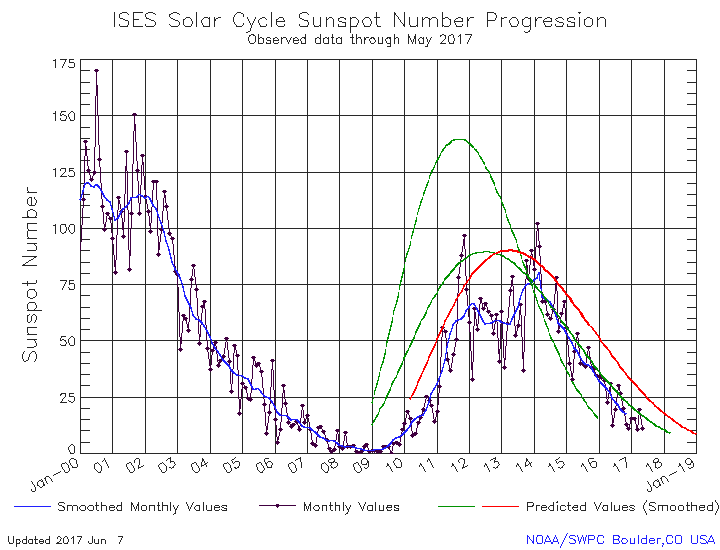
Yesterday NOAA posted its monthly update of the solar cycle, covering sunspot activity for August. That graph is posted below, with annotations.

August 2017 Solar Cycle graph

The graph above has been modified to show the predictions of the solar science community. The green curves show the community’s two original predictions from April 2007, with half the scientists predicting a very strong maximum and half predicting a weak one. The red curve is their revised May 2009 prediction.

The long slow decline to solar minimum has now shown itself. Up until now, the ramp down from solar maximum had been fast and steep, unlike past solar cycles where the ramp down is slow and steady. The last few months the ramp down had practically ceased. In this August graph the ramp down turned into a temporary ramp up. Considering the strong activity going on right now as well as the past week, I expect the September numbers to also show this increase.

None of this means that the ramp down has ended, or that we will not see a solar minimum. All it means is that it takes awhile for the Sun to slowly calm down after each solar maximum. The sunspots we are seeing right now, all near the equator, are from the solar cycle now slowly ending. We will know the minimum is coming as well as the next solar maximum when the first tiny and rare sunspots appear in high latitudes. These high latitude sunspots will belong to the next cycle, and will have reversed polarity.

2 comments

Local Democrat calls all disaffected New Hampshire voters “white supremacists”

This will win votes, I’m sure: The New Hampshire Democratic Party chairman on Sunday labeled all of that state’s rural and disaffected voters “white supremacists” and “extremists.”

The context is an effort by a conservative get-out-the-vote organization to reach out to these “disaffected” voters, and the response by the local Democratic Party head to that effort.

New Hampshire Democratic Party Chairman Ray Buckley doesn’t seem thrilled with the development, however, claiming that the disaffected voters Look Ahead will be working with are “extremists” and “white supremacists.”

“The organizing and activating of these extremists, these white supremacists, really could have a detrimental effect on the entire culture of New Hampshire,” Buckley said.

Buckley doubled down on calling these Americans “white supremacists” in a tweet on Sunday night, slamming the Koch Brothers and former Governor John Sununu for bringing Look Ahead to New Hampshire.

Essentially, the Democratic Party’s only position these days is that anyone who disagrees with them must be a “bigot,” a “racist,” a “white supremacist,” or a “Nazi.” No wonder they keep losing elections.

3 comments

First images released from Juno’s seventh close fly-by of Jupiter

Jupiter's South pole, August 2017

Cool image time! The raw images taken during Juno’s seventh close fly-by of Jupiter have been released. The image on the right, reduced in resolution to post here, was reprocessed by Gerald Eichstädt and shows the gas giant’s south polar region.

It is worthwhile comparing this with previous south pole images, as well as other images from this fly-by reprocessed by Eichstadt. I want to know whether anyone can identify specific storms and show how they have changed over time. Unfortunately, Juno’s orbit is large, and so it only drops in close every 53 days, allowing for these storms to change a great deal, and thus making it more difficult to link images of the same changing storm. Moreover, the images don’t necessarily show the same longitudes on Jupiter, making this even more difficult.

Nonetheless, to gain a real understanding of Jupiter’s atmosphere will require a clear understanding of the pace in which its storms and atmosphere change. These images might give us our first glimpse of this process.

0 comments

Senate/House budget conflicts over science and space

Link here. The article gives a good overview, from a pro-science, pro-big spending perspective, of some of the significant budget differences between the proposed House and Senate budgets for 2018.

Except for NASA’s planetary program, the House generally wants to cut more than the Senate. This once again reflects the overall political trends. Because House membership changes more frequently (its members must face the voters every two years), the positions of its membership tend to reflect more closely the wishes of the voters. The Senate meanwhile (with only one-third of its membership facing re-election every two years and with six year terms for all senators) has historically trailed behind, defending past positions that are no longer popular with the voters.

If you want to predict the political future, look at what the House proposes. The budget proposals here reflect the increasing desire of the voters to trim back the federal government. Congress (and the establishment Republican leadership) might not yet realize this, but the trends show it. Soon (I hope after 2018), the resistance by that leadership and within the Senate will break, and we shall finally see some major budget cutting.

2 comments
1 55 56 57 58 59 164