
Private company to offer tourist trips to its own facility on ISS

Capitalism in space: The private company Axiom has announced that it will offer tourist trips to its own facility it will add to ISS, and then eventually detach when the station is retired.

Axiom’s timeline has some flex, because it’s not yet clear how long the larger station will keep going, or what the assembly schedule will be for the company’s custom-built habitation module. But a weekend feature about the project in The New York Times cited 2022 as the supposed opening date.

In addition to the 10-day orbital stay, the $55 million would cover a 15-week training experience on Earth. Axiom is targeting space tourists as well as researchers and entrepreneurs who want to develop in-space manufacturing facilities.

Is this doable? Axiom isn’t yet laying out the complete logistical details, but the company will almost certainly rely on the likes of SpaceX and Boeing, which are developing space taxis for NASA’s use. Once those spaceships go into operation, sometime in the 2018-2019 period, there’s likely to be excess transportation capacity that Axiom could buy into.

This is the future of ISS, a privately run hotel. The Russians have announced a similar plan, attaching a module to ISS that will be designed as a hotel room for tourists. I expect others will eventually do the same. Once these profitable operations take hold, I guarantee that ISS will not be retired. There will be vested interests who will apply the right political pressure to keep it in orbit.

Will that be a good thing? It depends. From a taxpayer perspective, it might not be. ISS is very expensive to operate. Privately built and independent stations would be much cheaper, and would not involve any federal subsidy. At the same time, these private stations might not be doable at affordable prices in the near term. Maintaining ISS for these private companies might in this case be a very reasonably use of federal funds. As the profits rise, the companies will eventually be able to afford building their own stations that will serve their needs better than ISS. That will then be the time to retire ISS, when other private and profitable stations are there, ready to replace it.

6 comments

Walt Disney’s MultiPlane Camera

An evening pause: This was filmed in 1957, and was almost certainly made to be shown as part of Disney’s weekly television show series for kids that began in 1954 and was one of television’s most popular shows in the 1960s. It describes one of the most important technical developments in animation, developed by Disney, until the arrival of computers.

To repeat: This was made for kids, yet it is thoughtful, entertaining, educational, and quite detailed in the information being conveyed. It treats its young audience with great respect and dignity.

I generally do not watch children’s shows today, but the few that I have seen have generally been quite shallow, overwrought, and would have insulted me, when I was a child. I don’t know if today’s kids would react the same today, because when I was a child Disney’s show was somewhat typical. I expected to be treated with respect. Today’s kids might not have that expectation.

Hat tip Wayne DeVette.

4 comments

New analysis suggests Ceres has more organic molecules than previously estimated

The uncertainty of science: A new analysis of data from Dawn now suggests that the surface of Ceres has a greater percentage of organic molecules than previously estimated.

To get an initial idea of how abundant those compounds might be, the original research team compared the VIR data from Ceres with laboratory reflectance spectra of organic material formed on Earth. Based on that standard, the researchers concluded that between six and 10 percent of the spectral signature they detected on Ceres could be explained by organic matter.

But for this new research, Kaplan and her colleagues wanted to re-examine those data using a different standard. Instead of relying on Earth rocks to interpret the data, the team turned to an extraterrestrial source: meteorites. Some meteorites — chunks of carbonaceous chondrite that have fallen to Earth after being ejected from primitive asteroids — have been shown to contain organic material that’s slightly different from what’s commonly found on our own planet. And Kaplan’s work shows that the spectral reflectance of the extraterrestrial organics is distinct from that of terrestrial counterparts.

“What we find is that if we model the Ceres data using extraterrestrial organics, which may be a more appropriate analog than those found on Earth, then we need a lot more organic matter on Ceres to explain the strength of the spectral absorption that we see there,” Kaplan said. “We estimate that as much as 40 to 50 percent of the spectral signal we see on Ceres is explained by organics. That’s a huge difference compared to the six to 10 percent previously reported based on terrestrial organic compounds.”

Please note: Both estimates depend on assumptions that could easily be wrong. Ceres might have less organics, or more, than either estimate. Or somewhere in the middle. These estimates are merely educated guesses.

And remember, organic molecules does not mean life. It only means the molecules use carbon as a component.

0 comments

Contact with Opportunity lost

The Opportunity science team has lost contact with Opportunity as it automatically shuts down operations to survive low battery power due to the dust storm.

This does not necessarily mean the rover is dead. Depending on how long this period of low power lasts, the rover could return to life once the dust storm passes. Or not. We can only wait and see.

A press conference today on the dust storm and Opportunity’s status begins at 1:30 Eastern time today.

8 comments

Proposal to split California into three states makes ballot

A proposal to split California into three states has obtained sufficient signatures to be placed on the ballot in November.

Adding the proposal to the ballot is the first in a long number of steps that would be required to actually split the country’s largest state. Even if California voters supported the proposal in November, the California legislature would still have to vote in favor of it. The breakup would also likely be challenged in court and would need congressional approval, a tough get in today’s hyperpartisan Washington.

The initiative proposes the state to be split into three new states: California, Northern California and Southern California. Each state, though different in size, would have roughly the same population, according to the proposal.

I would not be surprised if the voters approve this proposal, as the state’s fascist and leftist urban areas along the coast have been making life miserable for the rest of the state. And when you treat people badly, they tend to vote against you.

Whether it can make it through the state legislature, dominated by the left, is more doubtful. It is likely the split would reduce the left’s power, and since the legislature is controlled by the left, I suspect they will not go along.

10 comments

Connecticut locks all train bathrooms because half are not ADA compliant

The coming dark age: Because of a complaint, Hartford officials have locked all bathrooms on a new train line because half are not ADA compliant.

Restrooms on half of the Hartford Line trains — those operated by the state as opposed to Amtrak — will remain closed until they are made accessible to individuals with disabilities in early 2019, the state Department of Transportation announced Tuesday. The closure comes in response to a reversed decision from the Federal Railroad Administration, which had previously granted the state a temporary exemption from the Americans for Disabilities Act, according to the DOT.

Disability Rights Connecticut, a nonprofit advocacy group for state residents with disabilities, said it filed an ADA complaint with the FRA on June 8 regarding the new commuter line, which is scheduled to open June 16.

In other words, because a small number of people are unhappy, no one can be happy. They rule, and if they don’t get what they want then no one will get anything.

5 comments

The two candidate landing sites for ExoMars2020

The June release of new images from Mars Reconnaissance Orbiter (MRO) included three images of the two candidate landing sites for Europe’s 2020 ExoMars rover mission. All three images provide us as hint at what that rover might see when it arrives a few years from now.

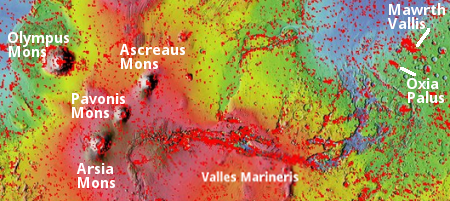
ExoMars 2020 landing sites

The two candidate sites are locations on Mars dubbed Mawrth Vallis and Oxia Palas. The map to the right shows their general location to the east of Mars’s giant volcanoes and giant canyon Valles Marineris. The red splotches indicate the large number of images taken by MRO of these locations, partly to help the ExoMars science team choose which site to pick and partly to study the geology in these Martian locations. As you can see, both candidate sites are in the transition zone between the northern low plains and the southern highlands.

At first glance Mawrth Vallis seems the more spectacular site. Mawrth (Welsh for Mars) is one of the gigantic drainage canyons near Valles Marineris. Though tiny in comparison to Valles Marineris, on Earth it would easily rival the Grand Canyon in size, and in fact is slightly longer (400 miles versus 300 miles). Unlike the Grand Canyon, however, Mawrth Vallis doesn’t appear to have a distinct or obvious rim. This video, produced by the European Space Agency using images from its Mars Express orbiter, gives a sense of the canyon’s terrain as it flies upstream from the northern lowlands to the canyon’s high point in the southern highlands. The highlands on either side of the canyon more resemble the broken geology of Mars’s chaos regions that are found scattered about in this transition zone than the flat generally level Kaibab plateau that surrounds the Grand Canyon.

Mawrth Vallis

The image on the right is a tiny crop from the most recently released MRO image. The full image shows a strip of the upper plateau south of canyon and near its inlet from the southern highlands. This crop reveals a surface that is a wild mixture of colors and complex geology. In fact, in a 2017 MRO image release showing a different place in Mawrth Vallis, the canyon was dubbed a “painted desert.” To quote that release:

The clay-rich terrain surrounding Mawrth Vallis is one of the most scenic regions of Mars, a future interplanetary park. …The origin of these altered layers is the subject of continued debates, perhaps to be resolved by a future rover on the surface. We do know that these layers are very ancient, dating back to a time when the environment of Mars was wetter and more habitable, if there were any inhabitants.

Other MRO images of Mawrth Vallis here and here emphasize this description.

As for Oxia Palas, the other candidate landing site for ExoMars 2020, in the June MRO image release there were two images.
» Read more

0 comments

Trump-Kim summit ends

The summit meeting between President Trump and North Korea’s dictator Kim Jong Un took place yesterday with much fanfare, ending with a signed agreement that did little but outline some future negotiating goals.

1. The United States and the DPRK commit to establish new U.S.–DPRK relations in accordance with the desire of the peoples of the two countries for peace and prosperity.
2. The United States and the DPRK will join their efforts to build a lasting and stable peace regime on the Korean Peninsula.
3. Reaffirming the April 27, 2018 Panmunjom Declaration, the DPRK commits to work toward complete denuclearization of the Korean Peninsula.
4. The United States and the DPRK commit to recovering POW/MIA remains, including the immediate repatriation of those already identified.

While Trump’s hard-nosed policies toward North Korea has clearly forced that nation to back away from its former bellicose positions, threatening war with everyone, we will have to wait and see if this summit really forces them to abandon their nuclear weapons and missile programs.

25 comments

California police raid home, confiscate guns, from man who tried to register AR-15

Fascist California: Police raided the home and confiscated the guns of a man who had made a sincere effort to follow new California laws requiring the registration of his AR-15.

The man also now faces a dozen felony charges.

Jeffrey Scott Kirschenmann attempted to register an AR-15 with the California Department of Justice last month but instead found himself in significant legal trouble. The California DOJ accused Kirschenmann of illegally modifying the rifle he attempted to register. Law enforcement officials raided his home in Bakersfield before ultimately confiscating a dozen firearms and a few hundred rounds of ammunition, then charging him with a dozen felonies, KGET reports. Kirschenmann was accused of possession of assault weapons, two silencers, and something referred to as a “multi-burst trigger activator.” He does not appear to have been charged with any violent crimes.

All this does is drive decent ordinary gun-owners underground. It makes them criminals for doing nothing morally wrong, and thus a target that the state can now oppress.

6 comments

Hayabusa-2 takes first photos of target asteroid Ryugu

On June 10 Hayabusa-2 took its first photos of Ryugu, the asteroid it will reach later this month.

The Sunday photos were taken when Hayabusa2 was about 930 miles (1,500 kilometers) from Ryugu. Last week, JAXA released a few ONC-T images taken on June 6, when the probe was 1,615 miles (2,600 km) from the space rock.

Hayabusa2, which launched in December 2014, is scheduled to arrive at Ryugu on or around June 27. At that time, the probe will begin orbiting the asteroid at an altitude of about 12 miles (20 km), JAXA officials have said.

Hayabusa2 will then start prepping for a series of complex, up-close studies of the space rock. If all goes according to plan, over the ensuing 12 months, the spacecraft will deploy three rovers and a lander on Ryugu’s surface, gouge out a small crater using an explosives-bearing impactor, and collect samples from the newly created crater.

The spacecraft will depart Ryugu in November or December 2019, and its collected samples will come back to Earth in a special return capsule in late 2020.

The image suggests that the asteroid is “not significantly elongated.”

0 comments
1 7 8 9 10 11 15