Bad times fall on Russian Proton rocket

Link here. The key quote is this:

All this means that after 53 years in service, the venerable Proton rocket might set an anti-record in 2018 by flying only a couple of missions. And, for the first time since its entrance onto the world market at the end of the Cold War, it may not bring any money to its cash-strapped developer.

This story confirms much of what I have been reporting about Proton and the loss of its customer base in the past three years.

0 comments

Moon Express loses lawsuit by subcontractor

Capitalism in space: Moon Express has lost a lawsuit by one of its subcontractors, who had claimed it had ceased work because the former Google Lunar X-Prize finalist had failed to pay for its work.

Intuitive Machines further claimed that Moon Express’s failure to pay harmed its business. The jury found in favor of Intuitive Machines and awarded the company $1.125 million in cash and $2.5 million in Moon Express equity related to the flight software claim. The jury also awarded Intuitive Machines $732,000 related to its work on the terrestrial return vehicle.

The importance of this story is that it suggests that Moon Express lacks sufficient capital to do what it claims. The decision further robs it of more capital.

Now it could be that Moon Express stopped paying because Intuitive Machines was not delivering good product, as Moon Express claims. The jury did not agree with this claim, however. I do wonder if the jury was sufficiently educated about the product itself.

4 comments

Amateur discovers long-dead NASA satellite has come back to life

Back from the dead: In his hunt to locate Zuma an amateur astronomer has discovered that a long-dead NASA satellite, designed to study the magnetosphere, has come back to life.

IMAGE went dead in 2005, and though NASA thought it might come back to life after experiencing a total eclipse in 2007 that would force a reboot, no evidence of life was seen then. It now appears that the satellite came to life sometime between then and 2018, and was chattering away at Earth waiting for a response. NASA is now looking at what it must do to take control of the spacecraft and resume science operations.

14 comments

Weird Martian geology: Kaiser Crater

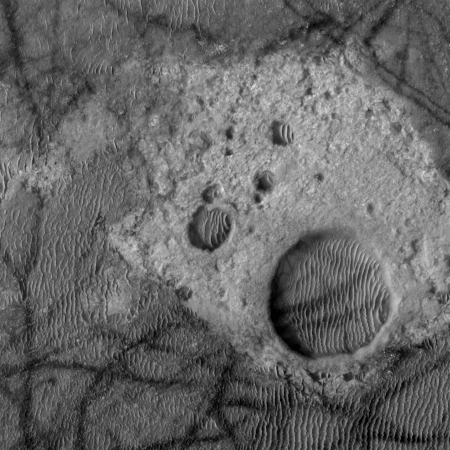
Kaiser Crater bedrock

Cool image time! This week JPL’s image site highlighted a picture taken by Mars Odyssey of the floor and dunes inside Kaiser Crater, located to the west of Helles basin in an area dubbed the Noachis Region.

To my eye, the Mars Odyssey picture was interesting, but not worth a post here on Behind the Black. However, I decided to take a look at what HiRise, the high resolution camera of Mars Reconnaissance Orbiter (MRO), had taken of the same area, just out of curiosity. A search at the master HiRise image site at the same latitude and longitude (-45 latitude, 180 longitude) showed that HiRise had imaged a part of the same area, but at much higher resolution.

When I zoomed in on this hi resolution image I came across some interesting and weird geology, cropped to show here on the right. Now this, I thought, is worth posting. Notice how the dark tracks, caused by dust devils, leave no tracks as they cut across the brighter areas. Obviously, these bright areas have no dust or sand, and are likely solid bedrock of some kind. The depressions might be craters, but they also might not. The raised area around the depressions might have been caused by the impact, or it might have been caused by some internal geological process that caused the depression while also raising the surrounding bulge. Since then the wind has been steadily depositing sand in the depressions, causing it to get trapped there.

7 comments

Forensic experts baffled about FBI claims about lost texts

They were lying: Forensic experts consider absurd the FBI claim that the texts between two anti-Trump FBI investigators were lost.

A former FBI special agent, who worked extensively on counterterrorism related cases, stated they were “dumbfounded” by the FBI’s original excuse that the text messages were irretrievable.

“Even though the servers ‘lost’ the text messages of Strzok they would still be on his actual device, even if he deleted them,” stated the former FBI special agent, who asked to speak on background due to the sensitivity of the case. “That’s how we catch bad guys, we forensically search their phones. Nothing disappears off the device, nothing… unless they take a hammer to it or microwave it. The question is, the FBI knows this, so why did the bureau say they couldn’t retrieve them – why did they mislead Congress.”

Makes sense to me. They are lying. They are trying to cover-up. And what they are lying about and trying to cover up is down-right treasonous.

27 comments

Today’s Ariane 5 launch NOT a failure

Arianespace’s first launch attempt in 2018 appears to have gotten the satellites into orbit, even though contact was lost during launch.

From the reports, it appears that contact was lost when the second stage began firing.

Before this, the Ariane 5 had completed 83 straight successful launches, a track record that Arianespace repeatedly touted as justification for its higher rates.

Update: Arianespace is now saying that though they had entirely lost contact with the rocket after the second stage fired, the satellite’s themselves reached orbit.

A few seconds after ignition of the upper stage, the second tracking station located in Natal, Brazil, did not acquire the launcher telemetry. This lack of telemetry lasted throughout the rest of powered flight.

Subsequently, both satellites were confirmed separated, acquired and they are on orbit. SES-14 and Al Yah 3 are communicating with their respective control centers. Both missions are continuing.

It appears that the SES-14 satellite can reach its planned orbit using its own engines. Al Yah 3’s status is less certain.

If these results hold up, I will then declare, for the purpose of my 2018 launch standings, that this launch is a success for Arianespace. Arianespace however will certainly not consider it so, and will need to figure out why it lost contact with its rocket and why the upper stage did not function as planned.

8 comments

Justice Dept inspector general says he has recovered missing texts

The inspector general of the Justice Department has told the pertinent congressional committees that he has recovered the missing texts between two anti-Trump FBI investigators that the FBI had claimed were lost.

In a letter sent to congressional committees, Justice Department Inspector General Michael Horowitz said his office “succeeded in using forensic tools to recover text messages from FBI devices, including text messages between Mr. Strzok and Ms. Page that were sent or received between December 14, 2016 and May 17, 2017. …Our effort to recover any additional text messages is ongoing,” Horowitz said. “We will provide copies of the text messages that we recover from these devices to the Department so that the Department’s leadership can take any management action it deems appropriate.”

Fox News has learned from U.S. government officials that the inspector general recovered the texts by taking possession of “at least four” phones belonging to Strzok and Page.

This quick recovery is proof to my mind that the initial claim by the FBI that the texts were lost was a lie. The FBI was stonewalling, and also hoping no one would push them about it, as had been the case with the Lois Lerner IRS emails that were so conveniently lost. Here, however, the people under attack are the politicians doing the investigation. They are not going to let this slide.

Expect some shocking revelations to come out in the coming weeks.

19 comments

Scientists created tiny projected 3D image using light and lasers

While the technique and result is a far cry from a projected image of Princess Leia begging for help, scientists have now been able to create a tiny but simple projected 3D image using light and lasers.

Using a barely visible violet laser controlled by mirrors, the researchers trapped a cellulose particle and moved it rapidly through space. The quickly moving mote was illuminated by other, colored lasers, making it visible. By moving the trapped particle fast enough, the researchers were able to trace out patterns in the air that, to an observer, appeared as a single image. “It’s not unlike when you have a sparkler at nighttime and you draw your name in the air,” Smalley says. “We know intellectually that it’s just one spot, but our eyes will integrate if it goes too fast.”

The researchers admit that this research is not aimed at producing 3D TV. Instead, they say its best use would be to provide 3D images of tiny difficult-to-see places, such as human internal organs that physicians might need to travel through remotely to complete a surgery. The images, provided prior to surgery, would help make that surgery safer and more reliable.

0 comments
1 142 143 144 145 146 155