NASA opens safety review of Boeing and SpaceX

Turf war! Prompted by Elon Musk’s single hit of marijuana during a podcast interview, NASA has begun a detailed safety review of both SpaceX and Boeing.

[William Gerstenmaier, NASA’s associate administrator for human exploration,] said the review would focus not on the technical details of developing rockets and spacecraft but rather the companies’ safety culture — encompassing the number of hours employees work, drug policies, leadership and management styles, whether employees’ safety concerns are taken seriously, and more.

“Is the culture reflective of an environment that builds quality spacecraft,” Gerstenmaier said. The review would be led by NASA’s Office of Safety and Mission Assurance, which has conducted similar probes inside NASA. Gerstenmaier said the process would be “pretty invasive,” involving hundreds of interviews with employees at every level of the companies and at multiple work locations.

This is a power-play, pure and simple. NASA might claim it cares about safety, but its track record suggests instead that its real motive is to prove to SpaceX that it is in charge, not SpaceX. It rankles NASA’s bureaucracy that they cannot call the shots at SpaceX, and have found themselves embarrassed by its success, compared to the agency’s continuing failures with SLS. Moreover, considering the space shuttle’s unsafe history, NASA’s safety track record and the workplace culture that produced that history is nothing to brag about.

These “invasive” interviews are guaranteed to find workplace issues that NASA will then use as a hammer to take further control SpaceX’s operations, making it less innovative, more expensive, and more bureaucratic. And I see no one in the Trump administration, including Trump, very interested in reining NASA in on these matters.

13 comments

Corruption at Vostochny included more than 140 criminal cases

A report from Russia today outlined the total amount of corruption so far uncovered by investigators at Russia’s new spaceport in Vostochny.

“Since 2014, more than 140 criminal cases have been opened, and the damage was assessed at 10 bln rubles,” Kurennoy said in an interview with the Efir Internet channel of the Russian Prosecutor-General’s Office. According to the spokesman, 50 individuals have been sentenced, and this year sentences for 27 people were announced.

The prosecutors have revealed 17,000 law violations during the construction since 2014. More than 1,000 people have been held accountable, including officials. Among the violations were delayed construction, multibillion embezzlement of state funds and the administration’s negligence.

Despite four years of investigation they still found 78 new law violations involving 140 companies in 2018.

It appears Russia does not know how to do capitalism properly. It doesn’t simply require a company to be privately owned. It also requires that new companies be allowed to compete, and that old companies can go out of business. Russia it appears did not understand these latter points. After the fall of the Soviet Union many individuals formed private companies from former government agencies and organizations, but then they divided up the market into territories and teamed up with the government to block any new entries.

The result of this corrupt system was rampant corruption, where the companies in power could do anything, with no incentive to produce good product.

Unfortunately, Russia’s answer to this has been for the government to take over the companies again.This will not solve their problem, merely shift the corruption from the companies to the government. Meanwhile, the quality of their aerospace products will continue to decline, resulting in the continued loss of international market share.

1 comment

Arianespace’s Vega rocket launches Moroccan satellite

Capitalism in space: Arianespace’s yesterday evening successfully launched Morocco’s second Earth observation satellite using its Vega rocket.

This article gives some interesting background to Morroco’s space effort.

The leaders in the 2018 launch race:

33 China
18 SpaceX
11 Russia
9 Europe (Arianespace)
8 ULA

There have now been 94 launches in 2018, the most in any single year since 1992.

3 comments

The soft landslides of Mars

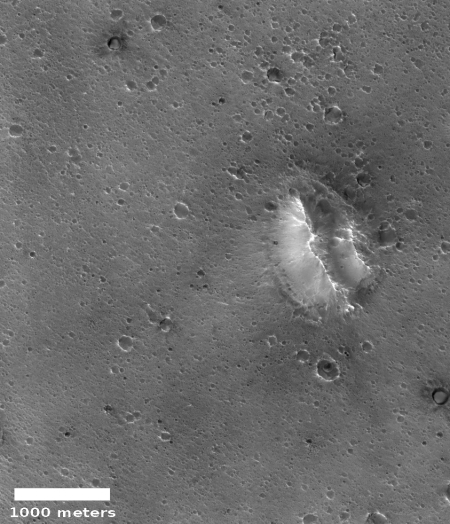
A soft avalanche on Mars

Context image of landslide

The light gravity of Mars, combined with different materials, a lot of dust, and a geological history different from Earth, produces events that — though reminiscent of similar geological events on Earth — are definitely not the same.

The image above, cropped and reduced to post here, was taken by the high resolution camera on Mars Reconnaissance Orbiter (MRO) and was one of the many uncaptioned images released in the November archive. If you click on the image you can see the full resolution version. It shows the tongue of a landslide inside a crater located in the planet’s southern highlands.

You can immediately see why I call it a soft landslide. The craters on its top are barely visible, as if they hit a soft surface that absorbed most of the impact. The grooves spreading southward in the slide suggest that this solid material flowed almost like mud. And the soft, smooth surface head of the slide suggests an almost liquid-like flow. As far as I can tell, this landslide had few large boulders. It was made up instead of small particles of about the same size.

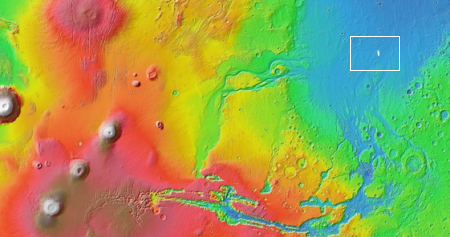
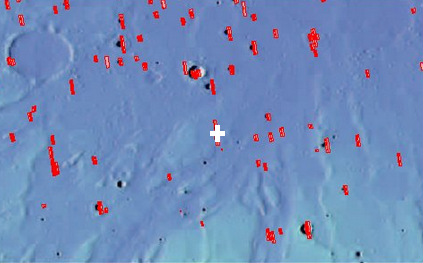
To the right is an image showing the wider context of the above image, taken by Mars Odyssey and cropped and annotated by me to post here. The white box shows the entire area photographed by the full resolution image of the landslide, with the tongue of the landslide at the bottom of the box. If you look at the floor of this crater, you can see what looks like the ghost of a past smaller impact, seemingly buried in either a field of lava or soft dusty regolith. The smoothness of the crater floor also suggests a material softness, allowing it to settle into a pondlike featureless flat plain.
» Read more

0 comments

NASA to hire private lunar probes for future missions

Capitalism in space: Rather than build its own future lunar landers and rovers, NASA is now planning to hire these services from private companies, with missions flying as soon as 2021.

Under a program called Commercial Lunar Payload Services (CLPS), NASA would buy space aboard a couple of launches a year, starting in 2021. The effort is similar to an agency program that paid private space companies such as Elon Musk’s SpaceX to deliver cargo to the International Space Station (ISS). “This a new way of doing business,” says Sarah Noble, a planetary scientist at NASA headquarters in Washington, D.C., who is leading the science side of NASA’s lunar plans.

Scientists are lining up for a ride. “It really feels like the future of lunar exploration,” says Erica Jawin, a planetary scientist at the Smithsonian Institution’s National Museum of Natural History in Washington, D.C. She and other attendees at the annual meeting of the Lunar Exploration Analysis Group in Columbia, Maryland, last week were eager to show NASA why their small experiments would be worthy hitchhikers on the landers.

Several companies, including Astrobotic, Moon Express, and iSpace, are vying to establish a commercial moon market. Buying rides to the moon from launch providers like Rocket Lab, each firm hopes to become the go-to carrier for other companies seeking to prospect the moon for rocket fuel ingredients, or to gather rocks to sell for study. But a contract with NASA is the real prize. Moon Express, for example, has designed the MX-1, a lander roughly the size and shape of Star Wars’s R2-D2. But, “We won’t pull the trigger until we know we have a CLPS award,” says Moon Express CEO Robert Richards in Cape Canaveral, Florida.

The companies selected for CLPS must deliver at least 10 kilograms of payload by the end of 2021, NASA says. It is scrambling to find instruments that are ready to fly. “What do you have sitting on shelf now that you can throw onto the mission immediately?” Noble says. “We’re looking for flight spares, engineering models, student-built projects. It’s a little bit of a weird call for us.” The agency is planning to pay up to $36 million to adapt eight to 12 existing scientific instruments to the initial small landers; by the middle of next decade it aims to build a pipeline of instruments for bigger landers that might also carry rovers.

These are going to small missions with limited lifespans and limited abilities. They will however be cheap, fast, and many. In the end I am certain NASA (and the taxpayer) will get far more bang for the buck.

2 comments

SpaceX now seeking a $250 million loan, not $500 million

Capitalism in space: SpaceX has reduced the private loan it is seeking from $500 to $750 million down to $250 million.

Goldman Sachs Group Inc. was initially canvassing investors for a $500 million deal for SpaceX. During marketing of the loan, Musk changed advisers and chose Bank of America to officially launch the deal to investors at $750 million.

The switch surprised bankers and investors, as Goldman is widely viewed as the Wall Street firm closest to Musk. It helped take Tesla Inc. public in 2010, led its $1.8 billion bond sale last year and advised Musk on his short-lived attempt to take the electric carmaker private for $420 a share Goldman balked when SpaceX, a first-time issuer, wanted wide latitude to raise additional debt in the future, people with knowledge of the matter said earlier this month.

The loan isn’t the only way Musk has been trying to raise cash with SpaceX, which was founded in 2002 and last valued at about $28 billion. He also recently inquired with at least one bank about a personal loan tied to his stake in the rocket company, a person with knowledge of the matter said earlier this month.

It seems to me that Musk is acting here in a manner that will allow him to maintain as much independence as possible, a very wise approach.

0 comments

New Wolf-Rayet star discovered 8,000 light years away

Astronomers have discovered a Wolf-Rayet star — the kind of star thought to eventually cause major explosions — 8,000 light years away.

The binary star system, containing a pair of massive ‘Wolf-Rayet’ stars, has been discovered by an international team of researchers, including Professor Paul Crowther from the University of Sheffield, and published in Nature Astronomy.

Wolf-Rayet stars are amongst the hottest stars in the Universe, blast out powerful winds of hot gas, and represent the last stage in the evolution of the most massive stars prior to exploding as a supernova.

Located around 8,000 light years away – half a billion times further away than our Sun – the binary system is surrounded by a gigantic dust cloud. The collision between the winds of the two stars can form dust, which takes on elegant spiral pinwheel shapes as the stars orbit each other.

Expect to see a number of news articles hinting at how this system is a deadly threat to Earth. It is not. For one thing, it is too far away for any supernovae or gamma ray burst to cause serious harm here. Second, it will be a long time before any of that is going to happen.

Wolf-Rayet stars however are rare, and being able to study them helps astronomers better understand the life and death of stars. Having another so relatively close is a boon to astronomers.

0 comments

New cost figures for Space Force

A budget analysis by a Washington think tank has proposed a new range of cost figures for a Defense Department unit devoted to space operations.

Todd Harrison, director of defense budget analysis and senior fellow at the Center for Strategic and International Studies, unveiled a highly anticipated report on Monday, detailing cost estimates for standing up a Space Force as a separate military branch. Harrison made headlines in September when he criticized Air Force Secretary Heather Wilson’s estimate — $13 billion over five years to establish a new service and a space command — as overinflated.

Harrison estimated it would cost the Pentagon an additional $1.5 billion to $2.7 billion over five years to stand up a new service, based on the assumption that more than 96 percent of the cost would be covered from existing budget accounts within DoD. Harrison’s numbers, however, are hard to compare directly with the Air Force secretary’s because they do not include costly items that Wilson put into her proposal, such as a Space Command and additional programs and people she argued would be needed to fight rising space rivals China and Russia.

Harrison laid out cost numbers for three options — a Space Corps, a Space Force Lite and a Space Force Heavy. The total annual budget of the new service would range from $11.3 billion to $21.5 billion under the three options. None includes the National Reconnaissance Office whose size and budget are classified.

These options are a much more realistic analysis of the costs for a military reorganization of its space operations. For example, most of the money for these options is already being spent, with the cheapest option including $11 billion of its $11.3 billion cost figure from present allocations.

I however now ask: Why are we spending $11 billion for offices in the Pentagon, with staffing exceeding 27,000? From what I can gather, these budget numbers do not appear to include the cost for any actual military satellite launches. It seems to me this should be doable with far fewer people, especially if the Pentagon is hiring private companies to build the satellites themselves.

2 comments

Soyuz launch failed pinned to “unintentional error”

The Russian investigation into the October 11 Soyuz launch abort has said that the failure of the valve to open was likely caused by an “unintentional error.”

The abortive launch of a Soyuz-FG carrier rocket in early October might have been caused by an unintentional error made during the rocket’s assembly at the Baikonur space center, head of Russia’s space agency Roscosmos Dmitry Rogozin said on Monday.

“There are two cranes there [in the assembly shop]. Probably they did something wrong. Most likely it was an unintentional error but we are looking at all possibilities,” he said, adding that neither of the shop’s workers has been suspended from work as of now, since it is up to law enforcement agencies to identify those responsible.

I remain very confident Roscosmos will figure out what went wrong and address the specific issue that caused it. I also remain very confident Roscosmos will do little to change the culture that is causing these repeated unforced errors and technical failures throughout their entire space industry. There is no competition right now within Russia’s space industry. Everything functions at the will of government policy and power politics, a very bad system for discouraging poor workmanship.

1 comment

Musk renames BFR

He must be reading BtB! Elon Musk today revealed new names for the two stages of his Big Falcon Rocket rocket, Super Heavy for the reusable first stage and Starship for the reusable orbiting second stage.

These are much more inspiring and saleable names. They also do not preclude SpaceX from giving each individual Super Heavy and Starship their own names as well, since these names apply to the class of rocket, not the ships themselves.

4 comments

China successfully completes another launch

China successfully launched five satellites yesterday using its Long March 2D rocket.

The main payload is apparently a military surveillance satellite.

The leaders in the 2018 launch race:

33 China
18 SpaceX
11 Russia
8 ULA
8 Europe (Arianespace)

China has widened its lead on the U.S. to 33 to 31. There have also been 93 successful launches this year, which ties 2014 for the most in the 21st century. My count of the number of future launches so far announced suggests that there will be about 110 launches total in 2018, the highest number since 1990, the year before the fall of the Soviet Union.

0 comments
1 13 14 15 16 17 155