Dust storms spotted on Titan

Scientists reviewing Cassini data have identified dust storms for the first time of Saturn’s moon Titan.

When Rodriguez and his team first spotted three unusual equatorial brightenings in infrared images taken by Cassini around the moon’s 2009 northern equinox, they thought they might be the same kind of methane clouds; however, an investigation revealed they were something completely different. “From what we know about cloud formation on Titan, we can say that such methane clouds in this area and in this time of the year are not physically possible,” said Rodriguez. “The convective methane clouds that can develop in this area and during this period of time would contain huge droplets and must be at a very high altitude — much higher than the 6 miles (10 kilometers) that modeling tells us the new features are located.”

The researchers were also able to rule out that the features were actually on the surface of Titan in the form of frozen methane rain or icy lavas. Such surface spots would have a different chemical signature and would remain visible for much longer than the bright features in this study, which were visible for only 11 hours to five weeks.

In addition, modeling showed that the features must be atmospheric but still close to the surface — most likely forming a very thin layer of tiny solid organic particles. Since they were located right over the dune fields around Titan’s equator, the only remaining explanation was that the spots were actually clouds of dust raised from the dunes.

Obviously there are large uncertainties here. Nonetheless, the conclusion is a reasonable one, as it is expected that such dust storms would occur on Titan.

Posted just outside Zion National Park in the town of Springdale.

0 comments

Greenhouse in Antarctica survives winter for 1st time

A greenhouse in Antarctica that is partly maintained remotely from Germany has survived through the polar winter for the first time.

Regularly withstanding temperatures below minus 40 degrees Fahrenheit (minus 40 degrees Celsius), the greenhouse provided herbs, lettuce and other vegetables to 10 people who were riding out the winter in the remote station, called the Alfred Wegener Institute’s Neumayer Station III. It’s the first time the greenhouse operated through the winter. “After more than half a year of operation in Antarctica, the self-sufficient greenhouse concept appears to be effective for climatically demanding regions on Earth, as well as for future manned missions to the moon and Mars,” DLR officials said in the statement.

“The harvests are now so plentiful that some of it does not always make it straight to the table, and we now have the luxury of spreading out our consumption of some refrigerated lettuce and herbs over several days,” Paul Zabel, a DLR researcher who works with EDEN ISS, said in the statement. “The overwintering team members are always looking forward to their next fresh meal.”

From a space exploration perspective, the most interesting aspect of this story is that, when the weather was too hostile for its Antarctic maintainer to reach it, the greenhouse was then maintained remotely from Germany, for up to three consecutive days. Clearly hands-on maintenance is necessary for such a facility, but to design it so that remote maintenance can occur is a technical capability that space-colonists are definitely going to want to have.

5 comments

On the road

My previous post was written from Flagstaff, Arizona, where Diane and I are temporarily stuck. Yesterday we had planned to drive to Zion for a week of hiking and sightseeing. South of Flagstaff the car overheated when all the antifreeze leaked out from below. Calls to insurance got a tow truck, which got us and the car to Flagstaff. Hopefully it will be fixed quickly and we will head out to Zion later today.

During this unplanned adventure I could not help wonder at how, in this case, satellites and smart phones have made life much better. In the past getting stranded on the side of the road in a remote place could mean hours of waiting. Unless the highway patrol saw you you had no way of contacting anyone. Yesterday however we immediately called our insurance’s roadside assistance, who arranged a tow truck. I then used the car GPS to local a hotel in Flagstaff near the car repair place and then used the phone to call them to make reservations. We were at the hotel, with the car in the shop, only two and a half hours after we had been forced to pull off to the side of the road. And we did this from a spot on the interstate miles from anything.

If only smart phones did not come with other baggage. Sadly they do, since no gain is ever truly one-sided. One must take the good with the bad, while trying to minimize the bad as much as possible.

Posting shall continue all week, though the timing might be different than normal.

4 comments

Bill increases funding to FAA space office, adds other provisions

A bill about to be approved by Congress increases funding to the FAA Office of Commercial Transportation while also requiring that office to create several new regulatory positions.

The bill authorizes a significant increase in spending for the FAA’s Office of Commercial Space Transportation, or AST, from the $22.6 million it received in fiscal year 2018 to a little more than $33 million in 2019, growing to nearly $76 million in 2023. Appropriators, though, have not matched that authorized increase for 2019, with House and Senate versions of spending bills funding the FAA offering just under $25 million for AST.

The reauthorization bill includes several policy provisions associated with commercial spaceflight as well. One would require the FAA to designate an official within its air traffic organization to serve as the single point of contact for working with the head of AST on airspace issues associated with commercial launch activity.

Another provision establishes an “Office of Spaceports” within AST intended to support commercial licensing of launch sites and develop policies to promote infrastructure improvements at such facilities. It also requires AST to develop a report within one year of the bill’s enactment on spaceport policies, including recommendations on government actions to “support, encourage, promote, and facilitate greater investments in infrastructure at spaceports.” It directs the Government Accountability Office to prepare a separate report on ways to provide federal support for spaceports.

The bill creates a category of commercial spaceflight vehicles known as “space support vehicles” that cover parts of launch vehicles systems flying for other purposes, such as training or testing. Such vehicles would include the aircraft used by air-launch systems. The bill allows commercial flights of space support vehicles without the need for a full-fledged airworthiness certificate from the FAA.

It is hard to say if these provisions will help or hurt the growth of commercial space. It does appear that Congress’s goal was to help, but their methods always include more spending and greater bureaucracy.

The article also reviews a number of bills not yet agreed to by Congress that would address the regulation of Earth observation satellites as well as satellite servicing. It quotes a number of industry experts supporting the laws being proposed, but once again, it is unclear if those laws would help or hurt. My previous review of one of these laws presently working its way through the House was decidedly mixed. It will clarify and simplify many of the regulatory problems that presently exist, while creating more bureaucracy.

1 comment

Japan successfully launches unmanned cargo ship to ISS

Japan today used a Mitsubishi H-2B rocket to successfully launch an unmanned cargo ship to ISS.

The cargo ship will take five days to rendezvous and dock with ISS. Its most interesting piece of cargo is a small capsule with a heat shield, designed to return experiment samples to Earth.

JAXA says the the capsule has an internal volume of about 30 liters, and astronauts could load up to 44 pounds (20 kilograms) of specimens inside the landing craft, which features a thermos-like container to store refrigerated biological samples. That is a fraction of the carrying capacity of the Dragon capsule, but the new HTV Small Return Capsule will offer station managers a new way to make sure time-critical items can return to Earth for analysis.

Astronauts will assemble the return capsule after the HTV arrives at the station, and mount it into position over the HTV’s forward hatch for deployment once the supply ship leaves the station.

The capsule, which carries no engines of its own, will jettison after the HTV completes its deorbit burn. The re-entry craft will deploy a parachute and splash down in the Pacific Ocean, where recovery teams will retrieve it and bring it back to Japan for inspections.

The leaders in the 2018 launch race:

25 China
16 SpaceX
8 Russia
7 ULA
5 Europe (Arianespace)
5 Japan

For Japan to be tied with Europe this late in the year either indicates that Europe is sagging, or Japan is growing. I suspect it is partly both. In the national rankings China still leads the U.S. 25 to 24.

9 comments

Minerva probes send back first pictures

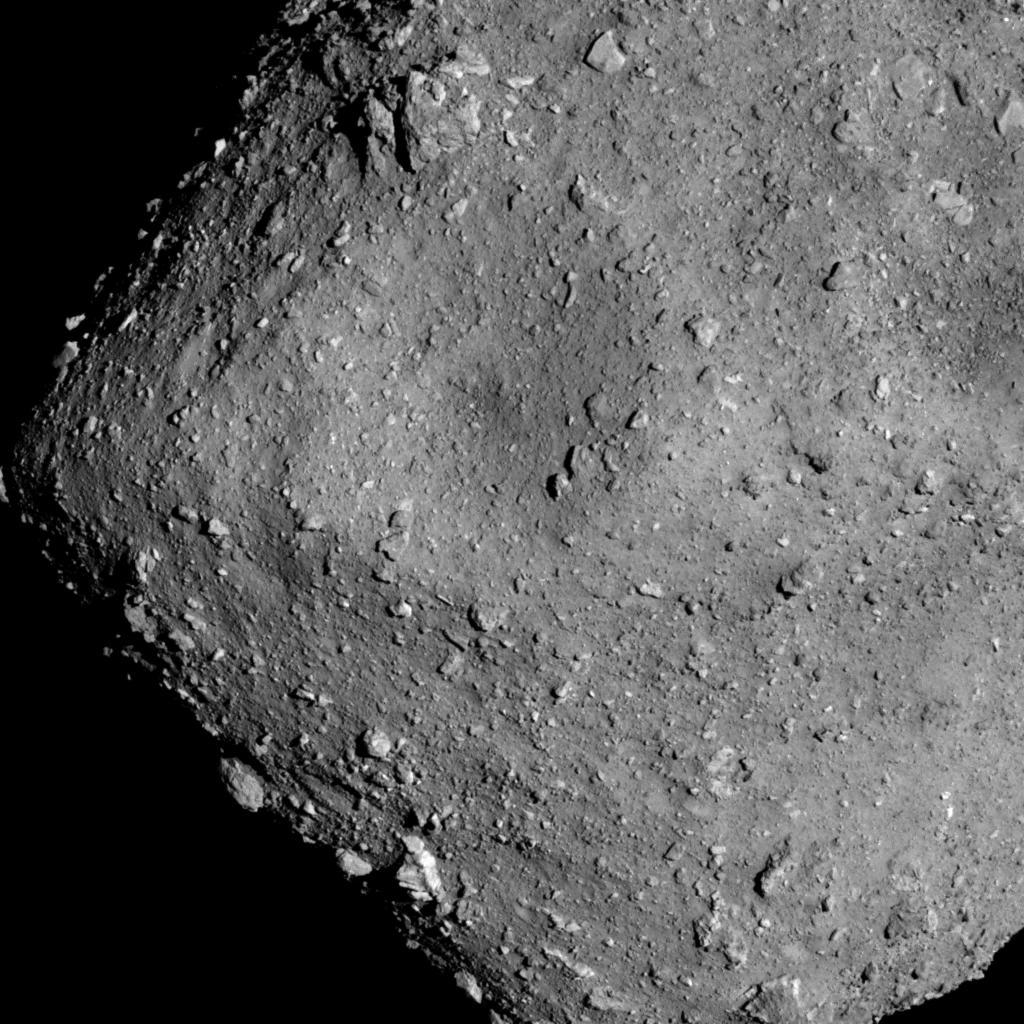
Ryugu's surface

Super cool images! The two Minerva probes released two days ago from Hayabusa-2 have both sent back spectacular images from the surface of Ryugu.

The image on the right was captured by the rover dubbed 1A. I have rotated it to show the surface on the bottom, but the actual picture was taking during one of the rover’s bounces while it was moving, so the returned picture had the surface on left. The white brightness is from sunlight. From the press release:

We have confirmed both rovers landed on the surface of asteroid Ryugu. The two rovers are in good condition and are transmitting images and data. Analysis of this information confirmed that at least one of the rovers is moving on the asteroid surface.

MINERVA-II1 is the world’s first rover (mobile exploration robot) to land on the surface of an asteroid. This is also the first time for autonomous movement and picture capture on an asteroid surface. MINERVA-II1 is therefore “the world’s first man-made object to explore movement on an asteroid surface”. We are also delighted that the two rovers both achieved this operation at the same time.

Other released images were taken just after release. One shows a blurred picture of Hayabusa-2, while the other sees Ryugu’s surface below.

Both of these rovers are designed to travel on the surface by a series of hops, taking advantage of Ryugu’s tiny gravity. There will be more images I’m sure from them in the coming days.

0 comments

Democrats have abandoned the presumption of innocence

Link here. As I’ve said numerous times in the past year, they’re coming for you next. As carefully documented in the article, no longer does the Democratic Party believe that everyone should be innocent until proven guilty. Now their standard is everyone who opposes their agenda is automatically guilty of any crime any Democratic Party supporter lodges against them.

Any accusation must be accepted, no matter how flimsy, unprovable, or blatantly partisan. If a Democrat says you are guilty of any crime, your career must be ruined and you must be hounded from public life.

Meanwhile, if a Democrat such as Keith Ellison in Minnesota, presently running for that state’s attorney general, is creditably accused of abusing his girlfriend, with good documentary evidence to back up the accusation, we must ignore it completely. All Democrats are always innocent, and any attempt to make them accountable for anything they do is unacceptable.

If we the public accept this standard, the American experiment in democracy is dead. The Democrats will have an endless and unchallengeable veto on everything.

117 comments

Historian discovers long-lost original of Galileo letter

An historian doing different research in the library of Great Britain’s Royal Society has accidentally discovered a long-lost original of a letter by Galileo that might clarify the events surrounding his eventual trial with the Inquisition.

The seven-page letter, written to a friend on 21 December 1613 and signed “G.G.”, provides the strongest evidence yet that, at the start of his battle with the religious authorities, Galileo actively engaged in damage control and tried to spread a toned-down version of his claims.

The question that has been bothering historians for hundreds of years is whether the letter, used as evidence against Galileo during his inquisition trail, was doctored by the inquisition or Galileo. During the trial Galileo presented a milder version that he claimed was the original. This original, with corrections in Galileo’s hand, suggests it was he that did the rewrite.

The story of how postdoctoral student from Italy, Salvatore Ricciardo, found it in a British library however is as interesting:

Ricciardo uncovered the document when he was spending a month this summer touring British libraries to study any handwritten comments that readers might have left on Galileo’s printed works. When his one day at the Royal Society was finished, he idly flicked through the online catalogue looking for anything to do with Castelli, whose writings he had recently finished editing.

One entry jumped out at him — a letter that Galileo wrote to Castelli. According to the catalogue, it was dated 21 October 1613. When Ricciardo examined it, his heart leapt. It appeared to include Galileo’s own signature, “G.G.”; was actually dated 21 December 1613; and contained many crossings out. He immediately realized the letter’s potential importance and asked for permission to photograph all seven pages.

“Strange as it might seem, it has gone unnoticed for centuries, as if it were transparent,” says Giudice [Ricciardo’s doctoral supervisor]. The misdating might be one reason that the letter has been overlooked by Galileo scholars, says Giudice. The letter was included in an 1840 Royal Society catalogue — but was also misdated there, as 21 December 1618.Another reason might be that the Royal Society is not the go-to place in the United Kingdom for this type of historical document, whose more natural home would have been the British Library.

The historians are now trying to trace how long the letter has been in the Royal Society library, and how it arrived there. They know that it has been there since at least the mid-eighteenth century, and they have found hints in old catalogues that it might even have been there a century or more earlier. The researchers speculate that it might have arrived at the society thanks to close connections between the Royal Society and the Academy of Experiments in Florence, which was founded in 1657 by Galileo’s students but fizzled out within a decade or so.

1 comment

Russia considering getting out of Gateway

The new colonial movement: In expressing a desire not to play a secondary role in its next space station, Roscosmos head Dmitry Rogozin said today that Russia might pull out of its partnership with NASA in building its Gateway lunar station.

Russia agreed last year to work with the U.S. National Aeronautics and Space Administration (NASA) on plans for the moon-orbiting Deep Space Gateway, which will serve as a staging post for future missions.

But the head of Russian space agency Roscosmos, Dmitry Rogozin, said Russia might exit the joint program and instead propose its own lunar orbit space station project. “The Russian Federation cannot afford to play the second fiddle role in it,” he was quoted as saying by the RIA news agency, without much further elaboration.

A spokesman for Roscosmos said later that Russia had no immediate plans to leave the project.

Russia’s problem is that they simply don’t have the cash to build their own lunar station. They could build a new station of their own in Earth orbit, and that might be what they end up doing. In fact, based on the knowledge they gained from both Mir and ISS, they might be able to design that station for short interplanetary flights, such as to the Moon and back, once built.

If I was Rogozin, that is exactly what I would do. Get out of NASA’s boondoggle, and build something in Earth orbit that will really demonstrate interplanetary travel.

4 comments

Robert DeMayo – The Star Spangled Banner

An evening pause: DeMayo does not sing the anthem, but interprets it using American Sign language. I am posting this now, in defiance of the new NFL season, with its spoiled million dollar football players spitting on this country and its freedoms that made them rich.

Stay with it. If you watch closely you will begin to understand the sign language, and the power of the song’s words will then start to hit you, in a new way.

Hat tip Wayne DeVette.

10 comments

Mountains on the Moon

Mountains on the Moon

Cool image time! The image on the right, reduced slightly to post here, shows several high mountains on the far side of the Moon. If you click on the image you can see it at full resolution.

The summit of the unnamed peak in the foreground (50.2° S, 236.6° E) has an elevation of 6710 meters, about 7000 meters (about 23,000 feet) of relief relative to the low point at the bottom of the image. The two peaks on the horizon, 200 kilometers in the distance (about 125 miles), have summit elevations of 4320 meters (14,200 feet) and 4680 meters (15,350), respectively and both rise more than 6000 meters (almost 20,000 feet) above their surroundings.

In the Lunar Reconnaissance Orbiter (LRO) science team release in June, they noted that the high peak here is actually taller than Denali (Mount McKinley), the highest peak within the U.S. And it has no name. They also note that the peak is likely 4 billion years old, and has experienced extensive erosion in that time, meaning that it is also likely shorter than it once was.

I don’t have anything to add, other than this would be an amazing place to put up a resort, with trails taking you to the top of the mountains. In the lighter gravity, the hike would actually be somewhat easy, even wearing a spacesuit. And you wouldn’t have to worry about a thinning atmosphere as you climbed higher, as you do on Earth. You’d be carrying it with you.

5 comments
1 40 41 42 43 44 155