Mars rover update: July 17, 2018

Summary: Curiosity climbs back up onto Vera Rubin Ridge to attempt its second drillhole since drill recovery, this time at a spot on the ridge with the highest orbital signature for hematite. Opportunity remains silent, shut down due to the global dust storm.

For a list of past updates beginning in July 2016, see my February 8, 2018 update.

Curiosity

Curiosity's travels on and off Vera Rubin Ridge

For the overall context of Curiosity’s travels, see Pinpointing Curiosity’s location in Gale Crater.

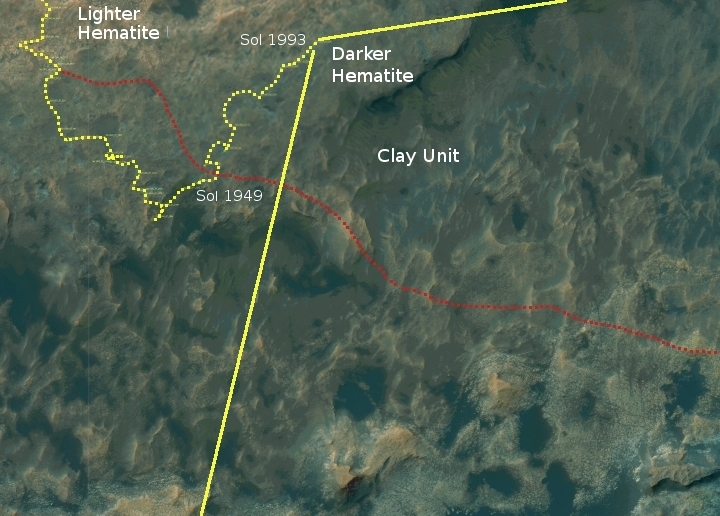
In the almost two months since my May 23, 2018 update, a lot has happened, much of which I covered in daily updates. Curiosity found a good drill spot to once again test the new drilling techniques designed by engineers to bypass its stuck drill feed mechanism, and was successful in getting its first drill sample in about a year and a half. The rover then returned uphill, returning to a spot on Vera Rubin Ridge that, according to satellite data, has the highest signature for hematite on the entire ridge. The light green dotted line in the traverse map to the right shows the route Curiosity has taken back up onto Vera Rubin Ridge. The red dotted line shows the original planned route off the ridge and up Mount Sharp.
» Read more

3 comments

On the radio

Tonight I will have two radio appearances. First my normal twenty minute John Batchelor Show appearance will be structured somewhat differently. Instead of reviewing the space news for the past few days, we will be focused entirely on reviewing NASA’s seeming effort to slow commercial space down, so as to reduce the embarrassment to SLS as well as benefit Boeing.

The idea will be that we will make believe that I am giving a briefing to Mike Pence and the National Space Council, explaining in detail why NASA actually seems hostile to getting anything done. It is our hope that maybe someone in the administration might hear it, and rethink the Trump space policy.

Then, beginning at 7 pm (Pacific), I will be doing another live two hour appearance on The Space Show with David Livingston. I am sure the same subject will come up, along with other things. Feel free to call in to ask questions. David does not screen his calls, so this is your opportunity to ask me anything.

0 comments

Astronomers discover 10 more Jupiter moons

Worlds without end: Astronomers, while searching for objects in the Kuiper Belt, have discovered 10 more Jupiter moons.

All the newfound moons are small, between about 1 and 3 kilometres across. Seven of them travel in remote orbits more than 20 million kilometres away from Jupiter, and in the opposite direction from the planet’s rotation. That puts them in the category known as retrograde moons.

The eighth moon stands out because it travels in the same region of space as the retrograde moons, but in the opposite direction (that is, in the same direction as Jupiter’s spin). Its orbit is also tilted with respect to those of the retrograde moons. That means it could easily smash into the retrograde moons, pulverizing itself into oblivion. It may be the leftovers of a bigger cosmic collision in the past, Sheppard says.

Jupiter’s moons are named after gods with connections to the mythological Jupiter or Zeus. Sheppard has proposed naming the oddball Valetudo, after one of Jupiter’s descendants, the Roman goddess of hygiene and health.

The ninth and tenth newfound moons orbit closer to Jupiter, moving in the same direction as the planet.

I predict that these are not the last moons of Jupiter to be discovered. As our observing skills improve, more are certain to pop up.

6 comments

Lockheed Martin key investor in Rocket Lab

Capitalism in space: In this article about how Lockheed Martin and a smallsat rocket company have won launch development contracts from the British government in connection with the UK’s first spaceport in Scotland was this tidbit of information I have never known:

Lockheed Martin and Orbex, a UK-based company development a small satellite booster, have announced their intention to launch from Sutherland. Lockheed Martin will receive £23.5 million ($31.1 million) and Orbex will get £5.5 million ($7.3 million) from the U.K. Space Agency to advance work on their launcher programs.

The British government, Lockheed Martin and Orbex made their announcements at the Farnborough International Airshow.

Lockheed Martin is reportedly interested in launching a variant of Rocket Lab’s Electron booster from the Sutherland site. The U.S. aerospace contractor is a strategic investor in Rocket Lab, which already operates an orbital spaceport in New Zealand, and is planning to develop a U.S. launch pad for the Electron vehicle, which has made two test flights to date. [emphasis mine]

It sounds as if Lockheed Martin, after funding Rocket Lab and letting it do all the initial risky development, is now moving in to use its vast resources to develop its own competitive smallsat rocket, possibly using some of the knowledge gained by Rocket Lab.

Hat tip reader Steve Golson.

1 comment

India tests upgraded rocket engine

The new colonial movement: India’s space agency ISRO has successfully tested an upgraded version of the Vikas rocket engine it uses in its PSLV and GSLV rockets.

The test was conducted on Sunday, and validated the performance adequacy of Vikas Engine to be used in the upcoming second developmental flight of GSLV Mk-III

Vikas Engine, a workhorse liquid rocket engine designed by the Indian Space Research Organsiation (ISRO), powers the second stage of Polar Satellite Launch Vehicle (PSLV) of India. It also powers the second stage and the fourth strap of Geosynchronous Launch Vehicle (GSLV) and the twin-engine core liquid stage (L110) of GSLV Mk-III.

Essentially India here is doing what SpaceX did with its Merlin engine. Rather than start over with a new engine, they are upgrading it, a process that is faster and less expensive. And as they do it, they remain operational and competitive in the launch market, with as many as five launches now scheduled before the end of 2018.

1 comment

ArianeGroup successfully tests solid rocket booster

Capitalism in space: ArianeGroup today successfully tested the solid rocket booster that it will use on both its Ariane 6 and Vega-C rockets in the 2020s.

The test success is good news for ArianeGroup, but this quote is actually more significant:

A compromise reached in May by European Space Agency members funding launch vehicle development will keep production of the P120C in Italy, allowing Avio to produce up to 35 boosters annually. A previous arrangement would have split production between Colleferro, Italy-based Avio and MT Aerospace of Augsburg, Germany.

The economies of scale provided by using the same booster for two rockets and concentrating production in one place are a key aspect of reducing the price for Ariane 6 missions by 40 to 50 percent compared to the Ariane 5 in use today.

Faced with stiff competition from SpaceX, the European Space Agency (ESA) gave ArianeGroup the power to structure operations more efficiently rather than cater to the pork desires of the agency’s many member nations.

Whether either Ariane 6 or Vega-C can compete with SpaceX’s reusuable rockets however remains doubtful. I expect that almost all of ArianeGroup’s customers in the next decade will be ESA member nations, required to buy its more expensive services.

5 comments

A weird lunar lava field

Weird terrain at Ina on the Moon

Cool image time! The image on the right, reduced and rotated 180 degrees to post here, comes from a recent release for Lunar Reconnaissance Orbiter (LRO). It shows a flow of lava that partly covers an older terrain.

Some scientists propose that Ina formed as very young (less than 100 million years) volcanic eruptions because only a few larger impact craters (>20 m) have formed on its surface. Others believe it is quite ancient (3.5 billion years), possessing highly unusual physical properties that stifle the formation of normal impact craters. At least everybody agrees it was formed as basalt was erupted to the surface! But how and when Ina formed remains open.

Ina’s morphology is so unusual that it is easy to see inverted topography – that is, craters appear as bubbles rather than bowls! Think of Ina as a cast iron frying pan with freshly poured pancake batter; the wiggly textured material is the frying pan and the bulbous smoother mounds are the batter.

The image to the right has been rotated 180 degrees so that my mind at least can see it with the craters as bowls and the uplifted smooth lava as uplifted. If this doesn’t work for you, click on the link and look at the original image.

While some scientists think the lava flows are recent, no one knows at present the origins of the rougher terrain that the lava has partly obscured.

6 comments

The federal black hole of lost nuclear bomb material

Link here. Key quote:

Unlike civilian stocks, which are closely monitored by the Nuclear Regulatory Commission and openly regulated – with reports of thefts or disappearances sent to an international agency in Vienna — the handling of military stocks tended by the Department of Energy is much less transparent.

The Energy Department, which declined comment for this story, doesn’t talk about instances of lost and stolen nuclear material produced for the military. It also has been less willing than the commission to punish its contractors when they lose track of such material, several incidents suggest.

As much as six tons of nuclear material is recorded as missing and unaccounted. Worse,

Regarding transfers to academic researchers, government agencies, or commercial firms within the United States, the Energy Department’s inspector general concluded in 2009 –the most recent public accounting – that at least a pound of plutonium and 45 pounds of highly-enriched uranium loaned from military stocks had been officially listed until 2004 as securely stored, when in fact it was missing.

The most important point made by the article is that the federal government imposes no consequences on anyone in the government who screws up in this matter. In fact, the article cites examples where the incompetent were given awards afterward. Meanwhile, this same federal government has punished private contractors very severely for similar mishaps.

This really is par for the course. The federal government today is terribly run, and those in charge routinely get away with being incompetent, and often get bonuses for being so. If we had any sense, we’d shut it down, firing everyone. We could quickly hire new people and get things done better.

4 comments

Boeing puts foam insulation on one SLS tank

My heart be still: Asked by NASA management to pick up the pace, Boeing managed to put foam insulation on one of the SLS oxygen tanks in less than two weeks.

The reason NASA wanted to pick up the pace? In May contamination had been found in the system’s supply lines.

“The prime contractor determined the vendor was not fully cleaning the tubes and it was leaving residue in the tubes,” McErlean said. “This was retained as a requirement in the prime contractor’s spec, but it was not properly carried out.” Boeing is the prime contractor for the SLS core stage, but he did not disclose the vendor who provided the contaminated tubing.

The contamination was initially found in a single tube, he said, but later checks found similar residue in other tubes. All the tubing in the core stage is now being inspected and cleaned, a process he said is not straightforward because of the “mass of tubing” in the engine section and also because cleaning is a “non-trivial process.”

In reading the first link above, however, I do not get the sense that things with SLS are really moving quickly. Instead, I get, as I have for this entire project, the sense that the pace is designed to proceed at a glacial pace. Thus, when they need to get things done more more quickly, they can easily do so. Whether that increased speed is really fast, however, remains to me quite questionable.

Note: My appearance tomorrow night on the John Batchelor Show will be focused entirely on NASA’s effort to slow commercial space down, so as to reduce the embarrassment to SLS. I am going to make believe I am giving a briefing to Mike Pence and the National Space Council, explaining in detail why NASA actually seems hostile to getting anything done.

It is our hope that maybe someone in the administration might hear it, and rethink the Trump space policy.

6 comments

United Kingdom picks location in Scotland for spaceport

The British government, after years of study, has chosen a location in northern Scotland for its first homegrown spaceport.

In a statement issued in advance of the start of the Farnborough International Airshow, the U.K. Space Agency said it will provide initial funding of 2.5 million pounds ($3.3 million) to begin development of a vertical launch site in Sutherland, on the Atlantic coast in northern Scotland.

In its announcement, the agency said it selected the site “because Scotland is the best place in the U.K. to reach highly sought-after satellite orbits with vertically launched rockets.” The site would allow launches to the north, supporting spacecraft operating in sun-synchronous or other highly inclined orbits.

The announcement gave few details about the facility or indicated what company, or companies, would use it, but noted launches would begin there in the early 2020s. More information is expected to be announced July 16 at the air show.

This announcement contradicts a 2016 policy decision that had instead opened up spaceport licensing to whatever location wished to do it. Now the British government appears to have stepped in and picked this one site, though the article also says they are considering a second site for horizontal launches, using such systems as the Pegasus rocket, Stratolaunch, and LauncherOne.

5 comments
1 72 73 74 75 76 155