Firefly inks big launch contract

Capitalism in space: The smallsat rocket company Firefly has signed a launch contact with an Italian satellite company to launch 15 of its satellites.

Firefly Aerospace Inc. has agreed to provide an Italian company 15 rides to space over a five-year period, the Cedar Park startup announced March 4. The agreement enables D-Orbit SpA to purchase room on future flights of Firefly’s Alpha rocket. The deal allows the Italian satellite company to “purchase, market and resell launch vehicle capacity, and to provide logistics support and integration activities at its operational premises in Italy,” according to the announcement.

I am certain that D-Orbit has options to back out and sign with other rocket companies should Firefly fall behind in its development of Alpha, which they say will have its first launch before the end of this year. Nonetheless, this contract bodes well for the company, as it indicates that others have faith in them.

0 comments

Sunspot update February 2019: The Sun flatlines again

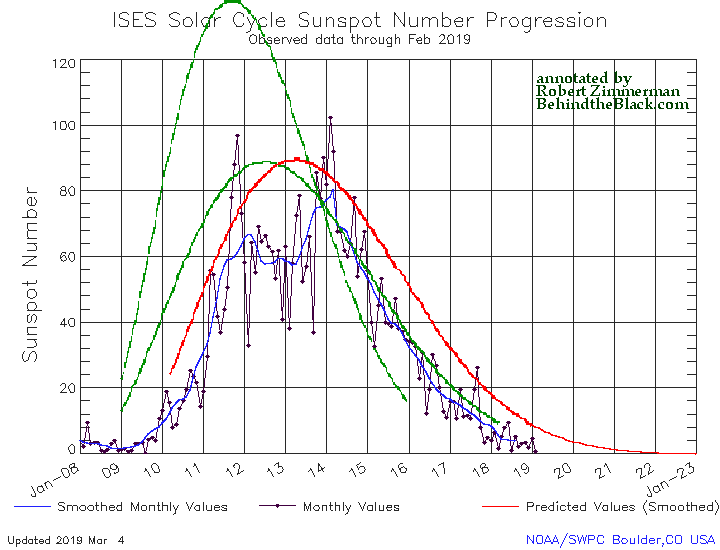
We are now deep into solar minimum. On Sunday NOAA released its the monthly update of the solar cycle, covering sunspot activity for February 2019. As I have done every month since the start of Behind the Black, I am posting it below, annotated to give it some context.

February 2019 sunspot activity

The graph above has been modified to show the predictions of the solar science community. The green curves show the community’s two original predictions from April 2007, with half the scientists predicting a very strong maximum and half predicting a weak one. The red curve is their revised May 2009 prediction.

For the second time since the beginning of the solar minimum last year, the Sun flat-lined for an month, producing no visible sunspots during the entire month of February.

That streak has continued into March. At present we are four days into March, and still no sunspots.

The big question that I will be repeating probably every month for the next two years is whether we are merely experiencing an early and possibly deep solar minimum, or the advent of a new grand minimum, with no visible sunspots for decades. During the last grand minimum in the 1600s there is evidence the Earth cooled, so much so that it was labeled the Little Ice Age. And with previous grand minimums over the past few thousand years there is evidence that similar coolings occurred. Similarly, periods where sunspot activity was high also appear to have been periods of warmer temperatures.

Why is not clearly understood, though there is some evidence that it might be related to the increasd cosmic ray flux during solar minimum.Those rays might interact with the atmosphere to produce more clouds, thus cooling the Earth. This is not proven however and remains merely a theory linked to some tentative preliminary evidence.

If we do enter a grand minimum, scientists will likely get the answers to these questions. However, we might also find ourselves experiencing significantly colder weather. I am right now flying from Chicago to Columbus, over Lake Michigan, which is filled with ice floes, something we have not seen in March for decades. Nor has this kind of cold weather been unusual for the past decade or so. Could it be because of the weak solar maximum we just experienced and the deep and extended solar minimum just before that? No one knows.

All we can do is gather data, and find out.

13 comments

More conflict on India-Pakistan Kashmir border

Gunfire this weekend from soldiers on both sides of the disputed India-Pakistan Kashmir border has resulted in more casualties.

Pakistan’s military said two of its soldiers were killed in an exchange of fire with Indian forces near the Line of Control that separates Kashmir between the rivals. It marked the first fatalities for Pakistani troops since Wednesday, when tensions dramatically escalated between the nuclear-armed countries over Kashmir, which is split between them but claimed by both in its entirety.

Indian police, meanwhile, said two siblings and their mother were killed in Indian-controlled Kashmir. The three died after a shell fired by Pakistani soldiers hit their home in the Poonch region near the Line of Control. The children’s father was critically wounded.

There appears to be an effort by politicians to ease the tensions, but it is not clear whether this effort is working.

17 comments

Dragon successfully docks with ISS

Capitalism in space: SpaceX’s Dragon capsule, designed to carry humans to space, has successfully docked for the first time at ISS.

The flight really has only one major task left, which it to return safely to Earth, which presently is scheduled for 8:45 am (eastern) on March 7. I expect that to go smoothly as well.

NASA and SpaceX will of course need to review all the test data from this unmanned test flight before okaying a manned flight. SpaceX also needs to first do a launch abort test, using this capsule. However, I do not expect either to result in any issues that should prevent a manned launch in July, as SpaceX presently plans.

NASA however might think differently. There have been strong factions within its management and bureaucracy that are hostile to this effort, and have been working to stall or stop it.

9 comments

EXOS successfully flies its reusable suborbital rocket, SARGE

Capitalsm in space: EXOS yesterday successfully completed its first full test flight, with commercial payloads, of its reusable suborbital rocket, SARGE.

The link has video of the launch and rocket plus payload recovery.

As I noted earlier this week, this company is positioning itself well to join the smallsat boom. It has developed a reusable rocket that it intends to use both as a testbed for development of an orbital reusable version, while simultaneously earning income to pay for that development.

1 comment

Dragon successfully launched on its first unmanned test flight to ISS

Capitalism in space: SpaceX tonight successfully launched its manned Dragon capsule on its first unmanned test flight to ISS.

They also successfully landed the first stage. I have embedded below the fold the video of the launch. Dragon will dock with ISS in about a day.

The leaders in the 2019:

3 SpaceX
2 China
2 Europe (Arianespace)

The U.S. now leads China and Europe 4 to 2 in national rankings.
» Read more

18 comments

InSight’s heat sensor begins drilling down

The German-made heat sensor hammer that the U.S. lander InSight placed on the Martian surface has begun hammering its heat sensor into the ground.

On 28 February 2019, the German Aerospace Center (Deutsches Zentrum für Luft- und Raumfahrt; DLR) ‘Mole’ fully automatically hammered its way into the Martian subsurface for the first time. In a first step, it penetrated to a depth between 18 and 50 centimetres [7 to 19 inches] into the Martian soil with 4000 hammer blows over a period of four hours. “On its way into the depths, the mole seems to have hit a stone, tilted about 15 degrees and pushed it aside or passed it,” reports Tilman Spohn, Principal Investigator of the HP3 experiment. “The Mole then worked its way up against another stone at an advanced depth until the planned four-hour operating time of the first sequence expired. Tests on Earth showed that the rod-shaped penetrometer is able to push smaller stones to the side, which is very time-consuming.

They will let the hammer cool down for a few days, and then resume hammering. If all goes well, they hope to get as much as 16 feet down.

0 comments

Pegasus problems continue

Capitalism in space: The much-delayed launch of a NASA science satellite by Northrop Grumman’s Pegasus rocket continues to slip, with the unstated technical issues that caused several earlier launch dates to be cancelled lingering.

NASA’s Ionospheric Connection Explorer (ICON) mission was scheduled to launch in late 2017 on a Pegasus XL rocket based out of Kwajalein Atoll in the Pacific. That launch was delayed to June 2018 because of an issue with the rocket’s separation system, then delayed again when engineers detected “off-nominal” data from the rocket during a ferry flight from California ahead of the June launch attempt.

That problem was linked to a faulty sensor that was replaced, with the launch eventually rescheduled for Nov. 7, this time flying out of Cape Canaveral Air Force Station in Florida. However, after the rocket’s L-1011 aircraft took off for the Nov. 7 launch attempt, engineers again detected off-nominal data from the rocket and scrubbed the launch.

Neither NASA nor Northrop Grumman Innovation Systems, which builds the Pegasus, have provided additional details about the problem, but at a December meeting of an advisory committee, Nicky Fox, director of NASA’s heliophysics division, said engineers were examining the control system of the rocket’s fins.

Fox, speaking at a Feb. 25 meeting of a National Academies committee here, said the launch was now scheduled for no earlier than the second quarter. “Northrop Grumman is still working extremely hard to analyze what is causing these anomalies during the ferry flight,” she said. “They’re working extremely hard to try and get ICON up as soon as possible.”

The article notes that Pegasus has only had three launches in the past decade. It was originally designed to provide a low cost option for smaller satellites, but over the decades did not fulfill that goal. It is now much more expensive than the many smallsat rockets coming on line. With these unexplained issues preventing this launch as well, its future appears dim at best

5 comments

Canada commits to NASA’s Lunar Gateway boondoggle

Canada’s leftwing government has agreed to be NASA’s first official international partner in the agency’s Lunar Gateway project, designed to go nowhere and cost billions.

Canada has become the first nation to formally commit to NASA’s lunar Gateway project with a financial contribution to cover a 24-year period and the development of a new generation robotic Canadarm.

Canadian Prime Minister Justin Trudeau made the announcement Wednesday that Canada would be partnering with NASA and spending 2 billion Canadian dollars ($1.4 billion) over 24 years on the Lunar Orbital Platform Gateway program, a human-tended facility in orbit around the moon, as well as other space programs. The announcement included funding of 150 million Canadian dollars over five years for a new Lunar Exploration Accelerator Program to help small and medium-sized businesses develop new technologies to be used and tested in lunar orbit and on the moon’s surface in fields that include artificial intelligence, robotics and health.

Canada will develop and contribute a smart robotic system – Canadarm3 – that will repair and maintain the Gateway, Trudeau announced.

I wonder if this Canadian program will survive a new rightwing administration. Such boondoggles often don’t, or get reshaped into something completely different.

Of course, this question assumes a truly rightwing government might someday retake power in Canada.

We are now entering a new cold war. This time the battle lines are not between the capitalist west and a communist Soviet bloc, but between the socialist big governments across the globe and the capitalist free citizenry struggling to survive independently under the thumb of those increasingly oppressive governments.

We can see this clearly in space. While big government space agencies in the U.S., Europe, Russia, and Canada are teaming up to get coerced government funding for Gateway (even as they work to simultaneously squelch any competing space exploration visions), private companies like SpaceX, Blue Origin, and the new smallsat companies strive to launch their own private endeavors, using profits and any available investment capital they can convince others to freely provide them.

The big government space programs will spend a lot of money taken involuntarily, wield power to maintain their dominance, and likely accomplish relatively little for all that power and money. The small private efforts, if allowed to do what they want to do, will spend comparatively little capital (voluntarily committed to them), work very efficiently, and likely get a lot more done. The key is whether the former will allow the latter the freedom to operate.

Sadly, the track records of powerful government throughout the history of the world leaves me very pessimistic about this coming cold war. Those governments will quite likely use its growing unchecked power to squelch any competition, especially competition that makes them look foolish.

We have already seen this happen somewhat at NASA with its commercial crew program. Unless the public starts voting for politicians that favor them over the government — something that public simply hasn’t done for more than a century — I can only see this government dominance grow and worsen.

8 comments

Beresheet successfully completes engine burn

After a computer issue prevented its last course correction, Beresheet, the Israeli private lunar probe, successfully completed that engine burn yesterday, raising its Earth orbit’s apogee to 81,000 miles, almost a third of the way to the Moon.

The Beresheet team has not explained exactly what went wrong with the computer earlier this week, or what they have done to fix the problem. All they said is that they have figured it out and worked around it.

The next engine burn to raise the orbit further will occur in about a week.

2 comments
1 6 7 8