Curiosity second drill hole in clay formation a success

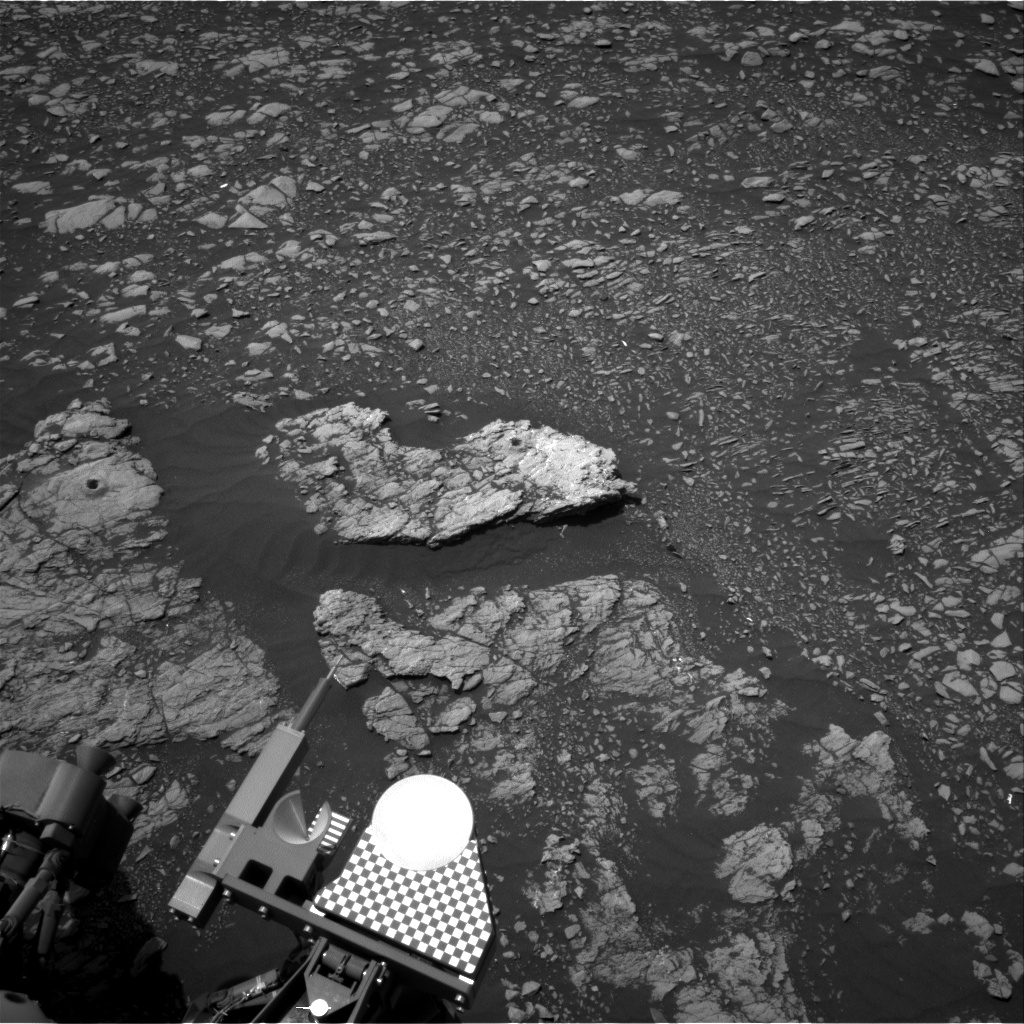
two drill holes in clay formation
Click for full image.

The Curiosity science team has confirmed that their second drill hole in the clay formation that the rover is presently exploring was a success.

They have confirmed that enough material from the drill hole has been deposited in their chemical analysis hopper.

The image to the right, cropped and reduced to post here, shows both drill holes on the two different flat sections of bedrock near the top.

It seems that the science team wants to spend a lot of time in this location, as described in my last rover update. It is therefore unclear when they will move south to follow their long term travel plans.

2 comments

Chang’e-4 and Yutu-2 awaken for fifth lunar day

The new colonial movement: China’s lunar lander Chang’e-4 and rover Yutu-2 have been awakened to begin work for their fifth lunar day on the far side of the Moon.

According to the report from this official Chinese government news source, Yutu-2 has now traveled just under 600 feet from the lander. We know from Lunar Reconnaissance Orbiter (LRO) images taken during the rover’s second lunar day of travel that it had moved to the west, but we don’t really know much else beyond that. LRO has not released any new images, and the Chinese have not told us.

2 comments

Settlement reached in lawsuit about private lunar mission

A lawsuit filed in 2017 by a man who had paid Space Adventures a $7 million deposit for a ticket to fly on a Soyuz rocket around the Moon has now been settled

McPike, an Austrian businessman and adventurer who lives in the Bahamas, filed the original suit in May 2017, seeking the return of a $7 million deposit he paid to Space Adventures for a $150 million seat on a Soyuz mission that would go around the moon, and additional damages. The defendants in the suit included Space Adventures; Tom Shelley, the company’s president; and Eric Anderson, the company’s chairman and chief executive.

According to McPike’s suit, he contacted Space Adventures in July 2012 about the possibility of flying on a mission around the moon that the company had been promoting for several years. In March 2013, he signed an agreement committing to participate in such a mission, and paid an initial deposit of $7 million towards the $150 million total price with the expectation that the mission would take place within six years.

McPike was scheduled to make a second deposit of $8 million one year after contract signing, but he postponed that because of concerns he had regarding the limited progress on developing the mission, including lack of information from the Russian companies and agencies that would carry out it. Space Adventures terminated the agreement in March 2015 after McPike failed to make that payment and retained his $7 million deposit.

According to his suit, McPike later contacted the Russian space agency Roscosmos directly, and was informed that, contrary to the contract he signed, there was no formal relationship between the agency and Space Adventures for a circumlunar mission, that that the proposed mission was only in the “preliminary planning phase” along with several other future projects.

The details of the settlement were not released.

The article also provides near the end a nice summary of all recent private attempts to fly humans around the Moon, including SpaceX’s now ongoing plan to fly a Japanese businessman in 2023 using its Starship upper stage.

0 comments

FCC approves SpaceX’s Starlink constellation

Capitalism in space: The FCC has approved SpaceX’s revised plan for its Starlink satellite constellation designed to provide global internet access.

SpaceX already had authorization for 4,425 Starlink satellites that would use Ku- and Ka-band radio spectrum to beam internet data, but last November, the company asked the FCC to sign off on a plan that would put more than a third of the satellites in 550-kilometer-high (340-mile-high) orbits rather than the previously approved 1,150-kilometer (715-mile) orbits.

Eventually, SpaceX plans to add another wave of more than 7,500 satellites in even lower orbits to enhance the constellation’s coverage.

They hope to begin launching their first set of satellites by May, and begin commercial operations as early as 2021.

2 comments

Two Chinese companies test reusable rocket technology

Link here.

One company, Space Transportation, tested on April 22 a design for launching its first stage vertically and then landinf it on a runway.

The joint flight was to test the performance of the dual waverider forebody configuration designed by Xiamen University’s School of Aeronautics and Astronautics, and to verify the rocket recovery and reuse technology, according to Xinhua. The 8.7-meter-long Jiageng-1 has a wingspan of 2.5 meters and part of development of the larger, future Tianxing-I-1 vertical takeoff, horizontal landing reusable launch vehicle.

Beijing-based Space Transportation, founded in August 2018 and also known as Lingkong Tianxing, received backing worth several million U.S. dollars from Source Code Capital earlier this year. [emphasis mine]

The second company, Linkspace, did on April 19th a untethered vertical take off and landing of a small prototype first stage, getting about 130 feet off the ground.

The highlighted words above are intriguing. I did not think it was legal for American investors to invest in Chinese rocket companies.

4 comments

NASA safety panel on SLS schedule, Dragon explosion

NASA’s safety panel held a long scheduled meeting to review NASA’s on-going manned projects, and had the following to say:

The first story describes very little new information about the explosion on April 20th that destroyed the Dragon crew capsule during engine tests, other than it occurred in connection with the firing of the Dragon’s eight SuperDraco engines. I am being vague because they were.

The second story describes the panel’s strong objection to any effort by NASA to trim the test program for SLS in order to meet the Trump administration’s 2024 deadline for returning to the Moon. It also confirms officially for the first time that NASA will not be able to fly the first unmanned mission of SLS in 2020. That flight is now expected in 2021, a decade after NASA began development of SLS, and seventeen years after George Bush Jr first proposed NASA build this heavy-lift rocket.

That’s practically one person’s entire career at NASA. Seems pretty shameful to me.

While I actually agree with the panel’s advice in both of these stories, both stories however do reflect the overall culture of this safety panel: Go slow, take no risks, be patient. This culture is in fact so cautious that it has served to practically make impossible any American exploration of space, on our own rockets.

Based on what I expect now during the investigation of the Dragon explosion, I would not be surprised if the panel successfully delays the first manned Dragon launch another year or two or three.

4 comments

ISRO delays Chandrayaan-2 to July

An unnamed official at India’s space agency ISRO has revealed that they have decided to further delay its lunar lander/rover Chandrayaan-2 until July following the landing failure of SpaceIL’s Beresheet on the Moon.

“We saw Israel’s example and we don’t want to take any risk. Despite Israel being such a technologically advanced country, the mission failed. We want the mission to be a success,” he said.

The launch of India’s Moon mission was scheduled in April but it was postponed after Israel’s Beresheet spacecraft crashed during moon landing early this month. The ambitious mission was a first for a private effort.

“Landing on the Moon is a very complex mission and all the exigencies have to be factored in,” the official added.

No reason was given for the delay, other than a desire to be cautious. While caution is often a wise thing in experimental engineering, too much caution can be a fatal flaw. Chandrayaan-2 was originally scheduled for launch in the first quarter of 2018. It has now been delayed repeatedly since then, with the only hint of a reason being an unconfirmed story suggesting it was damaged during ground tests.

If this damage is the reason, then ISRO should tell us. Otherwise, the agency is beginning to look like it is afraid to fly.

2 comments

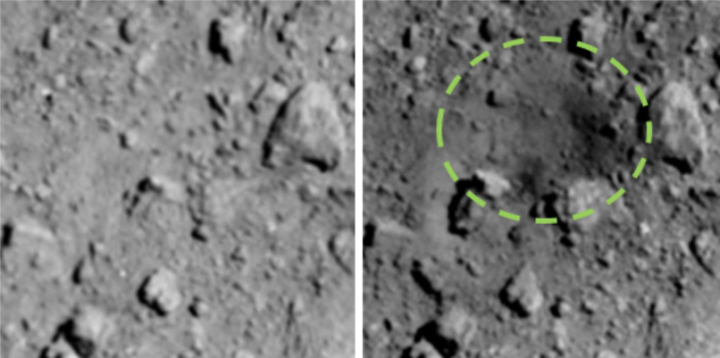
The new man-made crater on Ryugu

Man-made crater on Ryugu

The Hayabusa-2 science team has released before and after images of the spot on Ryugu where the spacecraft’s explosive projectile caused the creation of a small crater.

On the left above is the before, with the new crater indicated by the circle on the right. Note the rocks in both pictures, some now partly covered with debris. They did not give a scale, but this is a very small area, probably less than a few feet across.

They now need to analyze whether they can safely touchdown at this spot and grab a sample.

1 comment
1 101 102 103 104 105 156