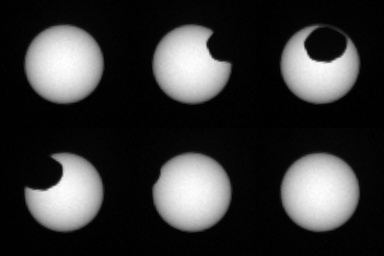
Curiosity films partial solar eclipses by both Phobos and Deimos

Phobos partial eclipse of Sun

Last week Curiosity successfully captured partial solar eclipses by both Phobos and Deimos as the Martian moons crossed the face of the Sun.

The movie on the right shows Phobos eclipsing the Sun. The speed is ten times faster than real time.

The press release can be seen here. It notes how these observations, of which 8 in total have been made since Curiosity arrived on Mars, have helped pin down the orbits of both moons.

3 comments

Scientists in Japan claim that cats can learn their name!

Science does important research! Scientists in Japan now claim that cats can learn their name!

Japanese scientists played recordings of a cat’s owner saying four words with lengths and accents similar to its name before saying the feline’s actual name. The word hihu (Japanese for “skin”), for example, might proceed the name “Kari.” As the random words—all nouns—played, the cats became less and less interested. But as soon as they heard their name, most moved their ears and heads; a few even got up (above). The scientists saw similar responses when the cat’s name came after the names of other felines he lived with, or when a stranger spoke the words.

Any cat owner could have told these scientists this. More significant is the fact that cats in the wild normally do not use meowing as a communications tool. Only with humans do they meow, indicating that they learn that humans respond to sound, and they then adapt to use the knowledge to gain what they want from their human staff.

11 comments

Air Force confirms more Rocket Lab launches

Capitalism in space:: With the successful launch of a DARPA satellite by Rocket Lab last week, the Air Force yesterday confirmed the purchase of several more launches on the company’s Electron Rocket.

Three satellites will be launched to low Earth orbit later this month from Mahia, New Zealand, using Rocket Lab USA’s Electron rocket.

…The upcoming Rocket Lab launch is one of five planned in 2019. … Five small launches will send 21 experimental satellites to space by the end of December, said Lt. Col. Andrew Anderson, chief of the DoD Space Test Program Branch.

One of the five will be by Vox Space later this year. The company will use Virgin Orbit’s LauncherOne rocket that is air launched from a Boeing 747 mothership.

Anderson said there is possibly another vendor in the mix but only Rocket Lab and Vox Space so far can be identified.

I suspect that the unnamed vendor is Vector, but the Air Force is likely not going commit to this until Vector gets farther along in its test program.

0 comments

Chandrayaan-2’s new delay is due to damage during test

The new colonial movement: It appears the reason for the new delay in the launch of India’s Chandrayaan-2 lunar lander is that the spacecraft suffered minor damage during a landing test.

A source in the know, said: “The rover and orbiter are in good health and tests met all the parameters. However, after the ‘Lander Drop Test’, we found that Vikram (the lander) needed to be strengthened in its legs. Prima facie, it appears that not all parameters were set correctly before the test, it could also be that the additional mass—a result of the new configuration—caused the problem.”

They still seem determined to launch in May, though I suspect this is not realistic. It depends on exactly when this test occurred. The article does not say, and if it occurred several months ago then the May date might make sense. Otherwise, expect further delays.

0 comments

Beresheet enters lunar orbit

The privately-built lunar lander Beresheet today successfully entered lunar orbit.

They achieved this by completing an engine burn that changed their Earth orbit to an elliptical lunar one.

At 5:18 p.m. Israel time on April 4, the spacecraft’s engine activated for six minutes and reduced its speed by 1,000 km/hour, from 8,500 km/hour to 7,500 km/hour, relative to the moon’s velocity. The maneuver was conducted with full communication between Beresheet’s control room in Israel and the spacecraft, and signals in real time match the correct course. In the coming week, with expected intense engineering activities, many more maneuvers will take Beresheet from an elliptical to a round orbit, at a height of 200 km. from the moon. The maneuvers will aim to reduce the spacecraft’s distance from the moon and reach the optimal point to conduct an autonomic landing in the Sea of Serenity in the evening Israel time, April 11.

You can see a video of their mission control at the completion of this burn here.

0 comments

Future of InSight’s heat probe dim

Blocked after drilling down only one foot instead of fifteen, engineers are increasingly worried that they will not be able to get InSight’s heat probe past whatever is blocking to so it can begin getting data of Mars’s inner thermal environment.

They are considering a bunch of options, including using InSight’s robot arm to either give the probe a nudge to help it get past the obstruction, or even use the arm to push the probe.

None of the options are encouraging it seems.

9 comments

A decade of changes at the Martian south pole

A decade of changes at the Martian south pole
Click for full image.

The image above, cropped, reduced, and annotated to post here, was released this week by the Mars Reconnaissance Orbiter (MRO) team. It shows the changes that have occurred at one location at the Martian south polar cap in the past decade. As planetary geologist Alfred McEwen wrote,

The south polar residual cap of carbon dioxide ice rapidly changes. This image was planned as an almost exact match to the illumination and viewing angles of a previous one we took in August 2009.

The pits have all expanded and merged, and we can just barely see the patterns in the 2009 image compared to this January 2019 picture. The 2009 image is also brighter and bluer, with more seasonal frost and/or less dust over the surface. These images were both taken in late southern summer, but our 2019 picture is slightly later in the Martian season by about two weeks.

You can get a better idea how much is changed by seeing the full image from which the above small area was cropped.
» Read more

1 comment

The Viking landers and its possible discovery of extraterrestrial life

Link here. One of the scientists involved in the Viking project has written a memoir of her experience, and the article interviews her.

Patricia Straat served as co-experimenter on one of the most controversial experiments ever sent to Mars: the Labeled Release instrument on the Viking Mars landers. The experiment’s principal investigator, Gilbert Levin, insists to this day that the project found extraterrestrial life. Most scientists doubt this interpretation, but the issue has never been fully settled.

Read it. It illustrates how uncertain science can be, even when an experiment produces a result that everyone involved dreamt of. As Straat notes,

The results met the pre-mission definition of a positive life response. But of course as soon as we got it everyone came up with alternative proposals to account for the results nonbiologically.

The problem was that though their experiment found evidence of life, none of the other Viking experiments did. Most significant was the apparently complete lack of organic material (based on carbon) in the soil.

To this day, no one has a good explanation for these results on Viking. The results remain a mystery, one that really will only be solved when we can return to Mars in force, and find out what it is really like.

5 comments
1 111 112 113 114 115 156