Beresheet’s first pictures of the Moon

Beresheet looks at the Moon

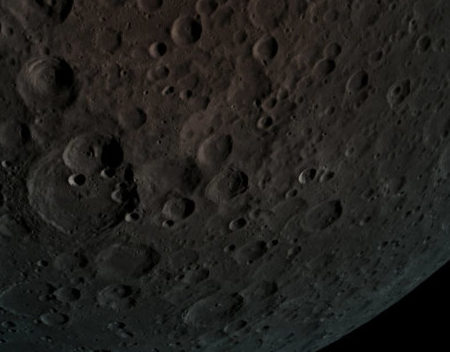
The new colonial movement: The privately built Israeli planetary probe Beresheet, now in lunar orbit, has released its first pictures of the Moon.

The image on the right is one of those images, cropped to post here, and was taken from about 300 miles altitude. The link has a second image showing the Moon with the Earth in the distance. The resolution of both images is quite impressive.

The landing is scheduled for April 11. Stay tuned!

4 comments

The eye of a storm on Jupiter

Storm on Jupiter

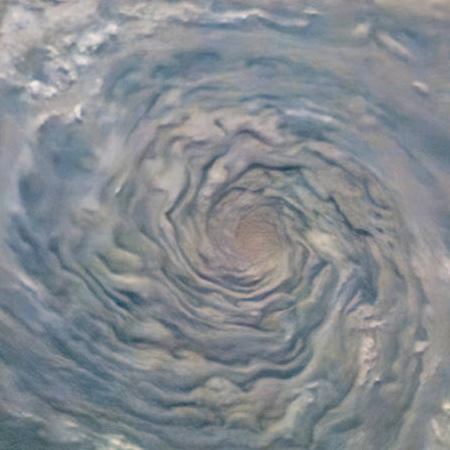
The image on the right, cropped to post here, was taken by Juno on February 12, 2019 as the spacecraft made its 17th close approach of Jupiter. The Juno science team today has highlighted this version, processed by citizen scientists Gerald Eichstädt and Seán Doran to enhance the details therein. They note how the white clouds can clear be seen sitting above the colored clouds below.

I cropped it to show the center of the storm. The full image is equally spectacular, as it shows the full storm. Unfortunately, there is no scale, but I suspect you could probably fit the entire Earth several times across the diameter of the storm.

1 comment

OSIRIS-REx maps Bennu by laser

The OSIRIS-REx science team today released a short animation showing a topographical global map of the asteroid Bennu, created by the spacecraft’s laser altimeter, dubbed OLA.

From Feb. 12 through 17, OLA made more than 11 million measurements of the distance between OSIRIS-REx and Bennu’s surface as the spacecraft flew less than 1.2 miles (2 km) above the surface – the closest orbit ever achieved by spacecraft. OLA obtained these measurements by firing laser pulses at Bennu and measuring the amount of time it takes for the light to bounce off the asteroid’s surface and return to the instrument. That time measurement is then translated into altitude data. Using this data, the OLA team created the 3-D model of Bennu’s surface.

0 comments

Fragment of a long dead planet’s iron core found orbiting white dwarf

Astronomers have identified the fragment of a long dead planet’s iron core orbiting a white dwarf star 410 light years away.

The [data] suggested its source was a solid object some 600 kilometers across—a suspected planetary core, with a density between 7.7 and 39 grams per cubic meter, comparable to the pure iron found within Earth’s core. “The density of the piece of rock is consistent with what we think the cores of planets [are],” says Luca Fossati of the Austrian Academy of Sciences, who was not involved in the paper.

It orbits the star every two hours, the fastest exoplanet orbit yet found. This alone should rip it apart, providing further evidence that the object’s density is very high.

The astronomers theorize that this object is likely the remains of a planet that existed when this star was young, and was destroyed as the star aged to become a red giant, expanding to swallow it. Later, when the star collapsed to become a tiny white dwarf, the core remained, its density allowing it survive as the planet’s outer crust was torn away.

5 comments

Falcon Heavy dress rehearsal countdown and static fire today

Capitalism in space: SpaceX hopes to complete today its standard prelaunch dress rehearsal countdown for the second Falcon Heavy launch, now likely scheduled for April 9.

The launch had previously been set for April 7.

The article provides a nice overview of the Falcon Heavy. It also included this tidbit:

Unlike most past missions, the two side boosters are already booked for a second launch. They – in addition to the brand new center core B1057 – will help launch the Air Force’s STP-2 mission, currently No Earlier Than (NET) June.

That they have already scheduled reuse of the side boosters for the next Falcon Heavy launch indicates just how confident they have become about recovering those boosters.

UPDATE: Dress rehearsal countdown and static fire have been completed. According to an Elon Musk tweet, the data looks good, but he cautioned that as this will be the first Falcon Heavy launch using Block 5 boosters, the launch date might change as they review the data.

1 comment

Hayabusa-2’s successfully bombs Ryugu

impact on Ryugu

Japan’s Hayabusa-2 probe yesterday successfully impacted an explosive charge on the surface of the asteroid Ryugu, creating a crater for observing the interior geology.

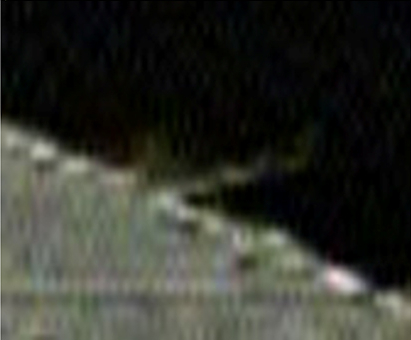
The image to the right was taken by a camera that has separated from Hayabusa-2 and stayed closer to the impact. It shows material flying off the asteroid’s surface, at the horizon line.

Hayabusa-2 — which moved to the other side of the asteroid to stay clear of any ejecta — will next arc around and get close to this impact site to study it. They first need to make sure the ejecta has cleared.

4 comments

Monitoring the ice scarps on Mars for changes

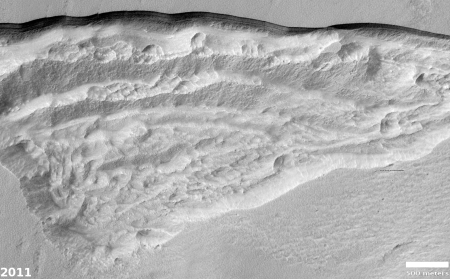
Scarp #1 in 2011
Click for full image.
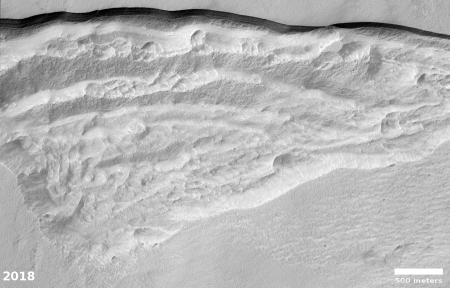
Scarp #1 in 2018
Click for full image.

Back in January 2018 planetary scientists released a paper announcing the discovery of a number of Martian cliff faces, or scarps as they called them, that all appeared to expose an underground layer of ice.

Those cliffs were mostly located to the southeast of Hellas Basin, the basement of Mars that is also advantageous for human colonization because its lower elevation means its atmosphere is thicker. (For example, that thicker atmosphere would make air transportation more practical.)

The two images to the right show what they listed as scarp #1 in their paper, rotated, cropped, and reduced to post here. The first image was taken in May 2011, with the second taken in December 2018, and was part of the March image release from the high resolution camera of Mars Reconnaissance Orbiter (MRO).

The December 2018 image was taken almost a year after the paper release, and was titled “Scarp Monitoring.” I therefore wondered whether the scientists had identified any changes. They theorize that these scarps form when the exposed ice slowly sublimates to gas into the atmosphere, causing the cliff face to collapse and retreat, which in the case of scarp #1 would be a retreat to the north. The terraces below the scarp suggest previous cliff locations. In their paper they noted evidence of some changes in the studied scarps, including some fallen boulders, as well as color changes that suggest some evolution.

The rate of that retreat is not known with precision, but based on the facts presently at hand, the scientists have estimated that it took about a million years to form this scarp. Whether any evidence of this retreat would be visible in only seven years is the purpose of these scarp monitoring images.

Do you see any difference? I don’t, but because I also don’t trust my expertise I decided to email the paper’s lead author, Colin Dundas of the U.S. Geological Survey’s Astrogeology Science Center. His emailed comments are most interesting.
» Read more

2 comments

Telescope store sues Asian telescope manufacturers for fixing prices

A San Francisco store that sells telescopes to the public is suing two Asian telescope manufacturers — who make almost all recreational telescopes sold in the U.S. — for conspiring together to fix prices and create that monopoly.

Orion Telescopes and Binoculars, which is headquartered in Watsonville and has stores there and in Cupertino, is seeking more than $180 million in damages in a lawsuit. A federal court in Northern California said the complaint against telescope maker Ningbo Sunny, filed in 2016, can go to trial. A subsidiary of Ningbo Sunny, a Chinese company, bought Irvine telescope maker Meade Instruments in 2013.

In the complaint, Orion alleges that Ningbo Sunny and a Taiwanese telescope manufacturer, Synta Technology, shared confidential information that competitors normally would not share, including product pricing, order forecasts and credit arrangements.

My question is this: Why are no American telescope manufacturers competing in this market? Are our labor costs too high? Our government regulations too restrictive? A little bit of competition could easily end this collusion by these Asian manufacturers, assuming it is happening.

11 comments

Amazon to build its own giant satellite constellation

Capitalism in space: Amazon has officially joined the race to build own giant satellite constellations for providing internet access worldwide.

[They] plan to put 3,236 satellites in low Earth orbit — including 784 satellites at an altitude of 367 miles (590 kilometers); 1,296 satellites at a height of 379 miles (610 kilometers); and 1,156 satellites in 391-mile (630-kilometer) orbits.

In response to GeekWire’s inquiries, Amazon confirmed that Kuiper Systems is actually one of its projects. “Project Kuiper is a new initiative to launch a constellation of low Earth orbit satellites that will provide low-latency, high-speed broadband connectivity to unserved and underserved communities around the world,” an Amazon spokesperson said in an emailed statement.

The competition now includes Amazon, SpaceX, OneWeb, and others, each of which will provide a lot of business for the launch industry. All told, more than 15,000 satellites will need to be launched by these companies before the middle of the next decade.

6 comments
1 110 111 112 113 114 156