
Falcon Heavy launch now set for tomorrow evening, April 10

Capitalism in space: SpaceX’s second launch of its Falcon Heavy rocket, the world’s most powerful, has now been rescheduled for 6:36 pm (eastern) on April 10.

This will definitely be worth watching. (I will post the SpaceX live stream link when it goes up.) If all goes well, the three first stage boosters will all land themselves after first stage separation, with two coming in simultaneously on neighboring landing pads in Florida, with the third landing very shortly thereafter on its landing barge in the Atlantic.

A success here will also give the Falcon Heavy two successful launches, two more than SLS (with none), and one more than China’s Long March 5, which is half as powerful but has not launched in almost two years after it failed on its second launch attempt.

The comparison with SLS is more pertinent. Tomorrow’s launch, if successful, will once again demonstrate the complete failure of NASA’s SLS rocket. This government boondoggle has been in development since 2004 in various iterations, for a cost that is likely to exceed $25 billion, fifty times more than it cost SpaceX to develop and make operational the Falcon Heavy. SLS’s first launch, originally scheduled for 2017, is now set to launch in June 2020, but is also more likely to be delayed months, if not more. Beyond that it will likely be more years before its second launch.

Falcon Heavy meanwhile is scheduled to do its third launch in mere months, should tomorrow go off without a hitch. It also has contracts for at least seven future launches. Nor would I be surprised if it completes most of these launches before SLS flies for the first time.

At some point the dimwits in Washington will I hope finally notice the contrast, and stop wasting money on SLS. Give it time, however. They are not very smart, and aren’t really interested in the needs of the American nation.
5 comments

Peter, Paul and Mary – Blowing in the Wind

An evening pause: I like the commentary about this song at the youtube webpage. “Although it has been described as a protest song, it poses a series of rhetorical questions about peace, war and freedom. The refrain “The answer, my friend, is blowin’ in the wind” [is] … impenetrably ambiguous: either the answer is so obvious it is right in your face, or the answer is as intangible as the wind.

In this sense, Bob Dylan’s song really does transcend the 1960s, as does much of his work.

Hat tip John Vernoski.

2 comments

Jupiter’s atmosphere reacts quickly to the solar wind

New data from ground-based telescopes show that the atmosphere of Jupiter quickly changes due to changes in the solar wind, and that these changes descend deeper into the atmosphere than expected.

Auroras at Earth’s poles (known as the aurora borealis at the North Pole and aurora australis at the South Pole) occur when the energetic particles blown out from the Sun (the solar wind) interact with and heat up the gases in the upper atmosphere. The same thing happens at Jupiter, but the new observations show the heating goes two or three times deeper down into its atmosphere than on Earth, into the lower level of Jupiter’s upper atmosphere, or stratosphere.

…”What is startling about the results is that we were able to associate for the first time the variations in solar wind and the response in the stratosphere – and that the response to these variations is so quick for such a large area,” said JPL’s Glenn Orton, co-author and part of the observing team.

Within a day of the solar wind hitting Jupiter, the chemistry in its atmosphere changed and its temperature rose, the team found. An infrared image captured during their observing campaign in January, February and May of 2017 clearly shows hot spots near the poles, where Jupiter’s auroras are.

Considering Jupiter’s size, for these effects to extend so quickly really is startling.

3 comments

Thumbprints on Mars!

Thumbprints terrain on Mars!
Click for full image.

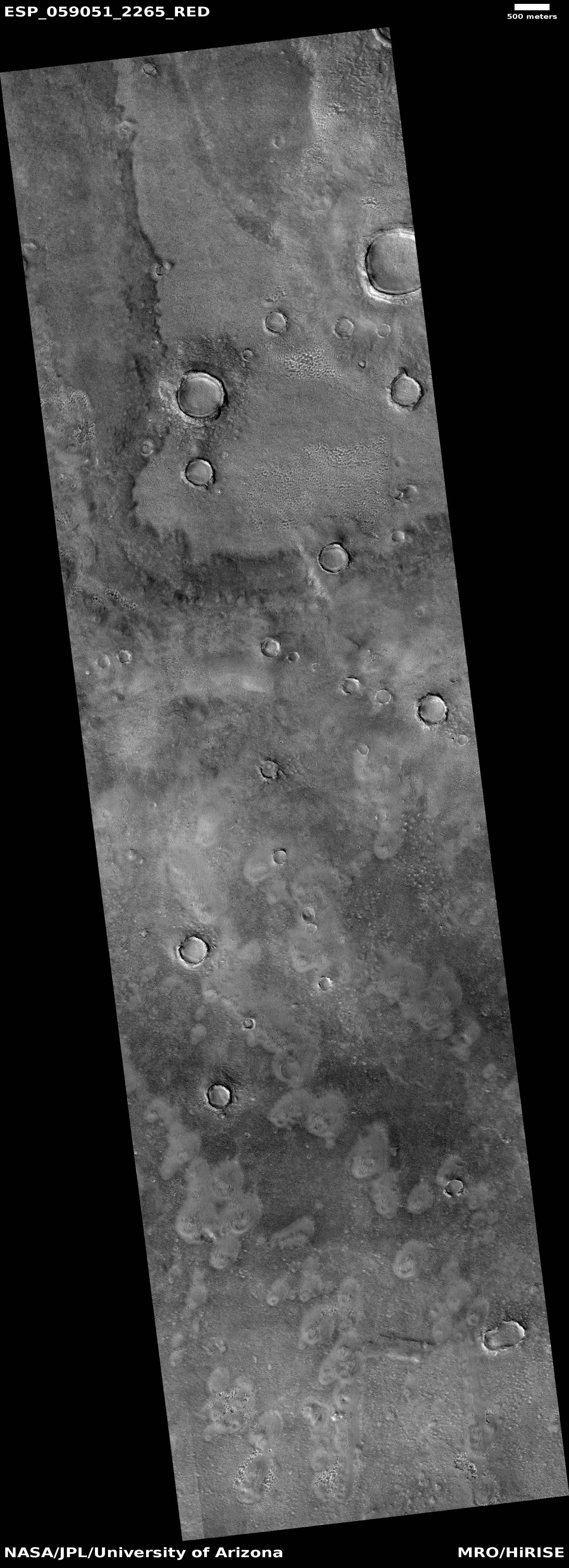
Honestly, don’t ask me. I didn’t come up with the name. I found the image on the right, cropped and reduced to post here, as part of the April image dump from the high resolution camera of Mars Reconnaissance Orbiter. The uncaptioned release dubbed this “Thumbprint Terrain in Northern Mid-Latitudes,” and it is obvious to see why. The cropped image on the right focuses in on the oval white mounds that really do look like some giant child was touching a soft damp muddy surface randomly with his fingers, leaving behind raised fingerprints as the mud stuck to his fingers as he pulled them away.

Each white area seems to have a crater. I suspect these are not impact craters, but possibly mud volcanoes, as each is at the top of a mound. My hypothesis is further strengthened by the location, which is deep within the low northern plains of Mars, a place where some scientists believe an intermittent ocean once existed. These mounds could have easily formed at that ocean’s floor, or thereafter when the land here was drying out.

On the other hand, these could be from impact. Maybe they are scattered ejecta from a larger impact, landing here in a group on a wet muddy surface. The impacts might have concentrated the material around the crater, making it more resistant to erosion, which is why the craters now stand above the floor of the plain.

On the third hand, all these theories could be wrong. Have any of your own?

4 comments

Leftist groups demand industry blacklist former Trump officials

They’re coming for you next: A coalition of more than forty leftwing organizations, most with strong ties to the Democratic Party, have written a letter demanding that corporations blacklist nearly thirty former Trump officials.

A coalition of left-wing groups is targeting nearly 30 current and former Trump-administration officials with a corporate blacklist meant to prevent the officials from obtaining jobs in the private sector.

…The letter urges the CEOs to not hire or contract any of the officials and to bar them from sitting on corporate boards.

Gee, I seem to remember how the left for decades condemned the concept of a blacklist. Of course, that was when the blacklist was aimed at them. I guess blacklists for the left are perfectly all right, as long as they only act to destroy the lives of those on the right.

To be blunt, a blacklist for political reasons is always wrong. While it is perfectly legitimate for certain companies to not hire certain people because of their political beliefs, especially if those beliefs could distract from the company’s business, it is never acceptable for society to demand that no one hire them, ever, which is exactly what what these leftist organizations are doing.

This is only the beginning. The left today smells blood, and wants it from all their opponents. It will not stop until someone stops it, forcefully. The best way this could happen would be by a smashing defeat at the polls. If that fails, then there will be violence, as eventually the people the fascist left wishes to oppress will stand up and fight.

19 comments

Sunspot update March 2019: An upcoming Grand Minimum?

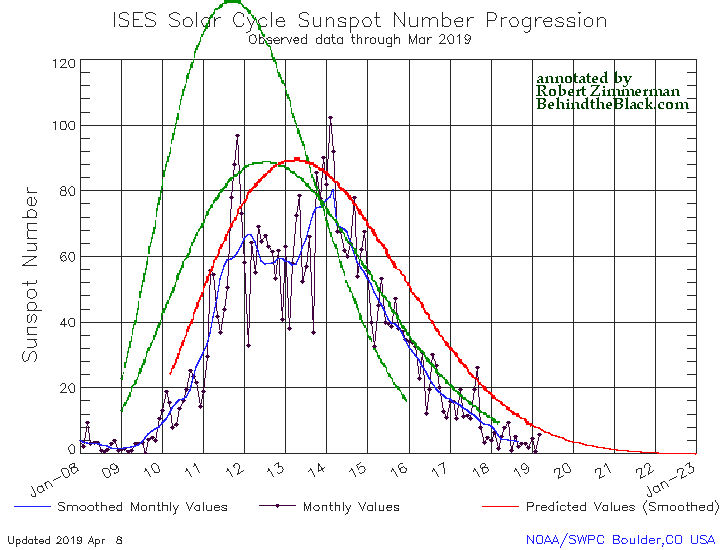
Even though we are now deep into the beginning of what might become the first grand minimum in sunspot activity since the invention of the telescope, that does not mean the Sun has as yet stopped producing sunspots. Yesterday NOAA released its the monthly update of its tracking of the solar cycle, adding sunspot activity for March 2019 to its graph. Below is that graph, annotated by me to give it some context.

It shows the Sun with a slight burst in activity in March, suggesting that though we are now in the solar minimum that minimum still has the ability to produce sunspots.

At the same time, for me to say that we might be heading to a grand minimum, a time period lasting many decades where no sunspots are visible and the sunspot cycle essentially ceases, is not click bait or hyperbole. It is instead based on what I now think the solar science community is thinking, based on this very graph.

March 2019 sunspot activity

The graph above has been modified to show the predictions of the solar science community for the previous solar maximum. The green curves show the community’s two original predictions from April 2007, with half the scientists predicting a very strong maximum and half predicting a weak one. The red curve is their revised May 2009 prediction, extended in November 2018 four years into the future.

For past half dozen or so cycles the solar science community had issued its prediction for the upcoming solar maximum at about this stage in the overall cycle, during the final ramp down to minimum when it was clear that the Sun had entered that minimum.

This cycle’s prediction however has not yet happened, and in fact appears to be late. In fact, the extension of the May 2009 red curve that was made in November 2018 might very well be the only prediction we see. That extension is shown by the differences between the green 2007 prediction and the red 2009 prediction in the graph. Before November 2018 both curves ended at the same place, the end of 2018.

The extension of that red curve is important. As I noted in my December 2018 sunspot update,
» Read more

19 comments

SpaceX drops protest against NASA launch decision

SpaceX has decided to withdraw its protest against NASA’s decision to choose ULA as the launch vehicle for its Lucy asteroid mission.

The company did not provide any reason for the withdrawal. I suspect Musk decided that it was doing SpaceX harm both publicly and privately. Publicly it threatened the launch date of Lucy, which might cause a significant and fatal delay to the mission. That did not make SpaceX look good to the general public.

Privately, I suspect that the protest was hurting SpaceX with NASA officials. They almost certainly did not say so directly, but I am certain they were able to make this clear in any number of ways. This, combined with the agency’s new willingness to consider commercial rockets, like the Falcon Heavy, for its lunar plans, probably convinced SpaceX that it was doing itself more harm than good with the protest.

3 comments

Smallsat rocket company Relativity gets its first launch contract

Capitalism in space: The smallsat rocket company Relativity has signed its first launch contract, even though they have yet to complete even one test flight.

Their chief executive nails the importance of this on the head:

In an interview, Tim Ellis, chief executive of Relativity, said the contract is the first customer for the Terran 1 that the company has announced. He said Relativity previously signed a contract with another customer that has yet to be announced.

โ€œWhatโ€™s really notable about this and why itโ€™s so important for Relativity and the industry is that this is the first time that Telesat, or any major global satellite operator, has selected a completely venture-based aerospace startup for launch services,โ€ Ellis said, noting that the companies had been in extensive discussions prior to announcing this contract. โ€œThe credibility of aligning with Telesat we believe is huge for what Relativity is developing.โ€ [emphasis mine]

Their rocket, Terran-1, is not scheduled for its first orbital flight until the end of 2020. Yet, Telesat has given this company a contract. I suspect that contract has a variety of exit clauses, but I also wonder if it gives Telesat some interest in the company in exchange for backing it at this early stage.

Either way, the demand for launch services created by these proposed new smallsat constellations is forcing the satellite companies to make deals that they might never have considered in a less booming market.

0 comments

Bennu’s cobbled equatorial ridge

Bennu as seen by OSIRIS-REx
Click for full image.

The OSIRIS-REx science team has released a new close-up image of Bennu, this time showing the asteroid’s equatorial ridge. The image on the right is that photograph, reduced to post here.

When the image was taken, the spacecraft was positioned over Bennuโ€™s northern hemisphere, looking southward over the asteroidโ€™s equatorial bulge. The field of view shown is 168 ft (51.2 m) wide. For scale, the bright, rectangular rock above the dark region is 8 ft (2.4 m) wide, about the size of a long bed on a pickup truck

Like Ryugu, the scientists for OSIRIS-REx are going to be challenged in finding a location smooth enough for their touchdown sample grab. That surface reminds me of some avalanche scree slopes I’ve hike across, where you’ve got nothing but rough rocks to walk on.

4 comments

Parker survives its second close Sun flyby

The Parker Solar probe has survived its second solar flyby, passing within fifteen million miles of the Sun on April 4.

It was moving at 213,000 miles per hour at that moment, which is probably a speed record for any human vehicle. That however is a record Parker will likely break on future fly-bys.

The entire close encounter runs from March 30 to April 10, during which the spacecraft gathers data about the Sun’s inner corona (the sun’s atmosphere).

0 comments
1 109 110 111 112 113 156