
Exos to test the reusability of their suborbital rocket

Capitalism in space: The smallsate rocket company Exos Aerospace has announced that they have scheduled its first fully reusable test flight of its SARGE suborbital rocket for March 2nd.

Exos completed the Pathfinder Launch on August 25, 2018 from Spaceport America. It was the first step in validating the SARGE SRLV that was flown and recovered for reuse. Exos gathered critical flight data that enabled advancing the design and setting them up for continued reuse of their SARGE vehicle.

,,,The โ€œMission 1โ€ test flight of the SARGE reusable system will carry the commercial payloads flown under the programs listed below. A successful launch will further solidify the companyโ€™s plan to use this technology as the design basis of their Jaguar orbital launch vehicle with reusable first stage capable of carrying 100kg to Low Earth Orbit (200-400km).

The link provides the list of payloads. For their orbital rocket their plan seems straightforward and brilliant. Build a simple suborbital rocket that lands by parachute gently enough so that it can be reused. While using that commercially also use it as the testbed for building an orbital rocket whose first stage would also land by parachute.

This approach puts them in direct competition with Blue Origin and Virgin Galactic for the suborbital business, and likely at a much cheaper price than either. And if the plan works to orbit, it also positions them to be a strong competitor in the smallsat orbital rocket business, being the first with a reusable vertically launched rocket.
0 comments

Hayabusa-2 touchdown images released

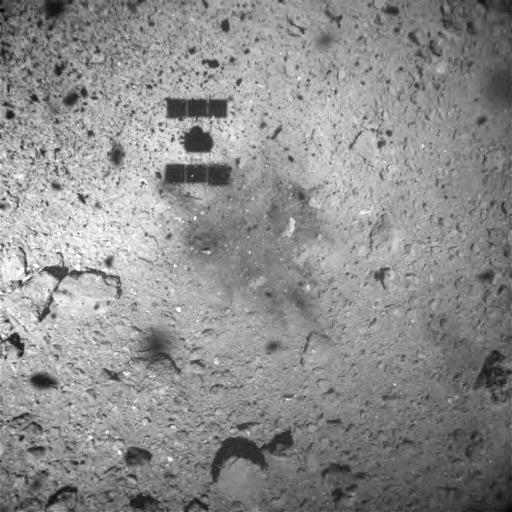
Surface of Ryugu 1 minute after touchdown

The Hayabusa-2 science team today released images taken during its quick touchdown on the asteroid Ryugu last week.

The image to the right was taken:

roughly 1 minute after touchdown at an estimated altitude of about 25m (error is a few meter) [80 feet]. The color of the region beneath the spacecraftโ€™s shadow differs from the surroundings and has been discolored by the touchdown. At the moment, the reason for the discoloration is unknown but it may be due to the grit that was blown upwards by the spacecraft thrusters or bullet (projectile).

The image proves that everything on Hayabusa-2 worked as planned, and it almost certainly captured some of that grit.

They are going to do at least two more touchdowns before they have Hayabusa-2 leave Ryugu and head back to Earth.

3 comments

Most popular theorized particle for explaining dark matter now eliminated

The uncertainty of science: The WIMP particle (Weakly Interacting Massive Particle), the most popular theorized particle to explain dark matter, has now been eliminated by experiments.

These experiments have now been ongoing for decades, and have seen no dark matter [WIMPs].

…Theorists can always tweak their models, and have done so many times, pushing the anticipated cross-section down and down as null result after null result rolls in. That’s the worst kind of science you can do, however: simply shifting the goalposts for no physical reason other than your experimental constraints have become more severe. There is no longer any motivation, other than preferring a conclusion that the data rules out, in doing.

Other theorized but less favored particles could still be proved to be dark matter, but the problem is getting harder and harder to solve, as presently assumed.

Dark matter has always been an invention created to explain the too-fast orbital velocities of stars in the other regions of galaxies. It could very well be however that the problem comes not from new physics and a newly contrived particle we can’t see, but from a deficiency in our overall observations of galaxies and what is there, within the constraints of the physics we know now.

Hat tip Mike Buford.

21 comments

Firefly to build and launch from Florida

Capitalism in space: The smallsat rocket company Firefly Aerospace announced yesterday that it will build its rocket manufacturing facility at Cape Canaveral, as well as launch from there.

Texas-based launch startup Firefly Aerospace finally revealed its plan to build a manufacturing facility near Kennedy Space Center and outfit the Air Force’s Space Launch Complex 20 in Cape Canaveral for its two core launch vehicles โ€” one of the first manufacturing facilities of its kind in the Sunshine State.

Firefly was shrouded under the codename “Maricopa” for months as Space Florida, the state’s space development agency, trickled out details of a deal that includes an 18-acre chunk of Exploration Park and 28 acres at LC20. The value of the deal is $52 million, and Firefly vows to put 200 of its 300 employees in the Cape.

Firefly’s first rocket, Alpha, will cost $15 million per launch, which means it will either launch a larger bunch of smallsats or they will be serving the larger smallsats in this new industry.

1 comment

New high resolution images of Ultima Thule

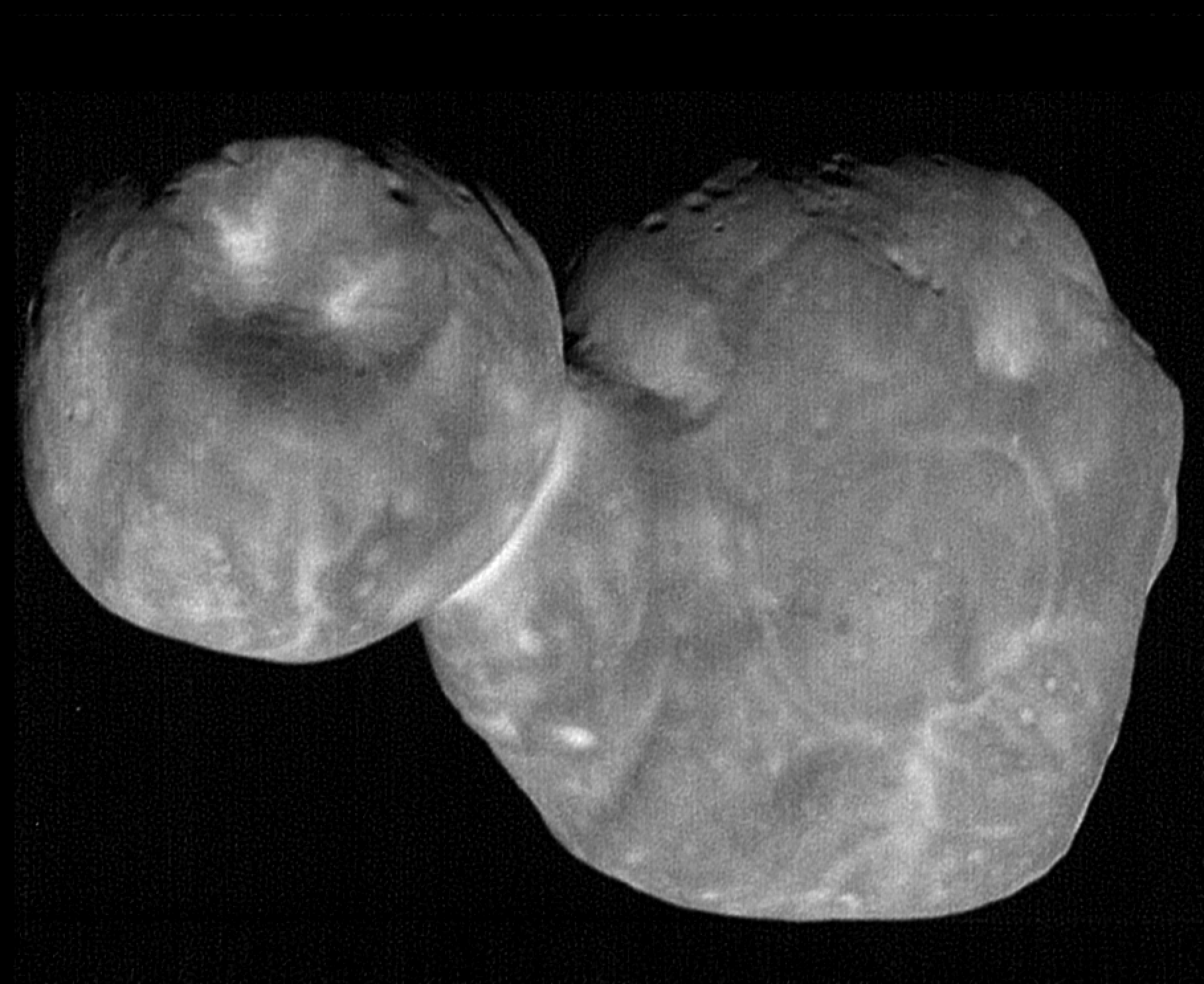
Highest resolution image of Ultima Thule
Click for full resolution image.

The New Horizons team has released new high resolution images of Ultima Thule, taken during its fly-by on January 1, 2019.

These new images of Ultima Thule โ€“ obtained by the telephoto Long-Range Reconnaissance Imager (LORRI) just 6ยฝ minutes before New Horizons’ closest approach to the object (officially named 2014 MU69) at 12:33 a.m. EST on Jan. 1 โ€“ offer a resolution of about 110 feet (33 meters) per pixel.

…The higher resolution brings out a many surface features that weren’t readily apparent in earlier images. Among them are several bright, enigmatic, roughly circular patches of terrain. In addition, many small, dark pits near the terminator (the boundary between the sunlit and dark sides of the body) are better resolved. “Whether these features are craters produced by impactors, sublimation pits, collapse pits, or something entirely different, is being debated in our science team,” said John Spencer, deputy project scientist from SwRI.

Available at the link above is a three-second long movie they created from these images, showing Ultima Thule as it zips across the camera’s view.

2 comments

Curiosity recovering from safe mode

Last week Curiosity suddenly went into safe mode, halting science operations for four days while engineers analyzed the issue.

Curiosity encountered a hurdle last Friday, when a hiccup during boot-up interrupted its planned activities and triggered a protective safe mode. The rover was brought out of this mode on Tuesday, Feb. 19, and is otherwise operating normally, having successfully booted up over 30 times without further issues.

Throughout the weekend, Curiosity was sending and receiving technical data, communicating with the team in order to help them pinpoint the cause of the issue. “We’re still not sure of its exact cause and are gathering the relevant data for analysis,” said Steven Lee, Curiosity’s deputy project manager at NASA’s Jet Propulsion Laboratory in Pasadena, California. JPL leads the Curiosity mission. “The rover experienced a one-time computer reset but has operated normally ever since, which is a good sign,” he added. “We’re currently working to take a snapshot of its memory to better understand what might have happened.”

…”In the short term, we are limiting commands to the vehicle to minimize changes to its memory,” Lee said. “We don’t want to destroy any evidence of what might have caused the computer reset. As a result, we expect science operations will be suspended for a short period of time.”

As far as I could tell, images were being uploaded to their public image page through February 20, when I did my last rover update. Since then however no new images have appeared. I fear this might be related to the computer issues Curiosity experienced in September that shut down operations for about six weeks and was never quite resolved. Of Curiosity’s two main computers both have now experienced serious problems.

0 comments

Virgin Galactic’s Unity spacecraft completes 2nd test flight above 50 miles

Capitalism in space: Virgin Galactic’s Unity suborbital spacecraft today successfully completed its seconnd test flight above 50 miles, carrying a test passenger for the first time.

The vessel was ferried up attached to a larger plan called WhiteKnightTwo, dropped into the sky, and then taken up by rocket-powered engine to more than 50 miles above the Earthโ€™s surface just before 9 a.m. local time. It landed safely 15 minutes later. The company said VSS Unity hit Mach 3.04 and traveled to an altitude of 55.87 miles or 295,007 feet, faster and higher than any test flight yet for the vessel.

In addition to the two pilots, Unity carried a test passenger, Beth Moses, the company’s chief astronaut instructor. Besides gathering data, she also unstrapped to experience weightlessness.

The link makes the false claim that this was the first time weightlessness was experienced in a commercial vehicle, even though numerous people have flown weightless on private “vomit comet” airplane flights.

It does appear that Virgin Galactic is finally, after fourteen years, getting close to that first ticketed tourist flight. It also looks possible that they will never quite reach 62 miles, the more commonly accepted definition for the beginnings of space.

2 comments
1 128 129 130 131 132 156