Russia’s first 2019 launch has launch issues

Russia’s first launch in 2019, putting an Egyptian Earth observation satellite in orbit with their Soyuz rocket, has had problems reaching its planned orbit.

Fregat is released shortly afterwards, firing its S5.98M engine to inject EgyptSat-A into an initial transfer orbit. Fregat will likely make a second burn following a coast phase – typically around 45 minutes after the first burn – circularise the orbit. After this burn EgyptSat-A separated, and Fregat will make an additional deorbit burn to dispose of itself into the atmosphere.

It was during the Fregat burn that Russian media reported it was tracking in a lower orbit than planned, although various reports point to the issue occurring during either the third stage flight or during the first Fregat burn.

Amazingly, Roscosmos then noted the mission was a success, potentially achieved by Fregat burning longer to catch up with the shortfall.

Remember, this is the rocket and aerospace nation that NASA prefers to use to send our astronauts into space. This is the second launch problem during a Soyuz launch in less than six months.

The standings in the 2019 launch race:

2 China
1 SpaceX
1 ULA
1 Japan
1 India
1 Europe
1 Russia

The U.S. and China remain tied at 2 in the national rankings. A SpaceX launch is set for tonight however.

2 comments

Even as NASA announces schedule for SpaceX Dragon test flight, anti-American forces at NASA work to block that flight

There were two stories today impacting the future of American manned spaceflight. The first is positive, the second is downright hostile to that effort, and could literally be called treasonous by some.

The first story outlines in detail NASA’s press coverage and schedule leading up to and including the March 2nd SpaceX unmanned Dragon test flight. The key event will be the flight readiness review on February 22nd. NASA will televise a post review press conference no earlier that 6 pm (Eastern) that night. That review will determine whether the flight goes on March 2nd.

That NASA has made this announcement indicates that the agency is slowly being dragged, kicking and screaming, into allowing the test flight to finally happen, after years of bureaucratic delay.

The second story illustrates some of the ongoing kicking and screaming that is still going on inside NASA. It is also more disturbing. As far as I can tell from the story, some of the anti-American forces within NASA’s bureaucracy teamed up with Reuters today to publish this hit piece on the manned capsules of both SpaceX and Boeing.

Two people with direct knowledge of the program told Reuters that the space agency’s concerns go beyond the four items listed, and include a risk ledger that as of early February contained 30 to 35 lingering technical concerns each for SpaceX and Boeing. Reuters could not verify what all of the nearly three dozen items are. But the sources familiar with the matter said the companies must address “most” of those concerns before flying astronauts and, eventually, tourists to space. [emphasis mine]

Note that these are anonymous sources. Note that their attack, a bunch of unsubstantiated leaks, is directly aimed at discrediting the efforts of both companies. Note also that if they succeed the ultimate and only benefactor will be Russia, since NASA will then be forced to buy more Soyuz flights from them, on a rocket that has recently had a launch failure and in a capsule that someone in Russia actually sabotaged during assembly.

The last highlighted phrase, suggesting that NASA is going to use its power to block the ability of these free American companies from privately selling tourist flights on their capsules, is even more egregious. Once again, the only benefactors of this action would be the Russians, who will then be able to grab that tourist business.

It is for these reasons I call these sources, with the help of Reuters, anti-American.

Moreover, the issues that are outlined in this article are very dubious, to put it mildly. Suddenly, after years of reviews that never mentioned any issues with SpaceX’s parachutes as well as seventeen successful parachute test flights, NASA has suddenly deemed that the parachute design has “some design discrepancies.”

As for Boeing, the article mentions the valve leak failures during a engine test last year. In response Boeing has had the valves redesigned and reordered, but they still need further testing. While this is a legitimate issue, I suspect it is being used here as a sledge hammer against this American company, not as an issue that requires intelligent review.

Where is our “America-First” president in all this? Political forces in Washington and within NASA are actively working to block our country’s effort to fly in space, for the benefit of a foreign power. Why isn’t Trump doing something about this?

29 comments

Buzz Aldrin’s son acts to block his father’s access to his assets

Sad: Andrew Aldrin, son to Buzz Aldrin, has moved to try to block his father’s access to the funds in two of his financial accounts.

Andrew Aldrin’s lawyer sent a letter last month to an associate in Morgan Stanley’s private wealth management division with instructions not to transfer any assets in two financial accounts in a trust of which Andrew Aldrin is a trustee. Buzz Aldrin, 89, has tried to terminate the trust and wants the assets distributed to him.
Astronaut Buzz Aldrin, member of the first landingBuy Photo

The letter from Andrew Aldrin’s lawyer warns Morgan Stanley that the son, acting as trustee, will seek damages if his instructions aren’t followed. “Please govern yourself accordingly,” the letter said.

Morgan Stanley asked a Florida court last week to decide if it should follow the instructions of Buzz Aldrin or his son.

The family has been fighting for control of Aldrin’s assets, with two of his children saying he has memory loss and is delusional.

5 comments

Bezos comparing New Shepard to SpaceShipTwo: “No asterisks.”

Capitalism in space: During an event yesterday, Blue Origin’s owner Jeff Bezos made it a point to note the superior launch capabilities of Blue Origin’s suborbital New Shepard spacecraft over Virgin Galactic’s SpaceShipTwo.

Bezos, in the interview, pointed out the altitude difference between the two vehicles. New Shepard has typically exceeded 100 kilometers, an altitude known as the Karman Line, on its test flights. SpaceShipTwo reached a peak altitude of 82.7 kilometers on its most recent test flight Dec. 13, its first above the 50-mile boundary used by U.S. government agencies to award astronaut wings. “One of the issues that Virgin Galactic will have to address, eventually, is that they are not flying above the Karman Line, not yet,” Bezos said. “I think one of the things they will have to figure out how to get above the Karman Line.”

“We’ve always had as our mission that we wanted to fly above the Karman Line, because we didn’t want there to be any asterisks next to your name about whether you’re an astronaut or not,” he continued. “That’s something they’re going to have to address, in my opinion.”

For those who fly on New Shepard, he said, there’ll be “no asterisks.”

Bezos also indicated that he is increasingly hopeful that the first manned test flights of New Shepard will occur this year.

1 comment

Hayabusa-2 has begun approach to Ryugu

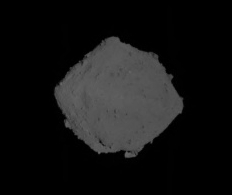
Ryugu during approach

Hayabusa-2 has begun its approach to Ryugu, aiming for a quick touchdown and sample grab at approximately 7:06 pm (Eastern) tonight. The image at the right is the most recent taken during the approach.

The risks? From the Hayabusa-2 website:

Our original schedule planned for touchdown in late October of last year (2018). However, Ryugu was revealed as a boulder strewn landscape that extended across the entire surface, with no flat or wide-open regions. Before arriving at Ryugu, it was assumed there would be flat areas around 100 meters in size. But far than finding this, we have not even seen flat planes 30 meters across!

During the scheduled time for touchdown in late October, we did not touchdown but descended and dropped a target marker near the intended landing site. We were able to drop the target marker in almost the planned spot and afterwards we examined the vicinity of the target marker landing site in detail. Finally, the area denoted L08-E1 was selected as the place for touchdown.

From the first link above you can see approach images as they are downloaded today, about once every half hour.

0 comments

Ohio music shop will refuse service to Trump supporters

They’re coming for you next: An Ohio music shop owner has announced that they no longer wish to provide any service to anyone who supports Donald Trump.

“Dear Trump sympathizers. I am truly sorry, however I feel unclean and dirty accepting money from you. Please, politely shop somewhere else. Sorry, I would rather starve and close the store than participate in wrong-doing. Many blessings to you. I hope you understand,” the sign said.

First, in a free society this owner would have the right to do this.

Second, in a free society this owner’s customers can all choose to go elsewhere, sending their business to places not so filled with hate, and thus giving him his wish and putting him out of business.

Third, the hypocrisy is tragically hilarious. Wasn’t it the left that insisted that bakeries, wedding photographers, and such must provide service to anyone who wants it, and if they refuse for religious reasons the state has the right to destroy their lives?

Fourth, and most important: Imagine the amount of close-minded hate that is required for this shop owner to do this. Blindly, he lumps everyone who supported Trump into a single basket of “wrong-doing”, without evidence or even a rational basis.

Sadly, he represents too many in today’s the leftist political and cultural world. And if you support such people, you are no different.

11 comments

Rover update: February 20, 2019

Summary: Curiosity in the clay unit valley. Opportunity’s long journey is over. Yutu-2 creeps to the northwest on the Moon’s far side.

For the overall context of Curiosity’s travels, see my March 2016 post, Pinpointing Curiosity’s location in Gale Crater.

For the updates in the past year go here. For a full list of updates before February 8, 2018, go here.

Curiosity

Curiosity's view to the east on Sol 2316
Click image for full resolution version

Overview of Curiosity's future travels
Click image for original image

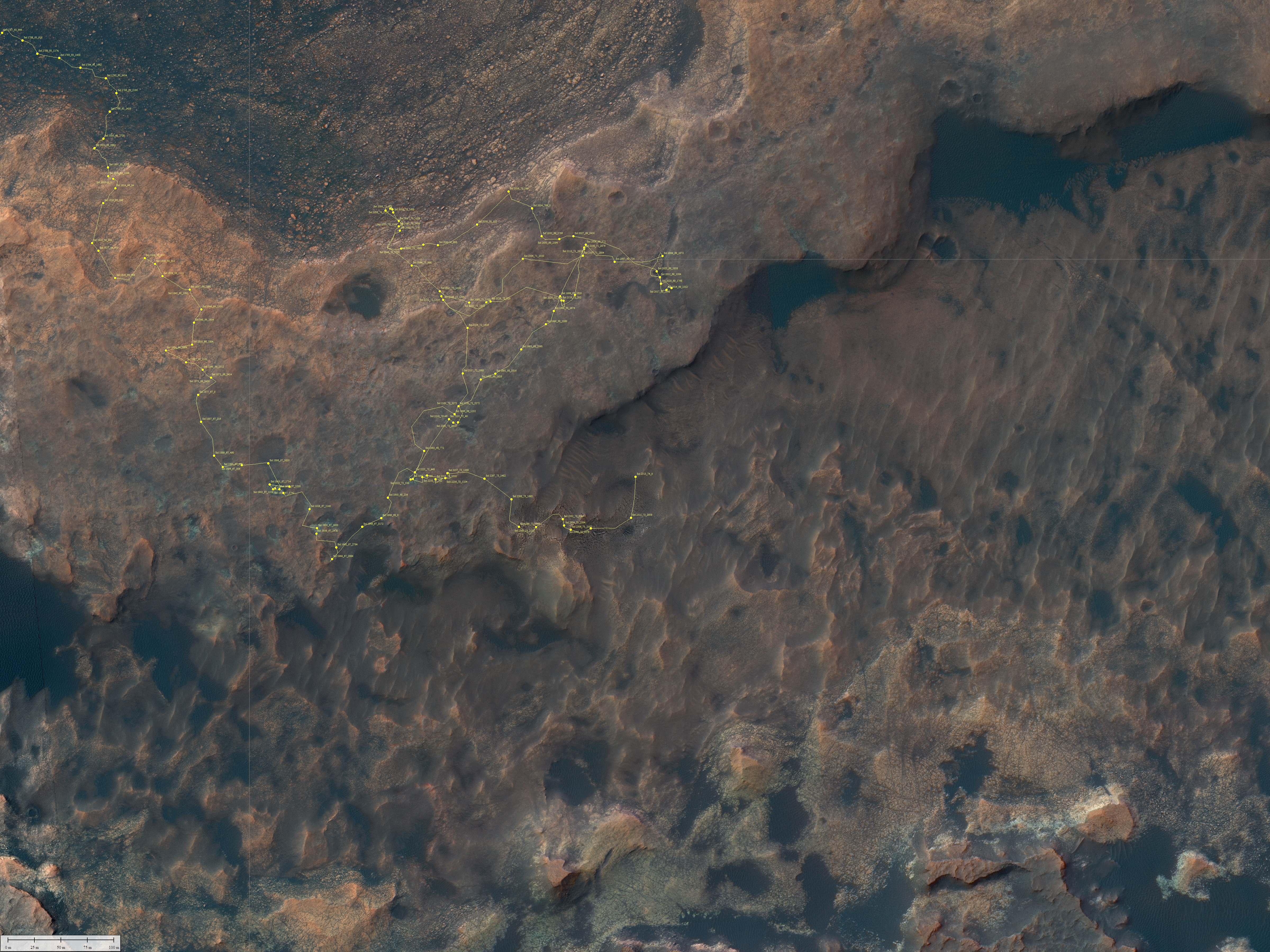
Since my January 22, 2019 update, Curiosity finally drove down off of Vera Rubin Ridge into a valley between the ridge and the lower slopes of Mt Sharp. The Mars Reconnaissance Orbiter (MRO) overview on the right has been annotated by me to show the rover’s travels (shown by the yellow dotted line), with its proposed route indicated by the red dotted line. The yellow lines indicate approximately the terrain seen in the panorama above. The panorama was created from images taken on Sol 2016.

The valley that Curiosity is presently traversing is dubbed “the clay unit” or “the clay-bearing unit” by the geologists, based on its make-up determined from orbital data. So far they have found this terrain to be “some of the best driving terrain we’ve encountered in Gale Crater, with just some occasional sandy patches in the lee of small ridges.” Initially they had problems finding any rocks or pebbles large enough for the instruments to use for gathering geological data. For the past week or so, however, they have stopped at “bright exposure of rock” where some bedrock was visible, giving them much better material to work with.
» Read more

1 comment

Hayabusa-2 prepares to land

Ryugu's northern hemisphere

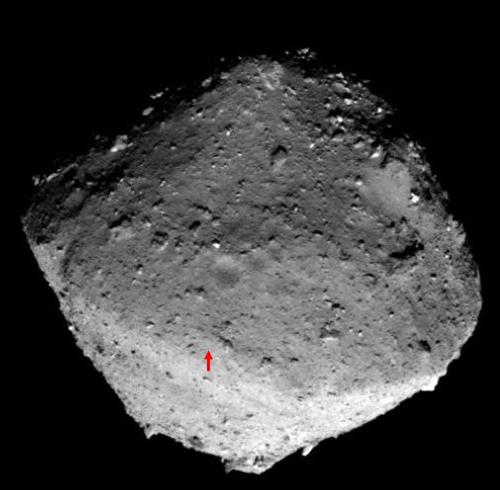
The JAXA science team has released a set of images taken in January by Hayabusa-2 of its landing site on Ryugu, describing how those images helped map the region where touchdown will occur on February 22. The image on the right is one such image.

[It] shows a diagonally imaged photograph of Ryugu, captured by moving the spacecraft towards the direction of the north pole. The upper side of the image shows the north pole and reveals a landscape dominated with many large boulders. The white band extending to the left and right slightly below the center of the image is the equatorial ridge (Ryujin Ridge). The arrow tip marks the planned touchdown site and you can see this site is on the main ridge.

This is the first time we have images the northern hemisphere of Ryugu. In this observation, we acquired data on the equatorial region of Ryugu, the southern and northern hemisphere. Imaging the entire area is very important for creating accurate global shape models for Ryugu.

They should begin beaming images down of the landing approach sometime tomorrow, and will do so about every 30 minutes throughout the sequence.

0 comments

How NASA’s X-34 ended up rotting in someone’s backyard

Link here. The story is a wonderful illustration of the epic failure that NASA has represented for the past thirty years. They spent billions, and threw it all away before even one flight.

How the two partly built X-34 spacecraft ended up in someone’s backyard is fascinating in itself, and worth the read.

One detail the article misses is why the X-34 got cancelled in 2001: politics. This program was part of a range of space initiatives under the Clinton administration (including the X-33). All were overpriced and essentially boondoggles. When George Bush Jr. became president, his administration reviewed them all and junked them, replacing them with his own boondoggles (Constellation and Orion).

5 comments

ISRO to launch new smallsat rocket by summer

Capitalism in space: K. Sivan, the head of India’s space agency ISRO, revealed today that they plan to launch two satellites on the maiden flight of their smallsat rocket, dubbed the Small Satellite Launch Vehicle (SSLV), this coming summer.

Sivan also said that they hope to be making between two to three launches a month with this smallsat rocket. In other words, as the satellite industry shifts to tiny satellites, they intend to directly compete against the American private companies and the Chinese government for this new commercial business.

0 comments
1 130 131 132 133 134 156