
NOAA’s aging fleet of sun-observation satellites

In testimony during a Senate hearing on February 12, the head of NOAA’s space weather division admitted that the agency’s ability to monitor the Sun is threatened by its aging fleet of solar satellites, combined with the agency’s slow progress on a large single replacement satellite, presently scheduled for launch in 2024.

NOAA currently uses the Deep Space Climate Observatory (DSCOVR) and NASAโ€™s Advanced Composition Explorer (ACE) spacecraft to collect solar wind data, and uses the ESA/NASA Solar and Heliospheric Observatory (SOHO) spacecraft to observe the solar corona, using those data to forecast solar storms that can affect satellites and terrestrial infrastructure such as power grids.

However, SOHO, launched in December 1995, is well past its design life. In addition, DSCOVR has been offline since June 2019 because of technical problems, forcing NOAA to depend solely on ACE, which launched in 1997. [emphasis mine]

NOAA has been trying, and failing, to build a replacement for ACE for more than a decade. Worse, the agency’s inability to deal with these issues was further revealed by this quote:

Congress has pushed to speed up work on that [replacement] mission, despite NOAAโ€™s assurances about the availability of data from other spacecraft. NOAA sought about $25 million for the mission in its fiscal year 2020 budget request, but Congress appropriated $64 million. NOAA has yet to release its fiscal year 2021 budget request, more than a week after the White House published the overall federal government budget proposal.

Something has been wrong in the management at NOAA now for at least a decade. They can’t seem to get new satellites built, and when they try they can’t seem to do it on schedule and for a reasonable cost. Their weather satellite program has been rife with problems, including cost overruns, schedule delays, and failing satellites.

But why should we be surprised? This kind of mismanagement at the federal government has been par for the course for the past half century.
7 comments

Harvard professor arrested for his work with China

Charles Lieber, the chairman of Harvard’s department of chemistry and chemical biology, has been arrested by the federal government for lying about the work he has been doing for China.

An affidavit accompanying the criminal complaint in Boston further accuses Lieber of making false statements to the National Institutes of Healthโ€”a major funder of his research into nanoscale biological interfaces, such as transistors that can interact with intracellular biological machineryโ€”as well as to Harvard itself, about his connections to [China’s] Thousand Talents program and the Wuhan University of Technology.

The arrest occurred very shortly after a Chinese medical student from Harvard was arrested for trying to smuggle cancer research material from a Harvard-affiliated medical center.

More information here. It appears that Lieber did not tell the truth about how much China was paying him for this work, which by the way was a lot of money, $50K per month plus $150K stipend for living in Wuhan while he helped build them a medical lab.

Hat tip Phill Oltmann.

1 comment

Maiden flight of China’s Long March 5B rocket targeted for April

The new colonial movement: China is now targeting mid-April for the maiden launch of its Long March 5B rocket, which will place in orbit China’s new manned capsule on its first unmanned demo flight.

The article at the link, from China’s normally reticent state-run press, actually provides a great deal of information. First, it outlines the launch schedule for their space station, using the Long March 5B rocket:

China aims to complete construction of the space station around 2022. According to the CMSA, more than 10 missions are planned in the next three years to complete the construction and master technologies for in-orbit assembly and construction of large complex spacecraft, long-term manned spaceflight in near-Earth space and large-scale space science experiments.

…The space station will be a T shape with the Tianhe core module at the center and a lab capsule on each side. The core module — at 16.6 meters long and 4.2 meters in diameter, with a takeoff weight of 22.5 tonnes — will be the management and control center.

Second, the article confirms that the Long March 5B rocket will be used to launch all of China’s manned missions. This means they are dependent on their biggest and possibly most expensive rocket to make things happen, suggesting that either they will have to go slow or they have made a very big commitment to space. The quote above suggests the latter.

Third, the article reveals that their new manned capsule, which will weigh almost as much as a single station module on either their station or ISS, will be capable of carrying six astronauts, and that the descent module is designed to be reusable.

Finally, they confirm once again that they will also be launching “a large optical telescope” that will fly in formation with their space station. An earlier news article indicated that this telescope would have a mirror 12 meters in diameter, which would be five times bigger than the mirror on the Hubble Space Telescope. That same article however also noted major design issues.

Overall, it appears China is about to step out as a major space power, with capabilities that in many ways will exceed anything from either the U.S. or Russia.

2 comments

Astronomers photograph baby stars in Orion

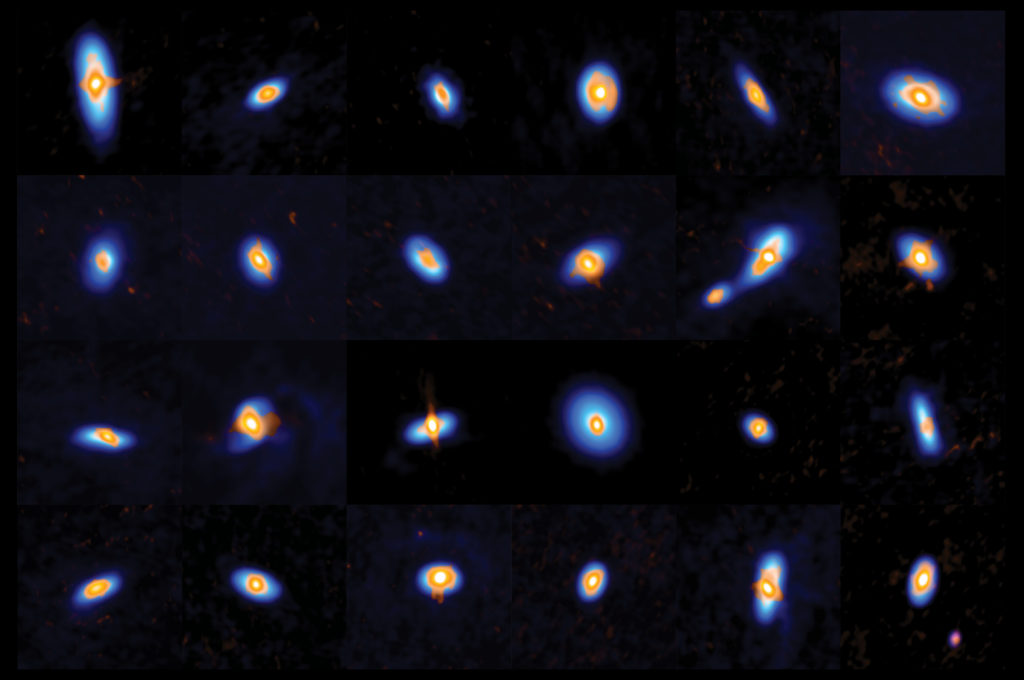
Some of the baby stars surveyed
Click for full image.

Astronomers using two radio telescopes have created multi-wavelength radio images of 300 protoplanetary disks, or proplyds, found in the star forming region in the constellation Orion. The image to the right shows only a small sampling of the proplyds imaged.

โ€œThis survey revealed the average mass and size of these very young protoplanetary disks,โ€ said John Tobin of the National Radio Astronomy Observatory (NRAO) in Charlottesville, Virginia, and leader of the survey team. โ€œWe can now compare them to older disks that have been studied intensively with [the radio telescope] ALMA as well.โ€

What Tobin and his team found, is that very young disks can be similar in size, but are on average much more massive than older disks. โ€œWhen a star grows, it eats away more and more material from the disk. This means that younger disks have a lot more raw material from which planets could form. Possibly bigger planets already start to form around very young stars.โ€

Of the disks photographed, four appear to be extremely young, probably less than ten thousand years, because of their very blobby and irregular shape.

0 comments

SpaceX begins assembling its next Starship test prototype

Capitalism in space: SpaceX has begun the assembly in Boca Chica of its next Starship test prototype, with a targeted launch date in April.

That first test flight is expected to be a 12-mile-high hop, using three Raptor engines.

Do not be surprised if that launch is delays by a few months. At the same time, do not be surprised if it occurs before the summer.

0 comments

Russia and China launch satellites

Today both China and Russia successfully placed satellites into orbit. China’s Long March 2D rocket placed four “technology test” satellites into orbit, while Russia used its Soyuz-2 rocket to launch a military communications satellite.

The leaders in the 2020 launch race:

4 China
3 SpaceX
2 Arianespace (Europe)
2 Russia

The U.S. continues to lead China 6 to 4 in the national rankings.

1 comment

Martian wind-swept buried depressions

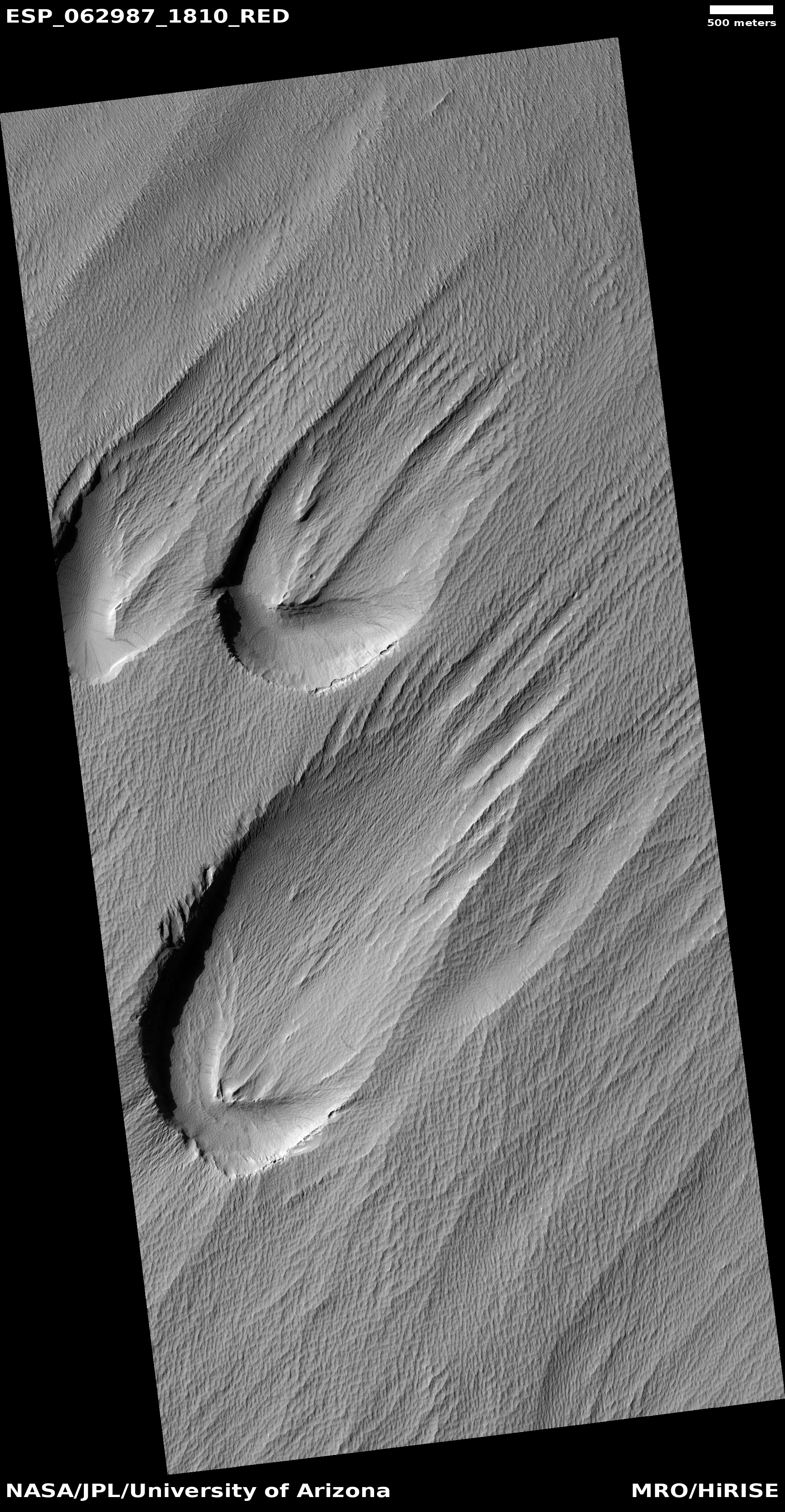
Wind-swept Martian depressions
Click for full image.

Cool image time! The photo to the right, rotated, cropped and reduced to post here, was taken on January 3, 2020 by the high resolution camera on Mars Reconnaissance Orbiter (MRO). It shows three strange teardrop-shaped depressions, clearly wind-swept and partly buried by dust and sand.

The location on Mars of these depressions is in the transition zone between the southern cratered highlands and the northern lowlands. This is also a region dubbed the Medusae Fossae Formation, a region where it appears a great deal of volcanic material was laid down during one or more eruptive events 3 to 3.8 billion years ago.

Whether these depressions were formed during those events is impossible to tell from the available data, especially because the underlying bedrock is buried in dust.

Their shape appears to have been caused as the wind slowly exposed three buried peaks of hard rock. The wind, blowing from the southwest to the northeast, would hit the peaks, producing an downward eddy that would churn out dust from the windward side. The wind and dust would then blow around the peaks, creating the teardrop tail on the leeward side to the northeast.

0 comments

MRO undergoing maintenance and software upgrade

NASA’s Mars Reconnaissance Orbiter, in space now for fifteen years, will undergo a two week computer software upgrade.

The maintenance work involves updating battery parameters in the spacecraft’s flash memory – a rare step that’s been done only twice before in the orbiter’s 15 years of flight. This special update is necessary because it was recently determined that the battery parameters in flash were out of date and if used, would not charge MRO’s batteries to the desired levels.

In addition to the battery parameters, engineers will use this opportunity to update planetary position tables that also reside in flash. The spacecraft will go into a precautionary standby mode, called safe mode, three times over the course of the update. It will also swap from its primary computer, called its Side-A computer, to its redundant one, called Side-B.

During these two weeks the spacecraft will suspend its science and communications operations.

0 comments
1 147 148 149 150 151 169