Brazilian Orchestra medley
An evening pause: This appears to be a youth orchestra, but unfortunately everything on the webpage is in Portuguese, so I’m not sure.
Hat tip David Nudelman.
An evening pause: This appears to be a youth orchestra, but unfortunately everything on the webpage is in Portuguese, so I’m not sure.
Hat tip David Nudelman.
The uncertainty of science: Scientists today released their first measurements from Juno of the amount of water found in Jupiter’s atmosphere.
The Juno science team used data collected during Juno’s first eight science flybys of Jupiter to generate the findings. They initially concentrated on the equatorial region because the atmosphere there appears more well-mixed, even at depth, than in other regions. From its orbital perch, the radiometer was able to collect data from a far greater depth into Jupiter’s atmosphere than the Galileo probe – 93 miles (150 kilometers), where the pressure reaches about 480 psi (33 bar).
“We found the water in the equator to be greater than what the Galileo probe measured,” said Cheng Li, a Juno scientist at the University of California, Berkeley. “Because the equatorial region is very unique at Jupiter, we need to compare these results with how much water is in other regions.”
These results remain very preliminary, especially because they have not yet gathered data at higher latitudes. Regardless the amount so far detected, 0.25% of all molecules in Jupiter’s atmosphere. seems remarkably small, suggesting that Jupiter has relatively little hydrogen or oxygen in its atmosphere.
Capitalism in space: SpaceX has signed a deal with the space tourism company Space Adventures to fly four tourists on a single crew Dragon flight.
The private spaceflight company founded by billionaire Elon Musk has signed an agreement with the U.S. space tourism company Space Adventures to launch up to four passengers on an orbital trip aboard a Crew Dragon space capsule. The mission would last up to five days and could launch as early as late 2021, Space Adventures representatives told Space.com.
The trip will not go to ISS, but remain free-flying in orbit.
Essentially, Space Adventures, which flew all its previous space tourists on Russian Soyuz capsules and has two more such flights scheduled in 2021 to ISS, is now adding the American company SpaceX to its staple. This gives them two places they can buy flights, which gives them some bargaining room to get prices down.
This is exactly what I hoped would happen if NASA stopped building spacecraft and instead bought its rides from privately built and owned capsules. Owned by SpaceX and built for profit, crew Dragon is not limited to only serving NASA’s needs. They can sell it to others to make more money. Here they are doing so.
I also would not be surprised if SpaceX reuses the Dragon capsules used on NASA flights for these tourist flights. NASA doesn’t want reused capsules, yet, so SpaceX will be accumulating once-used capsules capable of flying again. I bet they will use them here.
Engineers have confirmed that the first Solar Orbiter instrument that they have activated is working and in good health.
“Until the end of April, we will be gradually turning on the in-situ instruments and checking whether they are working correctly,” says Yannis Zouganelis, ESA’s deputy project scientist for the Solar Orbiter mission. “By the end of April, we will have a better idea of the performance of the instruments and hopefully start collecting first scientific data in mid-May.”
Through November 2021 the spacecraft will make fly-bys of the Sun, Venus, and Earth to get it into its prime orbit, which will pass Venus regularly to further raise its inclination so that eventually it will be as high as 33 degrees, allowing it to better see the Sun’s poles.

Click for full image.
The image to the right, reduced to post here, was taken by the high resolution camera on Mars Reconnaissance Orbiter (MRO), and provides a close-up of the relative smooth terrain found in the region on Mars that the Chinese have said is one of their prime landing sites for their 2020 Mars rover and lander. According to planetary scientist Alfred McEwen of the Lunar & Planetary Laboratory in Arizona,
There was a presentation at the European planetary & science conference in Geneva last fall, and a Chinese scientist gave an update on their plans and showed this area with the lat-long coordinates. That’s what I’m going on.
McEwen also admits that “there might have been a change since then. I’m not in the loop.” No one outside China really is, as that government remains quite opaque on these matters. They will likely only reveal their final landing site choice as we get closer to launch.

This location, on the northern lowlands plains of Utopia Planitia, makes great sense however for a first attempt by anyone to soft land on Mars. In fact, in 1976 these plains were the same location that NASA chose for Viking 2, for the same reasons. (The Viking 2 landing site was to the northeast of the Chinese site, just beyond the right edge of the overview map) While there are plenty of craters and rough features, compared to most of Mars’s surface, Utopia could be considered as smooth as a bowling ball.
Even so, a look at the full image shows that there are numerous features nearby that would be a threat for any robotic lander. McEwen notes,
» Read more
Two stories in the past week illustrate the routine failure of the urban political policies in cities nationwide that have been traditionally controlled by Democrats:
The first story proves the absurdity of gun control laws. Chicago, like most cities and states controlled by Democrats, has some of the strictest gun control laws in the nation. And Chicago, like most cities and states controlled by Democrats, is also home to one of the highest crime rates, using guns, in the nation. Routinely there are more people shot per week with in Chicago then in any hot spot in the Middle East.
This particular story further demonstrates how pointless those laws are in keeping guns from both criminals and even ordinary citizens. It not only describes the premeditated use of guns by young adults against each other, it documents two examples where children accidently shot a playmate because they were playing with guns that happened to be in their homes.
If those gun control laws had done what the Democrats had promised, those children would not have had those guns available to them. But they did, because first, criminals did not obey the laws and are thus very well armed in Chicago, and second, to defend themselves against these armed criminals Chicago citizens are forced to get guns illegally themselves. Instead of reducing access to guns, the gun control laws appear to have increased it. Worse, because those guns are illegal, proper training in gun use and safety is inaccessible. The result are stories like this.
The second story describes the consequences of these bad Democratic Party policies. Chicago’s population has now shrunk four years in a row, with many of those fleeing coming from the very black community that the Democrats supposedly care so much about. The reasons?
They have been driven out of the city by segregation, gun violence, discriminatory policing, racial disparities in employment, the uneven quality of public schools and frustration at life in neighborhoods whose once-humming commercial districts have gone quiet, as well as more universal urban complaints like rising rents and taxes.
Note that the blame for most of these failures (gun control, corrupt police, bad schools, rising taxes) can be traced directly to the polices of the Democratic Party that has run Chicago unopposed for almost a century, the same party that for decades these same blacks have voted for repeatedly.
As they say, you get the government you deserve. I just hope the blacks remaining in Chicago as well as the blacks who have fled will reconsider their blind loyalty to the Democratic Party. As Donald Trump told them directly during the 2016 campaign, “What have you got to lose?”.
So far, less than nothing, based on the disasters that the Democrats have brought upon them. I pray they will finally realize this.
Jeff Bezos yesterday announced that he plans to spend $10 billion of his own money on “climate change,” awarding grants to “scientists, activists and nonprofits.”
“I want to work alongside others both to amplify known ways and to explore new ways of fighting the devastating impact of climate change,” Bezos said in the post.
I wonder if has any idea what he means by “climate change.” From this and other quotes, I would guess he does not. Instead, it appears his knowledge of the climate field is similar to most leftist politicians and activists, superficial and based on slogans and soundbite claims.
Meanwhile, this story suggests that a good portion of the $4.6 billion he has gotten by cashing out his Amazon stock in the past few years will go to this initiative, rather than his space company Blue Origin.
Capitalism in space: Blue Origin yesterday cut the ribbon on its main rocket engine factory in Huntsville, Alabama, while also announcing that production of their BE-4 engine for both ULA’s new Vulcan rocket and their own New Glenn rocket will begin in a few months.
In the meantime, made-in-Kent engines are being tested at Blue Origin’s West Texas site. Smith said two flight readiness engines will be delivered in May to United Launch Alliance. They’ll be used for integrated tests of ULA’s Vulcan first-stage booster, which is taking shape not far from Huntsville in Decatur, Ala.
This is excellent news. For the past year and a half the company has released little information about their progress with the BE-4 engine, suggesting that they might be experiencing issues. Yesterday’s news bursts that pessimistic balloon, indicating that both the Vulcan and New Glenn rockets will be flying, maybe as soon as next year.
The new colonial movement: Engineers have reactivated China’s Chang’e-4 lander and Yutu-2 rover for their 15th lunar day on the far side of the Moon.
As usual, the story in China’s state-run press reveals little. This time however it does mention that Yutu-2 will continue traveling to the west, first to the northwest and then to the southwest.
An evening pause: This is a cover for a Guns N’ Roses song.
Hat tip Lee S.
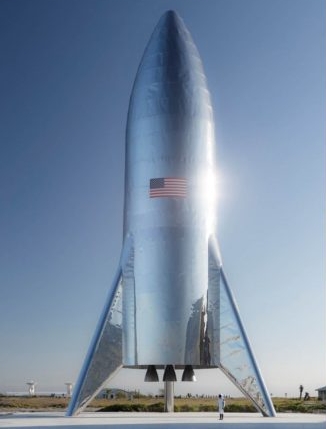
SpaceX’s first Starship prototype
Capitalism in space: Today’s launch by SpaceX of another sixty Starlink satellites in its planned constellation of thousands of satellites, designed to provide worldwide internet access, was significant in a way that is actually not obvious at first glance. To understand its significance, it is necessary to look at the launch in a wider context.
Below is the list of launches that have so far occurred in 2020. I keep track of this, and post an update here on Behind the Black after each new launch:
3 China
3 SpaceX
1 Arianespace (Europe)
1 Rocket Lab
1 Russia
1 Japan
1 ULA
1 Northrop Grumman
Notice anything? While the launches of every other nation in the world are centralized under one rocket company or agency, the United States has many different and independent companies competing for this business. Right now the U.S. has four different companies on this list, with one (SpaceX) now tied after today’s launch with China for the overall lead, and three (Rocket Lab, ULA, and Northrop Grumman) tied with Europe, Russia, and Japan for second place.
Only in America can you have individual private rocket companies competing head-to-head with whole nations, and beating them. (Some might argue that China’s rocket industry is also made up of competing companies, but that is a lie. While those companies might function somewhat independently, they are all under the strict supervision of the central communist government. They are not functioning as free and privately-owned companies.)
Nor is this pattern seen only in the launch market. Among airline companies it has been the norm since the beginnings of cheap passenger flight after World War II. While most other nations have a single national airline (British Airways, Aeroflot, El Al, Air Canada, Korean Air, Saudi Arabian Airlines, to name a few), the U.S. has a plethora of competing independent companies, with many flying many more passengers than these national airlines, sometimes even to their own countries.
How is this possible? Why does the U.S. so often dominate so many industries in this way?
» Read more
Capitalism in space: SpaceX this morning successfully launched sixty more Starlink satellites, raising the number in the constellation to 300.
However, though the launch was successful, the first stage, on its fourth flight, failed to land successfully on the drone ship in the Atlantic. Watching the live stream, it appeared from a whiff of smoke on the edge of the screen that the booster missed the target by only a short distance. This is the first time this has happened since 2015 2018 (correction from reader).
That this first stage landing failure is the news story illustrates how far they have come..
The standings in the 2020 launch race:
3 China
3 SpaceX
1 Arianespace (Europe)
1 Rocket Lab
1 Russia
1 Japan
1 ULA
1 Northrop Grumman
In the national rankings the U.S. now leads China 6 to 3.