
First Virgin Orbit launch pending?

Capitalism in space: According to their CEO, the first launch of Virgin Orbit’s LauncherOne rocket is expected to occur in the “coming weeks.”

“We are positioned at the end of the runway in Mojave. Our rocket is married to our 747,” he said. “We’re going through launch rehearsals.”

In an interview after the panel, Hart said that the company was ready to move into operations quickly should that test launch be a success. “If we have a great day, we’re poised to go forward pretty much immediately,” he said. The next LauncherOne rocket is currently “well along” in assembly at the company’s Long Beach, California, factory.

He also admitted that as a demo test flight, that first launch could go sour, and they were prepared for that.

The development of LauncherOne slowed appreciably in the past two years. In July 2018 got their first launch license, and said they would do this launch late that year. It did not happen. Then, in November 2018 they began capture-carry flights, with the expectation they would fly this first launch in 2019. This did not happen either. Worse, in August 2019 it was revealed that the company had lost a major launch contract, the lose of which might explain the slowdown in development.

Despite this slow down, my 2016 prediction that LauncherOne will complete its first commercial flight before Virgin Galactic’s SpaceShipTwo, still looks good, even though SpaceShipTwo began development more than a decade before LauncherOne.
1 comment

New solar results from Parker

Scientists have released a new set of science results from the Parker Solar Probe, all part of a special issue of the Astrophysical Journal.

From the introduction to the journal issue:

Over the past year and a half, PSP returned an enormous amount of science data that drew a new picture of the source region of the solar wind. The first discoveries of the mission were reported in the Nature magazine on 2019 December 4. This special issue of the Astrophysical Journal Supplement series consists of over 50 science papers that provide more detailed analyses of the data from the first two orbits.

Most of the results are very technical, relating to detailed phenomenon of the near solar environment, and are in a sense very preliminary. They are essentially still gathering data. It appears too soon for them to come to any solid conclusions yet.

0 comments

ISS crew returns to Earth

Three crew members from ISS returned to Earth today in a Soyuz capsule, including American Christina Koch, who set a new longevity record of 328 for a woman.

Christina Koch launched to the International Space Station aboard the Soyuz MS-12 launch vehicle on 14 March 2019 from the Baikonur Cosmodrome in Kazakhstan. At the time of launch, she was scheduled to perform a six-month mission, returning to Earth on the Soyuz MS-12 vehicle in early October 2019.

However, a variety of factors aligned to place NASA in the position of allowing one of its astronauts to remain aboard the International Space Station for close to one year. Christina was the logical choice given her background and EVA/spacewalk training. The decision, announced just one month after she began living and working aboard the Station for a few months, meant Christina would become the world-wide record holder for longest continuous time in space by a woman.

In fact, with a landing Thursday, Christina will have been in space 328 days, just 12 days shy of fellow NASA astronaut Scott Kelly’s record for single-longest continuous time in space by a NASA astronaut at 340 days.

The overall longevity record still belongs to Russian Valeri Polyakov, at 438 days in 1994-1995.

1 comment

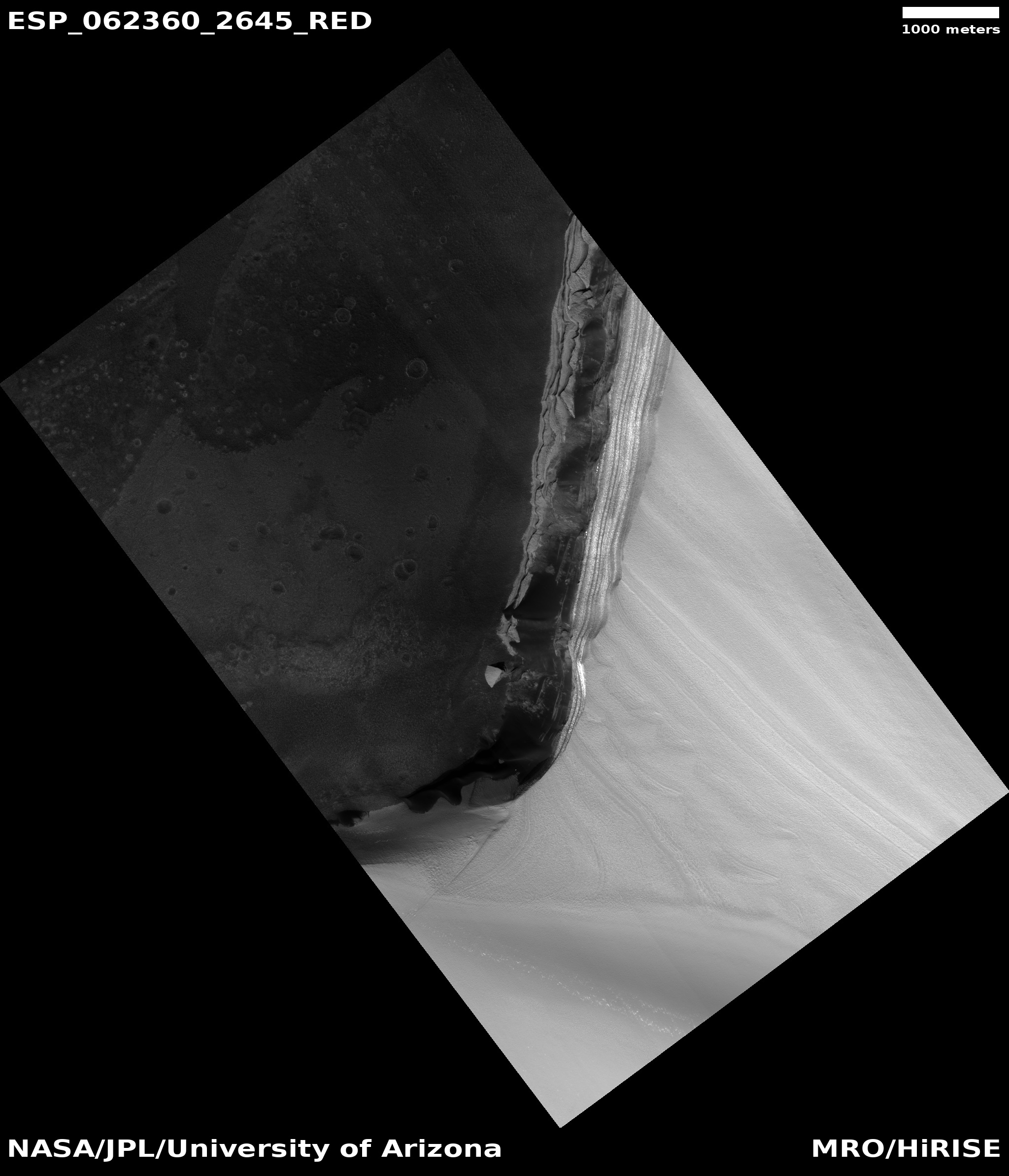
The cliff at the end of Chasma Boreale on Mars

The cliff at the end of Chasma Boreale
Click for full image.

Cool image time! The image to the right, cropped to post here, was taken by the high resolution camera on Mars Reconnaissance Orbiter (MRO) on November 15, 2019 during the height of the Martian summer in the northern hemisphere. It shows the scarp of the polar ice cap, looking directly down that scarp at what the MRO image post dubs an “exposure of basal unit”, or the bottom of the cap itself. This suggests that the base of that cliff is no longer ice, but the bedrock below it. If this cliff is similar to other scarps off the polar ice cap it should be at least 1,600 feet tall. It might be more, however, as the elevation difference between the cap and the floor of this basin is estimated by scientists to be more than a mile total.

This scarp however is different than the outer icecap scarps where avalanches occur with great frequency during the spring and summer. Instead, it is located in the heart of the ice cap, at the very end of the gigantic canyon Chasma Boreale that slashes a deep cut into that ice cap, practically cutting it in half.

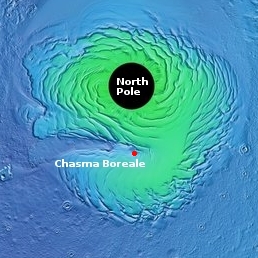
Overview

The overview map on the right, with the red dot showing where this image is located, illustrates the cutting nature of Chasma Boreale. The canyon itself is 350 miles long with a width of about 75 miles at its beginning and with walls that at some points rising a mile in height.

Scientists theorize this canyon was formed by melting ice from cap that built up at the cap’s base, causing erosion and collapse, with the flow following the grade down hill from this end point out to the lowland plains beyond. It is also possible winds played a part in this process, encouraging the canyon formation.

0 comments

Europa Clipper faces budget overruns

NASA’s $4.25 billion dollar mission to orbit the Jupiter moon Europa now faces cost overruns that threaten its launch in 2023.

The management of NASA’s Europa Clipper mission, facing dwindling cost reserves while still years away from launch, is looking at cost saving options that would preserve the mission’s science.

In a Feb. 3 presentation at a meeting of the Outer Planets Assessment Group in Houston, Jan Chodas, project manager for Europa Clipper at the Jet Propulsion Laboratory, said she was looking for ways to restore cost reserves that had declined precipitously in the last year.

Chodas said that Europa Clipper had met a JPL recommendation of 25% cost reserves, known at the lab as unallocated future expenses (UFE), when it completed a final “delta” preliminary design review in June 2019. By November, though, those reserves had fallen to just 12%, a level deemed “unacceptably low” for a mission not scheduled for launch until at least 2023.

To save money, they are “streamlining hardware testing and scaling back work on flight spare hardware. The project has also reduced the frequency of meetings of the mission’s science team.”

When the reserves in a government budget get this low, it almost always guarantees that the budget will go over. When the reserves get this low this early in the project, it almost always guarantees that the budget will go over, by a lot.

There have been other indications that Europa Clipper’s budget is in trouble. In March NASA canceled one science instrument to save money.

Making matter worse has been our lovely Congress, which has required this mission fly on its bloated, over-budget, and behind schedule SLS rocket, a mandate that is also costing the project an additional $1.5 billion (for the launch) while threatening its launch date (because of SLS delays). NASA would rather have the option to launch Clipper on the more reliable commercial and already operational Falcon Heavy, for about $100 million, thereby saving more than a billion dollars while guaranteeing its launch date. Congress so far has refused to budge, and has in fact insisted that the mission be delayed several years if necessary for getting it on SLS.

Meanwhile, Clipper itself is doing what too many big NASA projects routinely do, go overbudget.

Our federal government. Doesn’t its management skills just warm your heart?

8 comments

SpaceX’s next Starship test flight will go almost eight miles high

Capitalism in space: In its licensing request to the FCC SpaceX has revealed that its next Starship test flight, set to take off sometime between March and September of this year, will take off and land in its space facility in Boca Chica, Texas, and go almost eight miles high.

The filing also indicates the test could possibly go as high as twelve miles.

In related news, the company has announced a job fair this week, aimed at hiring people to work on Starship at Boca Chica. Want to help build the first totally reusable rocket? Here’s your chance.

5 comments

Bezos sells another $1.8 billion in Amazon stock

Capitalism in space: This past week Amazon CEO Jeff Bezos sold more than $1.8 billion of his Amazon stock, apparently as part of his continuing effort to fund his space company Blue Origin in the development of its suborbital New Shepard spacecraft, its New Glenn orbital rocket, and its Blue Moon lunar lander.

In 2017 Bezos had said he would sell off about a billion dollars per year to fund Blue Origin. However, a survey of these stock sales suggests he has upped that figured considerably, with higher sales more frequently. His first big stock sale was in May 2017 for $1 billion. The second was in November 2017 for another billion. Then in August 2018 Bezos did two stock sell-offs within a week of each other, totaling $2.8 billion.

Now, in February 2020, he has raised another $1.8 billion by selling his Amazon stock. All told, he has raised $6.6 billion in cash in just three years. According to him, all of it is supposedly for Blue Origin, though there is no public information to confirm this.

With that much cash, Bezos’s Blue Origin is likely the best funded space company in the world, and should have enough capital to build almost anything it wants.

4 comments

Momentus announces new customer for its cubesat upper stage services

Capitalism in space: Momentus, an company that is offering an upper stage to move tiny cubesats into higher orbits after launch, has announced that the United Kingdom cubesat company SteamJet has purchased that upper stage for use when its next satellite is launched on a Russian Soyuz rocket later this year.

Momentus’s approach signals a fundamental change that commercial space is now undergoing. Traditionally the launch company would provide this kind of service, but for cubesats flying as secondary payloads that isn’t possible. Momentus is thus taking it on as an independent secondary launch service for cubesats alone. With this announcement the company already has five customers, with launches scheduled for the next two years.

SteamJet also is most intriguing along these same lines.

Once in orbit, SteamJet intends to demonstrate a propulsion system that uses water or another low pressure, non-toxic, non-corrosive fluid propellant to create thrust. SteamJet houses its propulsion system in a module shaped like a tuna can that attaches to the exterior of a cubesat.

A lot of exciting things are going to be happening in space in this coming decade, and almost all will be because of private enterprise, freedom, and competition, fueled by profit.

0 comments

SpaceX wins another NASA launch contract

Capitalism in space: NASA yesterday awarded SpaceX the launch contract, estimated to cost about $80 million, to launch its Plankton, Aerosol, Cloud, ocean Ecosystem (PACE) climate mission.

That cost number seems high for a SpaceX launch, especially because, according to this Space News article, the launch will be using a reused first stage. For such launches SpaceX has generally been charging less than its standard $67 million, usually about $50 million. The press release says the contract covers both the launch and “other mission related services” but I cannot see how those additional services could raise the price almost 40%.

Unless someone at NASA is willing to prove me wrong, I suspect this is merely the case of our vaunted federal government overpaying for a service, simply because it isn’t their money and they are willing to spend extra for no reason other than it makes their job easier. Or possibly they are now playing favorites, and throwing extra money SpaceX’s way to help the company in its other endeavors, a method of funding that is really inappropriate.

12 comments
1 153 154 155 156 157 169