Scientists admit worst case global warming prediction won’t happen

The uncertainty of science: In a commentary published in the science journal Nature last week, a scientist admitted that the worse case global warming prediction, cited more the 2,500 times in the literature and a favorite of politicians and global warming activists, is not likely to happen and should no longer be referenced.

What is surprising here is not the discovery that this climate computer model doesn’t work, but that Nature was willing to publish the admission, and that this scientist, who still fears human-caused global warming, was willing to write it. The major science journals have in recent years taken sides in this scientific field, advocating the theory that increased carbon dioxide will cause the climate to warm, something no journal should ever do.

The article however has this quote that clearly illustrates the uncertainties of all climate predictions:

Scientists are still uncertain as to how sensitive global temperatures are to a doubling of CO2 in the atmosphere. The value, known as the Charney Sensitivity still isn’t known for certain, over 40 years after it was first introduced in 1979 by the United States National Academy of Sciences and chaired by Jule Charney. He estimated climate sensitivity to be 3 °C (5.4 °F), give or take 1.5 °C (2.7 °F).

Without knowing the true climate warming response to increased CO2, essentially all climate models become a crap-shoot. It is a glaring illustration of just how imprecise climate science actually is.

Note that this area of ignorance is only one of many. We don’t know the influence of pollution on the climate. We don’t know the influence of the Sun on the climate. And we don’t know the influence of clouds on the climate. And I could go on.

15 comments

Remnant moraine on Mars

Remnant moraine on Mars
Click for full image.

Cool image time! Using both Martian orbiters and rovers scientists are increasingly convinced that Mars has lots of buried glaciers in its mid-latitudes. These glaciers are presently either inactive or shrinking, their water ice sublimating away as gas, either escaping into space or transporting to the colder poles.

The image to the right, cropped and reduced to post here, shows some apparent proof of this process. Taken by the high resolution camera of Mars Reconnaissance Orbiter (MRO) on December 23, 2019, it shows a weird meandering ridge crossing the floor of a crater. The north and south parts of the crater rim are just beyond the cropped image, so that the gullied slope in the image’s lower left is actually a slope coming down from that rim.

My first reaction upon seeing this image was how much that ridge reminded me of the strange rimstone dams you often find on cave floors, formed when calcite in the water condenses out at the edge of the pond and begins to build up a dam over time.

This Martian ridge was certainly not formed by this process. To get a more accurate explanation, I contacted Dan Berman, senior scientist at the Planetary Science Institute in Arizona, who had requested this image. He explained:
» Read more

1 comment

NASA get boost in Trump proposed budget for 2021

The 2021 budget request by the Trump administration includes a big budget increase for NASA while also proposing major cuts to many of its science programs.

According to the analysis at the second link, the big gainer is Artemis. The losers in astronomy are the space telescope WFIRST and the airborne telescope SOFIA, both of which the administration wants terminated. Also on the chopping block are two climate satellites.

I plan to go through the budget in the next day or so and do my own analysis, which will also provide a longer term context that I guarantee no other news source will do. For example, routinely when most mainstream sources declare a cut in any program, it only means either a reduction in its growth rate, or a reduction to spending levels deemed entirely satisfactory only a few years before. To understand any new budget proposal, you need to look at the long term spending trends.

I will, as I have done in the past, also include more than just NASA in my analysis, reviewing the budget changes for all the science agencies.

I would do this today, but an eye doctor’s appointment this afternoon takes priority.

1 comment

The terrible consequences of NOAA’s data tampering

Link here.

In 2017 Tony Heller broke the story of how NOAA and NASA have been routinely adjusting their historic global temperature records to cool the past and warm the present in order to create the illusion that the climate is warming, far more than it is.

The post by Heller at the link above focuses in on how that tampering, which erased from the temperature data the record-hot year of 1934, is then used by both NOAA and NASA to claim each year for the past decade was the hottest ever.

The raw data however tells a far different story. The raw data from 1934, as reported amply at the time, recorded big heat waves and murderous droughts and extensive dust storms, all far more extreme than anything we have experienced in the past decade. Moreover, that raw data matches well with public news stories, and also matches well with all the published science prior to the 2000s.

Since then, however, intellectual honesty and the real scientific method has been replaced by an agenda-driven political manipulations. Having 1934 be the hottest year ever cannot stand, especially if present temperatures do not exceed that year’s records. Global warming demands a correction!

The nicest interpretation we can give to these adjustments is that the scientists are innocently engaged in confirmation bias. They believe the Earth is warming due to increased carbon dioxide in the atmosphere, and thus they must find evidence of that warming, even if it requires data adjustments to past record-hot years like 1934, adjustments that they then rationalize as necessary and scientifically justified.

More likely, they have decided that their political agenda to prove human-caused global warming requires them to be intellectually dishonest and the falsify the global temperature record. If so, this is a tragedy beyond words, as it signals that the revolution in human thought that began with the Renaissance and Galileo and was reinforced and cemented by the Enlightenment and Francis Bacon, has now ended.

That revolution made possible a burst of human creativity and civilization that lasted more than five hundred years. The consequences for future generations should that revolution be rejected now cannot be good.

18 comments

Martian dust devil!

Martian dust devil!
Click for full image.

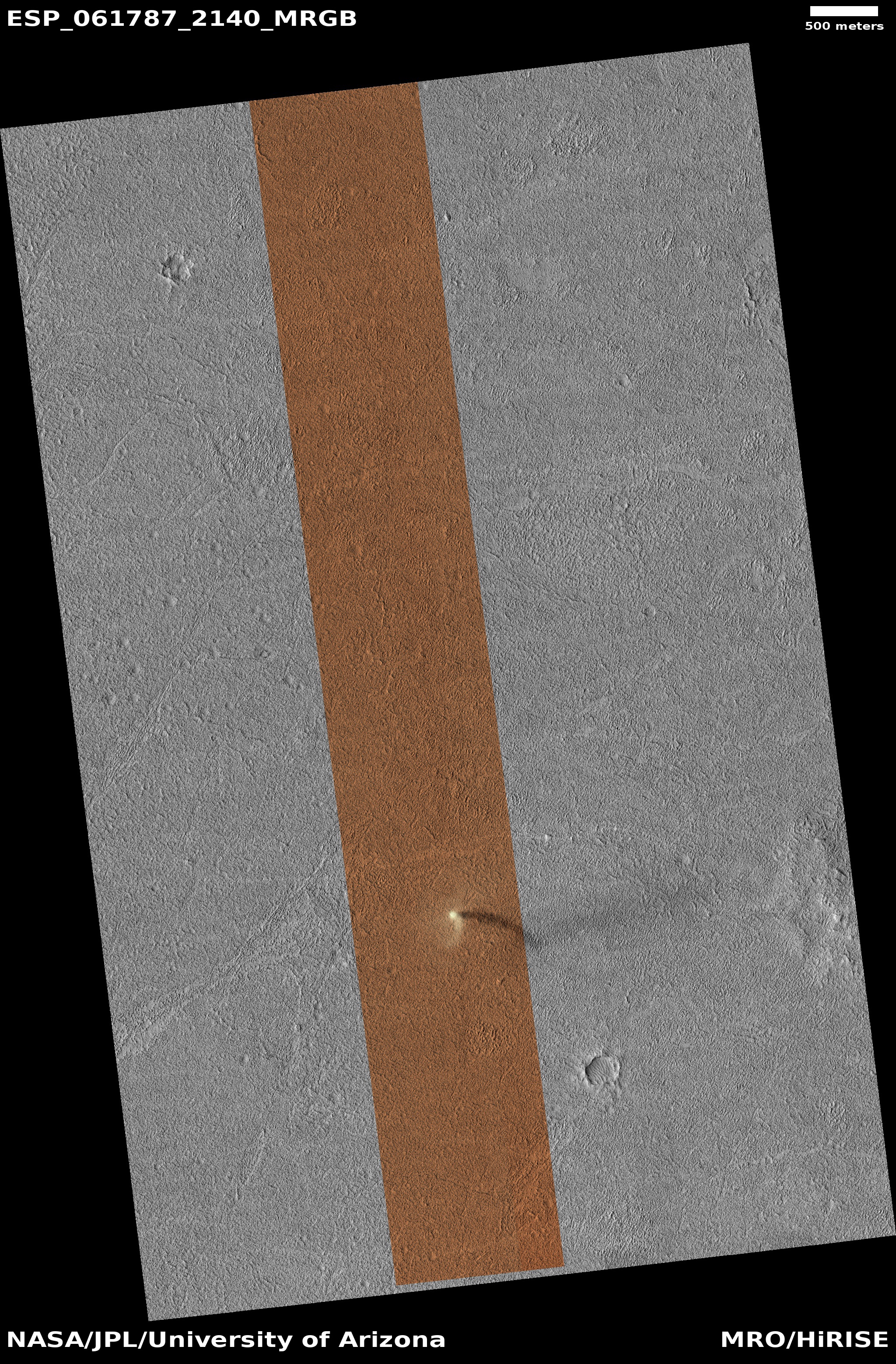
Cool image time! The science team for the high resolution camera today posted a new captioned image, cropped by me to the right to post here, showing an active Martian dust devil as it moves across the surface of Mars.

Dust devils are rotating columns of dust that form around low-pressure air pockets, and are common on both Earth and Mars. This Martian dust devil formed on the dust-covered, volcanic plains of Amazonis Planitia. The dust devil is bright, and its core is roughly 50 meters across. The dark streak on the ground behind the dust devil is its shadow. The length of the shadow suggests the plume of rotating dust rises about 650 meters into the atmosphere!

That’s about 2,100 feet tall, almost a half mile in height. The location, Amazonis Planitia, is part of the northern lowlands of Mars, flat and somewhat featureless. It is also somewhat near the region near Erebus Montes that is the candidate landing site for SpaceX’s Starship rocket, a region that appears to have a lot of ice just below the surface.

The science team also linked to a 2012 active dust devil image that was even more spectacular. I have also posted on Behind the Black a number of other dust devil images, highlighting this very active, dramatic, and somewhat mysterious aspect of the Martian surface:
» Read more

3 comments

ULA’s Atlas 5 launches Solar Orbiter

Capitalism in space: ULA tonight successfully launched a new solar science spacecraft Solar Orbiter.

For more information about Solar Orbiter, which will take the first high resolution images of the Sun’s poles, see the link above or video I’ve embedded below the fold.

Earlier today Northrop Grumman aborted the launch of its Cygnus cargo freighter to ISS only three minutes before launch because of an issue with a ground support sensor. Right now they are are targeting a new launch date of February 13, 2020.

The status in the 2020 launch race:

3 China
2 SpaceX
1 Arianespace (Europe)
1 Rocket Lab
1 Russia
1 Japan
1 ULA

In the national ranking, the U.S. now leads China 4-3. If Northrop Grumman had launched, that lead would have been 5-3, and the U.S. total would have been comprised of four different and completely independent competing launch companies, all capable of topping the efforts of entire nations. If that doesn’t illustrate the power of freedom, capitalism, competition, and private ownership, I don’t know what does. Moreover, this is only the start. The U.S. right now has numerous other new launch companies rushing to join the competition.

Even more startling, the way we do things is freely available to every other nation in the world. All they have to do is to embrace freedom and the reduction of control and power by their governments. Sadly, very few in these times are willing to do this. In fact, even the U.S. resisted this concept for the entire last half of the 20th century. Only in the past decade have we returned to our roots, and that decision is now beginning to bear abundant fruit.
» Read more

0 comments

Sunspot update: A tiny burst of activity that might mean something

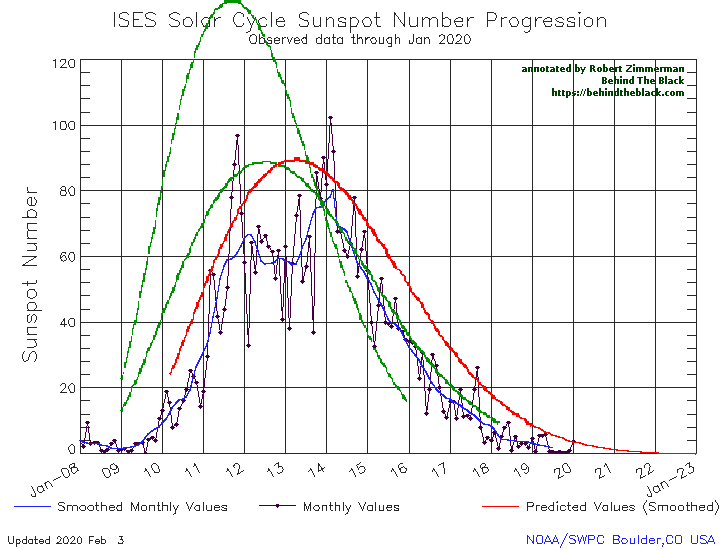
On February 3, 2020, NOAA posted its January of its monthly graph showing the long term sunspot activity of the Sun. As I have done now every month since this webpage began in 2011, it is posted below, with annotations:

After seven months of practically no sunspot activity, the longest such stretch in probably a century, January had a tiny burst of activity, breaking that string. Of the month’s four sunspots, two had a polarity from the old solar cycle, two from the new.

January 2020 sunspot activity
The graph above has been modified to show the predictions of the solar science community for the previous solar maximum. The green curves show the community’s two original predictions from April 2007, with half the scientists predicting a very strong maximum and half predicting a weak one. The red curve is their revised May 2009 prediction, extended in November 2018 four years into the future.

Despite their low number and general weakness, the continuing appearance of sunspots with polarities aligned with the new cycle strongly indicates that we will have a solar maximum in the next five years, not a grand minimum lasting decades that some scientists are predicting. While the year is young and it is certainly too soon to trust any trends, the fact that January saw an increase in activity over the past seven months suggests that we might have passed the low point of the minimum. We shall find out this year.

It must be remembered that the uncertainties in this field of science remain gigantic. No one really understands why the Sun’s magnetic dynamo goes through these cycles and flips in polarity. No one really understands why it produces sunspots as it does. And no one for sure yet knows exactly how the Sun’s cyclical behavior directly effects the climate. We only have circumstantial evidence, some of which can be legitimately questioned.

What is certain is that we don’t know very much, and are always in error when we forget this fact. Remember this always when some politician or scientist claims the science is settled or certain, and they know without doubt what is going to happen. They are either lying, fooling themselves, or are simply fools. In any case, such certainty in science should never be trusted.

6 comments

The impact of coronavirus on China’s space industry

Link here. The focus when discussing the epidemic, which continues to grow, should certainly not be on how it is slowing China’s space industry. At the same time, any slow down in their space effort will give us a good indicator on how the virus is effecting their entire economy.

Anyway, it appears, at least as this moment, that the biggest effect in space is the halt of operations for the Kuaizhou smallsat rocket.

Expace, a launch service provider for solid-propellant Kuaizhou rockets, has temporarily halted work due to its proximity to the epicenter of the outbreak. A new Kuaizhou-11 rocket, larger than the Kuaizhou-1A currently in service, was reportedly scheduled for a test flight late February.

Expace is situated in the Wuhan National Space Industry Base, a hub designed to facilitate commercial space activities. The firm is a spinoff from defense contractor CASIC and its subsidiary, China Sanjiang Space Group. The Kuaizhou launch vehicle series are understood to be derived from missile technology.

Other impacts probably won’t become obvious for months, when we can gauge whether there has been a slow down in Chinese launches below the predicted 40 for 2020.

7 comments

Voyager-2 back in action

Engineers announced yesterday that Voyager-2 has resumed science operations after going into safe mode in late January.

“Mission operators report that Voyager 2 continues to be stable and that communications between Earth and the spacecraft are good,” agency officials wrote in a mission update yesterday. “The spacecraft has resumed taking science data, and the science teams are now evaluating the health of the instruments following their brief shut-off.”

Still ticking after 42 years in space. Take that, Timex!

4 comments
1 151 152 153 154 155 169