Webb to release first science images July 12th

The science team for the James Webb Space Telescope announced today that the first infrared science images from the telescope will be released on July 12, 2022.

The first images package of materials will highlight the science themes that inspired the mission and will be the focus of its work: the early universe, the evolution of galaxies through time, the lifecycle of stars, and other worlds. All of Webb’s commissioning data – the data taken while aligning the telescope and preparing the instruments – will also be made publicly available.

In many ways this first release will likely mirror the first release of images from the Hubble Space Telescope in 1993, after its serious focus problem had been solved. Then, the science team and NASA picked images for the press conference that, to them, would pass what they called the “grandmother test,” whereby an ordinary person not familiar with space objects would still instantly recognize the object imaged.

The result of that criteria was that some of Hubble’s best ground-breaking first images were not included, such as its first sharp picture of the exploding star Eta Carinae. While the images shown were beautiful, they did not immediately demonstrate what Hubble was going to accomplish. The Eta Carinae picture did however.

Hopefully this time the scientists will be more daring, and have a greater respect for the general public, and include some infrared images that are not familiar to non-scientists. It is such data that is almost always the most exciting.

1 comment

On the radio…

UPDATE: The show started late due to technical problems, but is going on now!

I will be doing another long guest appearance tonight on The Space Show with David Livingston, beginning at 7 pm (Pacific). You can listen live here. (link fixed, though now it doesn’t matter as the show just ended. It will be archived and available in a day or so.)

As always, I strongly encourage my readers to call in. Makes the show more fun.

3 comments

Pushback: HOA demands flag be removed; Neighbors rally and raise their own flags

Banned by Cumberland Crossing HOA
Free speech banned by Cumberland Crossing HOA.

Bring a gun to a knife fight: When the Cumberland Crossing HOA in Ohio demanded that resident Thomas DiSario take down the thin blue line flag he had been flying for five years to honor his son — who had been a policeman killed in the line of duty — he not only refused, all his neighbors rallied in support by raising their own flags throughout the neighborhood.

Some neighbors in a subdivision near Etna are making a statement after a resident was told to take down his “thin blue line flag” by the Homeowner’s Association. The HOA told him to remove it, calling it a political statement.

“I applaud them for it and it’s growing. You see more flags out every few days, you see a few more flags and blue light bulbs,” said Kathy Riddle, neighbor.

More and more neighbors in Cumberland Crossing are mounting thin blue line flags outside their homes. “We wanted to show respect for our neighbor. And we appreciate the service that his family member gave,” said Riddle.

It appears that the HOA demanded the flag’s removal after one complaint, and claimed the reason for doing so was simply because “It is a political statement.” The image below shows the text from the HOA letter, clearly indicating that its reasons for demanding the flag’s removal was an attempt by the HOA to ban political speech.
» Read more

28 comments

Astronomers discover pulsar with slowest rotation rate of any known neutron star

The uncertainty of science: Using the MeerKAT radio telescope in South Africa, astronomers have discovered a pulsar with the slowest rotation rate of any known neutron star, completing each rotation every 76 seconds.

According to the press release:

Neutron stars are extremely dense remnants of supernova explosions of massive stars. Scientists know of about 3,000 of these in our Galaxy. However, the new discovery is unlike anything seen so far. The team think it could belong to the theorised class of ultra-long period magnetars – stars with extremely strong magnetic fields.

From the paper’s abstract:

With a spin period of 75.88 s, a characteristic age of 5.3 Myr and a narrow pulse duty cycle, it is uncertain how its radio emission is generated and challenges our current understanding of how these systems evolve. The radio emission has unique spectro-temporal properties, such as quasi-periodicity and partial nulling, that provide important clues to the emission mechanism. Detecting similar sources is observationally challenging, which implies a larger undetected population. Our discovery establishes the existence of ultra-long-period neutron stars, suggesting a possible connection to the evolution of highly magnetized neutron stars, ultra-long-period magnetars and fast radio bursts.

Essentially, a pulsar with this length rotation was not expected, and its existence throws a wrench into present theories about their formation and evolution. That its existence might provide a link between neutron stars, magnetars, and the as-yet unexplained fast radio bursts, however, is very intriguing.

1 comment

Rogozin: Russia’s first lunar lander in decades to launch by end of September

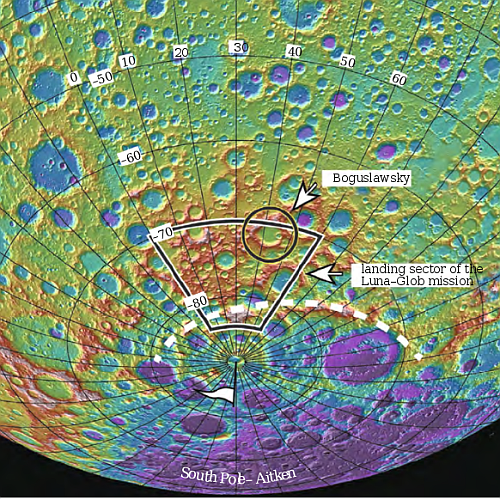
The landing area for Luna-25

The new colonial movement: Dmitry Rogozin, the head of Russia’s Roscosmos space corporation, revealed yesterday that it is now targeting the end of September for the launch of Luna-25, the first Russian lunar lander to the Moon since Luna-24 in 1976.

The Russians hope to land the rover near 60-mile-wide Boguslawsky crater, located about 550 miles from the Moon’s south pole. The map to the right, figure 1 from a 2018 paper, provides the reasoning for picking this location.

The Luna–Glob mission [the title for the entire Russian program of future lunar probes] is designed for investigations in the polar regions of the Moon and targeted primarily on testing a new generation of technologies for landing a descent module. In this regard, the choice of scientific tasks of this mission is rather subordinate. Further realization of our lunar program, inclusive of the Luna–Resource mission with an extended complex of scientific tasks, and subsequently, a new generation of lunar rovers and modules for lunar subsurface sampling and return to the Earth, depends on the results of the present mission [Luna-25]. …The detailed photo geological analysis of the surface in the Luna–Glob mission landing sector (70°–85° S, 0°–60° E) using high-resolution images and topographic data made it possible to select the definite landing site. This site (the eastern landing ellipse, 73.9° S, 43.9° E) on the Boguslawsky floor represents a higher scientific priority and also provides relatively safe landing conditions.

The Russians have been attempting to launch this Luna-Glob program for almost a quarter of a century. Hopefully the first launch will finally happen this year.

4 comments

FAA once again delays approval for launching Starship from Boca Chica

Capitalism in space: The FAA today announced that it is once again delaying release of its environmental reassessment of SpaceX’s Boca Chica facility in Texas, setting a new release date only two weeks hence.

The FAA intended to release the Final PEA on May 31, 2022. The FAA now plans to release the Final PEA on June 13, 2022 to account for ongoing interagency consultations. A notice will be sent to individuals and organizations on the project distribution list when the Final PEA is available.

The previous five delays had each been month-long. This two week delay strongly suggests that the bureaucrats are getting close to a final agreement. Whether that means SpaceX will receive an approval, which is what the initial draft had suggested back in December, or be blocked, we shall have to see. A statement SpaceX CEO Gwynne Shotwell in mid-May that the company would be ready to launch Starship by June suggests it will be an approval.

I have been predicting since December that the month-by-month delays would continue until after the November election. I will be quite happy if that prediction ends up wrong.

2 comments

Freedom Toons – Jordan Peterson sings Evanescence

An evening pause: I don’t know why, but to me this cartoon, which puts the fundamental words of Jordan Peterson to the tune of a rock song, with appropriate but light-hearted visuals, seems perfect for this year’s Memorial Day. From the song:

You cannot escape the suffering that comes with life
Carry all your pain
Become hero archetype

The past generations who sacrificed their lives for our civilization, whom we are supposed to honor and remember today, understood these words and didn’t need a teacher to explain them. Today’s generation, badly taught by my 60s generation, needs to hear them and think about them. If they do, the future will be bright indeed.

Hat tip Geoffrey Carman.

7 comments

Today’s blacklisted American: College punishes student for telling others about her religious exemption from COVID jab

Free speech voided at Oakland University

They’re coming for you next: The Oakland University (OU), a public college in Michigan, has punished student Inara Ramazanova because she had the nerve to describe to others how she had gotten a religious exemption from its mandate that all students get COVID shots or be banned from campus.

From the warning letter [pdf] sent to the university by her lawyers, the First Liberty Institute:

Last summer, OU granted Ms. Ramazanova a religious accommodation from the university’s COVID-19 vaccine mandate. The accommodation would have allowed her to reside on campus for the 2021–22 academic year.

However, OU evicted Ms. Ramazanova after it deemed her protected, religious speech, which Ms. Ramazanova intended to aid others in the exercise of their rights, to be “collusion or conspiracy” under the OU’s Code of Conduct for sharing about COVID-19 religious accommodations in a private Facebook group. OU’s decision forced Ms. Ramazanova to spend her final semester at OU living at home and attending classes online while participating in OU-required weekly COVID-19 testing on campus.
» Read more

4 comments

The new satellite industry, energized by freedom

Liberty enlightening the world
Liberty enlightening the world, both on it and in space.

Last week SpaceX successfully completed its 22nd launch in 2022, sending 59 smallsats into orbit with its Falcon 9 rocket.

In the past few decades, the launch of a smallsat would generally have not merited much further coverage. These satellites, almost always based on the 10-centimeter (or 4-inch) square cubesat design, had generally been short term objects built almost always by university students not so much to do space research as to simply learn how to build satellites and learn how they operated in orbit.

This has now all changed, fueled both by the immense drop in launch costs generated by the competition between the new rockets built by SpaceX and the new emerging smallsat rocket companies (Rocket Lab, Virgin Orbit, and Astra) and by the improved capabilities of miniaturized components. Cubesats can now do far more despite being tiny, and they can be launched for much less money.

The result has been wonderfully illustrated by the satellites launched last week on that Falcon 9. Below is a short list of the press releases in the past few days, announcing the successful activation of these satellites:
» Read more

6 comments

Boeing picks company to manufacture flight suits for passengers on Starliner

Dover's spacesuits
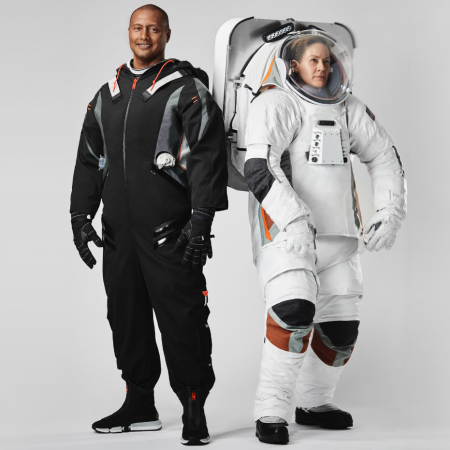
ILC Dover’s spacesuits.

Capitalism in space: On May 26th ILC Dover announced it has been chosen by Boeing as one of two companies to manufacture flight suits for passengers on Starliner.

The Boeing AES [Ascent/Entry Suit] is based off ILC Dover’s commercial Launch, Entry, and Abort suit, SOL™. ILC Dover worked with Boeing to tailor SOL for the Starliner spacecraft to provide protection for astronauts during the most critical phases of spaceflight, including launch, docking, re-entry and landing. With over 50 years of spacesuit experience, the AES suit was designed to provide maximum mobility to operate, enter and exit the spacecraft, as well as provide protection for astronauts in case of an emergency.

The black spacesuit on the left in the picture is Dover’s SOL suit, which it is adapting for Boeing. The white suit is the spacewalk suit it has made for NASA for use on ISS, which I also think is the same spacesuit that has for now almost a decade had repeated problems with water leaking into the helmet.

In other words, big space Boeing has hired another big space company to build its Starliner flight suits. I hope ILC Dover does a better job with the AES suit then it has with its EVA suit.

12 comments

Egypt to create a “space city” for space research and development

The new colonial movement: Mohamed al-Qousy, the head of Egypt’s space agency, announced yesterday that by the end of this year it will open a 123-acre site devoted to space research and commercial space business.

Qousy explained that the space city will contain 23 buildings to serve space activities, including a space academy, a research center, a center for the assembly of satellites, and a museum in the form of tourism in addition to the African Space Agency.

The agency aims to develop and transfer space science and technology into Egypt to build satellites and launch them from Egyptian territories.

It is not clear how much of this facility will be government-run, or privately owned. It appears most will be run by the government.

0 comments
1 117 118 119 120 121 192