China plans more than 50 launches in 2022

China today released what it calls a blue paper outlining its space plans for 2022, predicting it will launch more than fifty times while completing assembly of its Tiangong space station.

The Shenzhou-14 astronauts will be aboard Tianhe core module for the arrival of the 20-metric-ton-plus Wentian and Mengtian modules, both now expected to launch in the second half of the year, later than earlier tentative times of June and August respectively. The module launches will complete the T-shaped orbital outpost. Tianzhou-5 will launch ahead of Shenzhou-15, both scheduled for late in the year.

Work on the Long March 2F, Long March 5B and Long March 7 rockets for launching Shenzhou, space station module and cargo missions respectively continued during the recent Lunar New Year holiday, according to CASC [China’s space agency]. The module launches will be followed closely, partly due to the significance of the missions, but also because of the use of the Long March 5B, the two previous launches of which saw the large first stages make high-profile uncontrolled reentries which sparked acrimony.

The rocket maker, the China Academy of Launch Vehicle Technology (CALT), says it has further optimized the two new Long March 5B rockets to ensure mission success without providing details. [emphasis mine]

The highlighted words, as well as the delay in launch of these two modules, suggests China might have done some work on its Long March 5B to control the de-orbit of its core stage.

China also says the year will also include the first six month long mission on Tiangong, as well as the first arrival of two crews to the station.

My present count of all proposed launches for 2022 is just under 200, more than double the average number of launches (89) completed annually since the launch of Sputnik. U.S. companies alone right now are predicting 100 launches. While all of these numbers are uncertain, it looks like ’22 will be a banner year for space exploration.
0 comments

Forty just-launched Starlink satellites lost because of geomagnetic storm

SpaceX revealed today that because of the unexpected and ill-timed arrival of a geomagnetic storm from the Sun, 40 of the 49 Starlink satellites launched on February 3rd were lost and will quickly burn up in the atmosphere. As noted at Teslarati:

SpaceX says it “commanded the satellites into a safe-mode where they would fly edge-on (like a sheet of paper) to minimize drag” as soon as it was aware of the issue but that “the increased drag…prevented the satellites from leaving safe-mode to begin orbit raising maneuvers.” Based on that phrasing, the most obvious explanation is that the added drag caused up to 40 of the satellites to fall far enough into the atmosphere that their ion thrusters would no longer be able to raise their orbits faster than the drag was lowering them. Raising their solar arrays into the position needed for maximum power generation (and thus maximum sustained thrust) would also drastically accelerate reentry.

A lot of the press and those who love to attack SpaceX have made a big deal about this, but the real news of this story is the unprecedented impact of a geomagnetic storm on some newly launched satellites. Such a thing has never happened before, and only happened now because SpaceX does not raise the orbits of any Starlink into a more stable orbit before making sure the satellite is functioning properly. If it is not, the company leaves it in a low orbit so it quickly burns up and does not add to the amount of space junk in orbit. This approach is also somewhat unprecedented, but it also demonstrates SpaceX’s generally rational and responsible approach to what it does in commercial space.

Because of this approach, however, these satellites were vulnerable to this storm. The timing had to be just perfect to destroy them, and sadly for SpaceX it was. I fully expect SpaceX to add solar activity as a factor in timing future Starlink launches.

Note: I didn’t initially comment because I don’t see this as that big a deal. The effort to slander SpaceX by some (see the quotes for example near the end of this article) however changed my mind.

15 comments

Amira & Friends – My Way

A evening pause: Performed live in 2017. It is sad that too many now no longer honor someone who follows these words, but despises them instead:

For what is a man, what has he got?
If not himself, then he has naught
To say the things he truly feels
And not the words of one who kneels
The record shows
I took the blows
And did it my way

Hat tip Mike Nelson.

2 comments

Parker images the surface of Venus

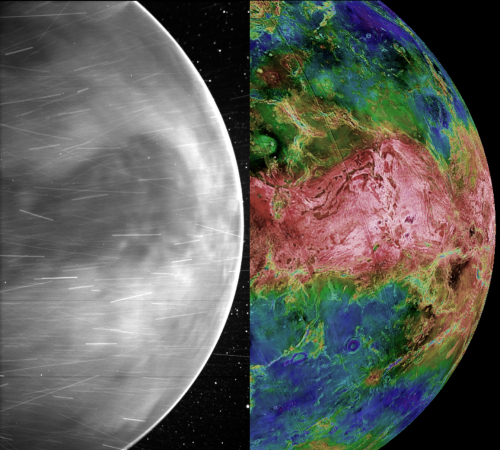
Parker image compared to radar maps of Venus
For original images go here and here.

During its flybys of Venus in July 2020 and February 2021 the Parker Solar Probe used its wide field camera to take images of the night side of Venus in red optical and near infrared wavelengths, essentially measuring the heat (in the range of 863 degrees Fahrenheit) being emitted by the planet’s surface.

The resulting images, the first orbital photos of Venus’ surface in the optical, showed continent-sized surface details that matched previously made radar maps, and confirmed as expected that the higher altitudes are cooler than the lower.

The paper outlining these results can be read here.

The two pictures to the right compare previous radar maps (on the right) with the new Parker image (on the left). The central dark and cooler area is a region called Aphrodite Terra, which like Earth’s continents sits higher than the surrounding terrain.

Note that though cooler, the surface at these dark areas is still hellishly hot, more than 800 degrees Fahrenheit. Exploring the surface of Venus is going to be a far far far more challenging task that going to Mars.

11 comments

Mars: Glaciers on top of glaciers on top of glaciers

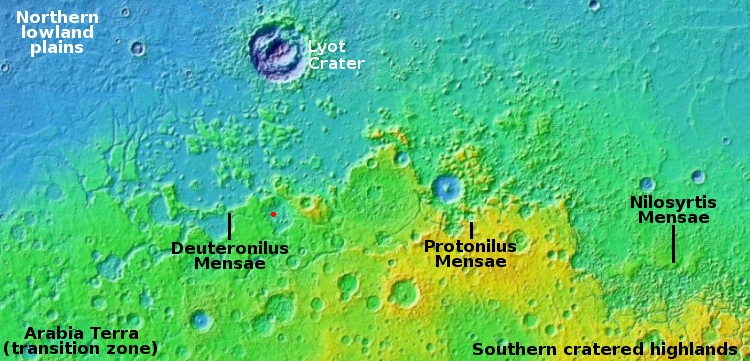
Overview map
Mars’ glacier country.

glaciers on top of glaciers on top of glaciers
Click for full image.

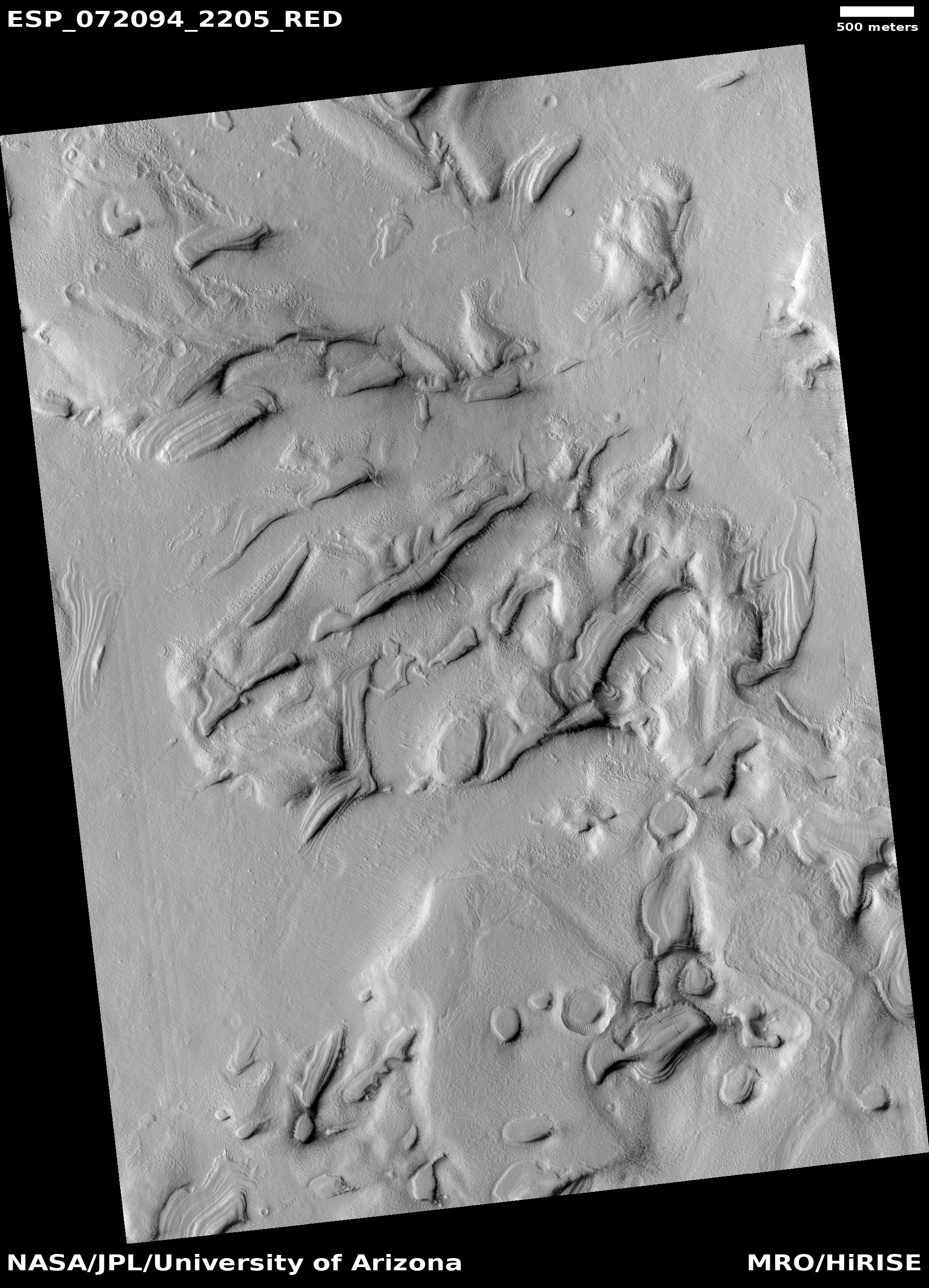
Cool image time! The photo to the right, rotated, cropped, and reduced to post here, was taken on December 12, 2021 by the high resolution camera on Mars Reconnaissance Orbiter (MRO). It shows a small patch of layered glacial features flowing in all directions. The overview map above marks its location by the red dot, at 40 degrees north latitude in the region dubbed Deuteronilus Mensae, on the western end of the 2,000 long strip from 30 to 60 degrees north latitude that I dub Mars’s glacier country because practically every image in this region shows glacial features.

What makes the glacial features in this picture so remarkable is their number, their somewhat chaotic nature, and the evidence of many layers, suggesting a cyclical process of ebb and flow over the eons.

Below I zoom into one section of this photo, showing that section at full resolution.
» Read more

1 comment

Pushback: Oral surgeon sues state for shutting down his practice for refusing COVID shots

Oral surgeon Stephen Skoly, blackballed by Rhode Island

Don’t comply: Stephen Skoly, an oral surgeon in Rhode Island, has sued both his governor, Democrat Daniel McKee, and the head of the state’s health department, James McDonald, for shutting down his dental practice — serving 800 patients monthly — and preventing him (and his ten employees) from earning a living, simply because he has decided for medical reasons not to get the COVID shots.

Skoly, who’s been a dental surgeon since 1990, requested medical exemption from the COVID-19 vaccine because of his history of Bell’s palsy paralysis, the complaint says, and he says he has “natural immunity” against the virus because of a “blood test” that confirmed he has COVID-19 antibodies.

More information here.
» Read more

6 comments

Have astronomers discovered an asteroid with three moons?

The uncertainty of science: According to a New York Times article published yesterday, astronomers have now discovered an asteroid with three moons, making it the first such asteroid ever discovered.

The asteroid, Electra, was first discovered in 1873, and orbits the Sun in the asteroid belt between Mars and Jupiter. It was already known that it had two moons. The new research thinks it has found a third.

In reading the researchers’ the actual paper describing this research, it appears that the Times is spinning the data, making it sound more certain than it is. This new result comes entirely from new software that was designed to better resolve archival images of the asteroid, and thus carries a lot of uncertainty. From the paper’s conclusion:

[There remain] a lot of uncertainties remain concerning the orbit of S3 [the new asteroid moon]. More data on S2 and S3, as well as a more thorough dynamical study are necessary to solve the problem of the motion of the satellites of Elektra. However, the discovery of the first quadruple asteroid system slightly opens the way for understanding the mechanisms of the formation of these satellites.

In terms of data processing, S3 is barely visible in the data reduced with the standard pipeline and processed with standard halo removal algorithms and it was missed until now.

The paper repeatedly notes that the orbital data for Electra and its moons is presently “poorly constrained” and needs significant refinement in order to confirm this result.

If true, however, these moons are probably pieces that broke off of Electra at some point in the past, and could provide good information about the long term history of asteroids in the asteroid belt.

0 comments

Swiss startup raises $29 million to build a hypersonic commercial plane

Capitalism in space: Destinus, a new Swiss startup, has successfully raised $29 million in seed money to begin development of a hypersonic commercial plane.

Destinus is developing a vehicle that takes off and lands horizontally under the power of airbreathing jet engines. Once out of controlled airspace, Destinus’ hyperplane is designed to accelerate to hypersonic speeds with the help of a cryogenic hydrogen-fueled rocket engine, according to the company’s Feb. 8 news release.

Destinus has been testing airbreathing engines during flight tests of an unpiloted prototype. By the end of the year, the company aims to show its prototype can break the sound barrier

This company’s founding has an interesting backstory. Its founder, Mikhail Kokorich, was a major investor in the American space tug company Momentus. When the Defense Department forced him to sell his share in that company last year because he was not an American, he moved to Switzerland to form Destinus instead. Nor is this Kokorich’s only endeavors in commercial space. He has started a number of other small companies previously.

Don’t expect Destinus’s plane to fly in the near future. Though it has already flown a small scale prototype, the company only started to hire engineers in the past few months.

1 comment

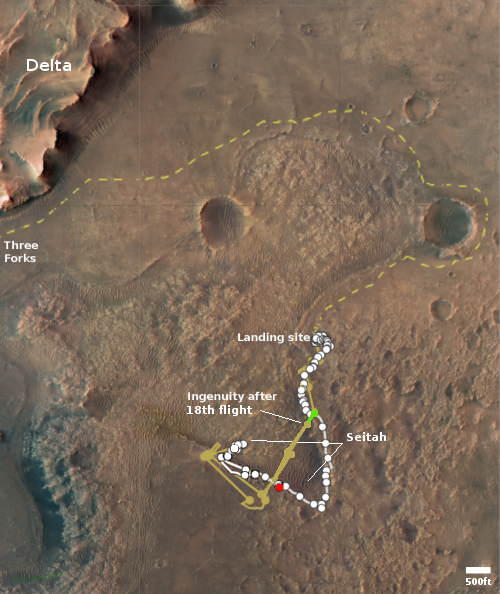
Ingenuity completes 19th flight

Perserverance and Ingenuity as of February 8, 2022
Click for interactive map.

The Mars helicopter Ingenuity yesterday successfully completed its 19th flight on the Martian surface, traveling for 99 seconds about 200 feet to the northeast, landing close to the landing site of its 8th flight back in June 2021.

The map to the right shows the helicopter’s overall travels in tan, with the 19th flight path in green. The white line marks Perseverance’s travels, with the red dot indicating its present location. The dashed yellow line indicates the rover’s planned route. To achieve that the rover team is retracing its steps along the path it had previously traveled, with Ingenuity flying in front, along that path.

The flight had been delayed more than a month while waiting for a dust storm to settle as well as making sure Perseverance was in a good position to maintain communications throughout the flight. With Perseverance finally on the move to the east and the dust storm subsiding, the Ingenuity flight was finally possible.

0 comments

Pioneer game update: Full demo of game released

Though no launch date for the Kickstarter campaign for funding the creation of a videogame based on my science fiction book Pioneer has been announced, the producer, Aaron Jenkin, early this week released the full demo of the game. You can download a version for either Windows, Mac, or Linux here.

I’ve played the Linux version and had a great time. While this is only a demo, Aaron has captured the feel of my book, while adapting it to the needs of a video game. I really hope when the Kickstarter campaign starts, it quickly raises enough to produce the game. It will be a blast for players.

For those who want to get the game’s newsletter updates, published about once per week, you can subscribe at PioneerSpaceGame.com. If you are definitely interested in donating to the game, you should also subscribe as it gives Aaron a sense of the amount of interest (the numbers have been rising quickly in the past month, a very good sign!).

For those who want to get a sense of of what the game itself will be like now, below the fold is the game’s trailer.
» Read more

13 comments
1 171 172 173 174 175 192