Pushback: Republicans move to expel Democrats who gave aid to rioters in Tennessee statehouse

Riot in Tennessee Statehouse
L to R, Gloria Johnson, Justin Jones and Justin Pearson stand at
the podium, using a bullhorn to lead protester chants.

Bring a gun to a knife fight: Wasting no time following the riot by protesters that invaded the Tennessee statehouse on March 30, 2023, Republican state legislators have removed from all committees the Democratic Party legislators who gave aid to rioters and are now moving to have them expelled from office.

Resolutions have been filed against Reps. Gloria Johnson, Justin Jones and Justin Pearson after they led chants from the House floor with supporters in the gallery last Thursday. The resolution declared that the three had participated in “disorderly behavior” and “did knowingly and intentionally bring disorder and dishonor to the House of Representatives.”

Republican Reps. Bud Hulsey, Gino Bulso, and Andrew Farmer filed the resolutions. They successfully requested Monday that the House expedite the process and vote on the resolutions Thursday.

Not surprisingly, the three legislators threatened with expulsion claimed they did nothing wrong, even though all three shared a bullhorn in the chamber (as shown in the picture above), leading chants for the demonstrators. Justin Pearson proudly touted what he did in a tweet:
» Read more
3 comments

Exploring the cratered southern highlands of Mars, part 1

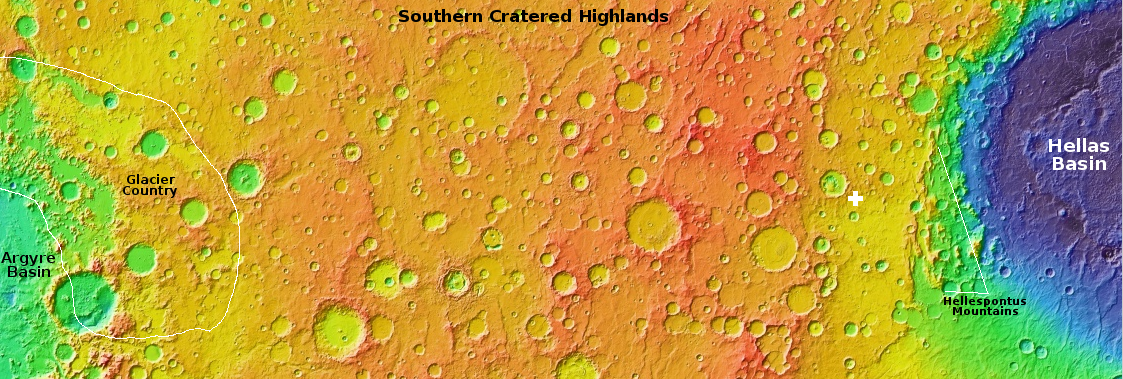
Overview map of southern cratered highlands of Mars

Glacial filled crater
Click for original image.

Today and for the next three days the cool images that I will post from Mars will explore a region that I have not covered very much in depth, the cratered southern highlands between the giant basins Argyre and Hellas. The map above is an overview of this 7,000-mile-long region, all of which is inside the 30 to 60 degree south latitude band where scientists have found much evidence of buried glaciers. In this region the bulk of that evidence is most obvious inside craters.

The picture to the right, cropped, reduced, and sharpened to post here, was taken on December 21, 2022 by the high resolution camera on Mars Reconnaissance Orbiter (MRO), and shows a typical example of the kind of glacial feature found. The white cross on the map marks its location, west of the Hellespontus Mountains that form the western rim of Hellas Basin.

Scientists have dubbed this feature concentric crater fill, a purposely vague term because — though it looks like glacial fill — until there is data to confirm it the scientists would quite properly rather not commit themselves. The concentric rings suggest multiple layers, each of which likely marks a different climate cycle in Mars’ geological history.

In this case the glacier features also appear to cover the entire plain surrounding the crater as well as its rim. The small crater to the west is similar, and both give the appearance that the ice sheet that covers them came after the impact, draping itself over everything, with the craters only visible because the ice sheet sags within their interiors.

More crazy features from the cratered highlands to come.

0 comments

First binary quasar found

Double quasar as seen by the Hubble Space Telescope

Using a suite of telescopes on the ground and in orbit, astronomers have found the first galaxy made up of two quasars, supermassive black holes that are very active in eating material from around them.

ESA’s (European Space Agency) Gaia space observatory first detected the unresolved double quasar, capturing images that indicate two closely aligned beacons of light in the young universe. Chen and his team then used NASA’s Hubble Space Telescope to verify the points of light were in fact coming from a pair of supermassive black holes.

Multi-wavelength observations followed; using Keck Observatory’s second generation Near-Infrared Camera (NIRC2) paired with its adaptive optics system, as well as Gemini North, NASA’s Chandra X-ray Observatory, and the Very Large Array network of radio telescopes in New Mexico, the researchers confirmed the double quasar was not two images of the same quasar created by gravitational lensing.

The two quasars are estimated to be only about 10,000 light years apart. Scientists estimate that this galaxy is about ten billion light years away, and exists in this state only about three billion years after the Big Bang.

0 comments

Shetland Spaceport now faces same regulatory hurdles that destroyed Virgin Orbit

The new Shetland spaceport, Saxavord, is right now attempting to get launch approvals from United Kingdom’s Civil Aviation Authority (CAA), the same agency that dithered for six months approving a Virgin Orbit launch, thus causing the bankruptcy of that company.

According to Saxavord’s CEO, the spaceport has two launches aiming to launch before the end of this year, assuming the CAA can get its act together and give its approval. This quote however is worrisom:

The Saxavord spaceport says it is “still on track” to receive its necessary licences from the sector’s regulator before the summer. This relates to applications to the Civil Aviation Authority for range and spaceport licences.

Meanwhile SaxaVord CEO Frank Strang said the company is also on track for two rocket launches this year – “albeit they have moved slightly to the right”. [emphasis mine]

The delays could be coming from the rocket companies themselves. One of those companies is the German startup, Rocket Factory Augsburg, which has leased exclusive use of one launchsite. The other is the American startup ABL, which has had one launch attempt from the U.S. that failed.

Based on the CAA’s track record however the delays are just as likely coming from it. The CAA began this licensing process in November 2022, and is not done yet six months later.

2 comments

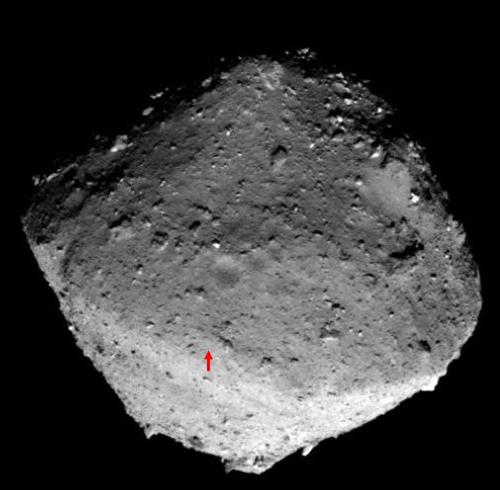
Scientists try to model what would happen if Ryugu hit Earth

Ryugu's northen hemisphere
Ryugu’s northen hemisphere. The arrow marks the spot Hayabusa-2
gathered samples

Scientists, using the data and rock samples gathered by the Japanese probe Hayabusa-2, have attempted to predict what what would happen if the rubble-pile asteroid Ryugu hit the Earth.

Without diversion intervention, Tanaka explained, if the Ryugu asteroid was heading to Earth and entered the planet’s atmosphere at an angle of 45 degrees and at a speed of around 38,000 miles per hour (17 kilometers per second), the rubble pile asteroid would break up at an altitude of around 25 to 21 miles (40 to 35 km) over the surface of the planet.

This would result in an “airburst” similar to that seen over Russia in February 2013 when the Chelyabinsk meteor erupted at an altitude of around 19 miles (30 kilometers) over Earth. The result of the Chelyabinsk blast was a bright flash of light and an atmospheric blast equivalent to the detonation of 400–500 kilotons of TNT. This is as much as 33 times the energy released by the atomic bomb that devastated Hiroshima at the end of the Second World War.

The Chelyabinsk meteor caused about 1,500 injuries, mostly from people injured by glass thrown out by breaking windows when it suddenly and unexpectedly exploded during re-entry. With Ryugu this would not be a surprise, so these injuries could be reduced, though not eliminated. The damage and injuries from pieces that survived the breakup and hit the ground remains unknown because scientists don’t know how much of the asteroid would survive the break up.

Ryugu of course poses no threat, because it is not on a collision course with Earth. Whether an asteroid like Ryugu could be diverted however remains unknown, since any such diversion must not cause the asteroid to break apart as well.

7 comments

Judges expand hiring boycott of elite law colleges that allow violent protests and censorship

Judge James Ho
Judge James Ho

Two federal judges have now expanded their hiring boycott to include Stanford Law School along with Yale Law School because the administrators at both schools have refused to punish violent student protesters who acted to silence others.

The judges, James C. Ho of the U.S. Court of Appeals for the Fifth Circuit and Elizabeth Branch, a United States circuit judge of the United States Court of Appeals for the Eleventh Circuit, will hire no graduates from these schools, thus reducing the whole reason for going there. Law students graduate hoping this diploma will get them jobs working for important judges, an early step to becoming a judge themselves.

The question that Ho and Branch raise, however, is whether any judge would want to hire any students from these particular schools. As Judge Ho noted in a speech on April 1st at the annual meeting of the Texas Review of Law & Politics.
» Read more

3 comments

The outermost edge of Mars’ north polar icecap

The outermost edge of Mars' north polar icecap
Click for original image.

Cool image time! The picture to the right, rotated, cropped, reduced, and sharpened to post here, was taken on February 4, 2023 by the high resolution camera on Mars Reconnaissance Orbiter (MRO). It shows the terminating cliffs of the north pole ice cap of Mars, dubbed Rupes Tenius on this side of the icecap.

At this point the elevation difference of the icecap’s edge from top to bottom is not significant, only about 1,500 feet or so, though this is a very rough estimate. As with all other images of the ice cape’s edge, there are many many layers visible, all indicating a different cycle in the climate history of Mars as its rotational tilt swings from about 11 degrees to 60 degrees over eons.

Moreover, at this point there is likely not that much difference between the terrain on top and the terrain below. Both will be mixed ice and dust and coarse rocks, though the percentages will be shifting towards less ice as we go down.
» Read more

1 comment

FAA issues travel advisory for Boca Chica for April 10, 2023 Starship launch

Though the FAA has not yet issued the launch license to SpaceX, allowing it to do the first orbital launch test of its Superheavy/Starship rocket, the agency today did issue a travel advisory for the Boca Chica area for April 10-11, 2023, in connection with this launch.

The FAA advisory is here. Scroll down to see the space activities section, which includes this information:

SPACEX STARSHIP SUPERHEAVY BOCA CHICA, TX
PRIMARY: 04/10/23 1310-1745Z
BACKUP(S): 04/11-12/23 1310-1745Z

Based on this information, we should expect the FAA launch license to be publicly announced any moment.

Hat tip BtB’s stringer Jay, who trolls Twitter so I don’t have to.

16 comments

English company buys land in Ohio for astronaut training facility

Blue Abyss, an English company focused on establishing “extreme environment research, test, and training centres,” has purchased twelve acres in Ohio where it plans to build an astronaut training facility.

The property, which is near Cleveland’s NASA Glenn Research Center, will include a 164-foot deep pool, microgravity center, astronaut training center, and a hotel. Brook Park Mayor Edward Orcutt described the facility as a “boot camp for astronauts.”

It appears the company is expecting there to be a lot of commercial astronauts in the coming years who will need training, and anticipates that NASA will not be capable of or interested in providing the service.

5 comments

Lockheed Martin picked by Australia to build two military communications satellites

Australia’s military announced yesterday that it has chosen Lockheed Martin as the “preferred bidder” to build two military communications satellites.

According to Australian media reports, the ADF [Australian Defense Force] is interested in buying at least two geostationary communications satellites and wants a sovereign military satcom capability. Currently Australia’s defense forces rely on commercial satellite services and on the U.S. Wideband Global Satcom constellation. Air Vice-Marshal David Scheul, head of Australia’s Air Defence and Space Systems Division, said the project will deliver the country’s “first sovereign-controlled satellite communication system over the Indo-Pacific ocean regions.”

Lockheed Martin edged out competing teams led by Airbus, Boeing, Northrop Grumman and Australia’s largest satellite operator Optus.

To get the contract, Lockheed Martin partnered with almost a dozen Australian companies. The specifics of the deal however still have to be worked out.

2 comments

Virgin Orbit files for bankruptcy

Less than a week after it laid off 85% of its workforce, Virgin Orbit’s management has filed for Chapter 11 bankruptcy.

Under Chapter 11, it appears the company can still be purchased and re-established, much like Firefly Aerospace was when it filed for bankruptcy. Since Richard Branson’s Virgin Group pumped a lot of cash into the company in the past six months, exceeding $70 million, it would get first crack at ownership rights. We should therefore not be surprised if Virgin Orbit comes back to life, owned by Branson and bought for pennies on the dollar, with the little stockholders and investors left in the lurch.

1 comment
1 145 146 147 148 149 196