The Earth hangs above the Moon

The Earth hangs above the Moon
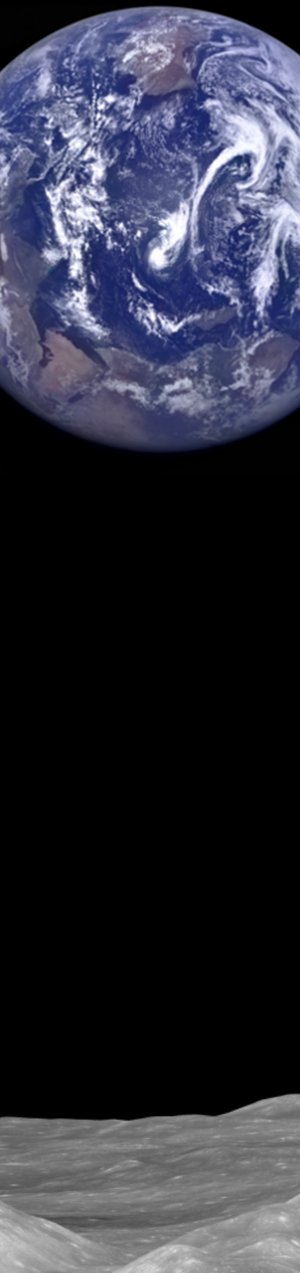
Cool image time! The picture to the right, cropped, reduced, and enhanced to post here, was taken by Lunar Reconnaissance Orbiter (LRO) on December 10, 2015 and released by the LRO team this week. From the caption:

LRO slewed to the east as it passed over the northwest rim (-8.536°N, 251.028°E, 82 km altitude) of the Orientale basin and snapped this spectacular Earth-Moon sequence with the NAC and WAC [cameras]. Tropical Cyclone Bohale is visible in the center of the image. MODIS (onboard the NASA Aqua satellite) imaged the same storm 3 hours after LRO.

The NAC and WAC images of the Earth were projected using a Point-Perspective projection to recreate the view one would see from the LRO spacecraft while taking the NAC image. Due to the relatively slow speed of the spacecraft slew, many NAC framelets of the Earth were acquired. All these WAC frames were oversampled and averaged, enabling a “super-resolution” color image (115 pixels across!), which was then combined with the 4000-pixel-wide NAC image.

…[For the Earth:] North is to the left, Antarctica to the right, Australia at the top, and Africa at the bottom

NAC and WAC are names of two different LRO cameras, one of which captured the Earth in high resolution color while the other captured the Moon. The two images were then combined, superimposing the Earth at the right size onto the second lunar image.

As noted in the caption, this view is as LRO sees the Earth from Lunar orbit, while taking a slewed oblique image of the Moon. It however is not how things would look if you were standing on the surface of the Moon. For one, the photo is zoomed in to get details on the lunar surface, making the Earth appear much larger.

For another, the image is taken 82 kilometers or 51 miles above the Moon. This higher altitude changes the position of the Earth relative to the Moon, making it appear farther from the horizon.

To a person standing in Orientale basin at 8 degrees south latitude (near the equator), but also near the edge of the visible near side of the Moon, the Earth would likely be very close to the horizon, but much smaller. To get a comparable view of the Earth, the person would likely need to use binoculars.

Orientale basin is mostly on the far side of the Moon, though it was known to exist before the space age because ground-based telescopes could see it on the edge of the visible face. It was only with the first lunar orbiters was the basin imaged from directly above, revealing its large size and distinct concentric rings forming its several circular rims.

At this location, the Earth would essentially always remain at approximately the same spot in the sky, though its illuminated face would wax and wane, like the Moon’s does, during the Moon’s twenty-eight day-long day.

3 comments

Exploring the cratered southern highlands of Mars, part 3

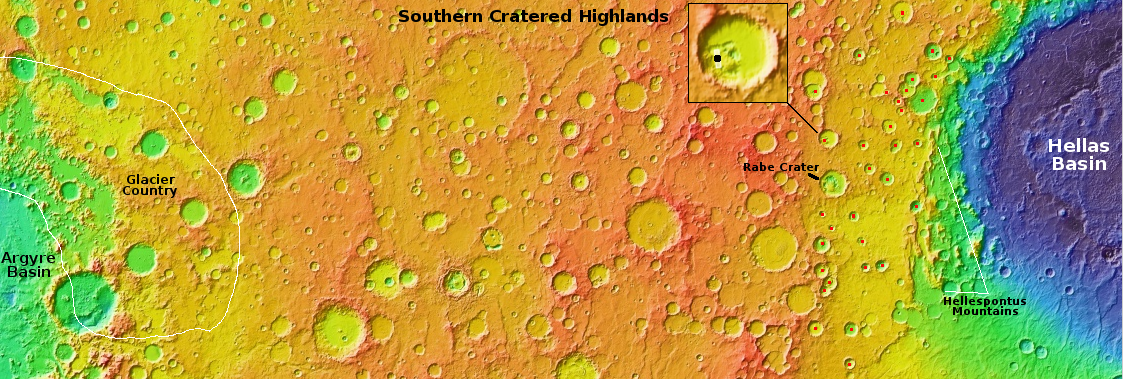
Overview map

Pit and surface in crater
Click for original image.

This is the third part of this week’s series taking a look at some of the strange features in the southern cratered highlands of Mars. In the first part I posted a beautiful image of what appears to be a crater filled to the brim with glacial ice, surrounded by an ice sheet plain. In part two we took a look at the interior of Rabe Crater, which though very nearby does not appear to have obvious glacial features within it at all. What it has instead are deep open air pits and a lot of sand dunes.

Today’s image to the right, cropped, reduced, and sharpened to post here, takes us to the interior of an unnamed 45-mile-wide crater only about 70 miles north of Rabe. The black dot in the inset on overview map above indicates the photo’s location. The picture was taken on January 1, 2023 by the high resolution camera on Mars Reconnaissance Orbiter (MRO). Like Rabe, this crater also has many large open-air pits. In the picture one pit, near the lower center of the picture, is surrounded by soft-looking mounds and a strangely swirling textured and uneven terrain that makes up the majority of the crater’s floor.

This picture might help explain what we saw in Rabe. The textured terrain in this unnamed crater could easily be ice-impregnated and now hardened sand dunes. The pit could be where that impregnated ice has sublimated away, leaving behind the dust from those ancient dunes which then forms new sand dunes. In Rabe, the crater floor above its pits looks very similar to this swirling textured surface, suggesting the same process is going on there.

What strengthens this explanation is the many other craters nearby, all indicated by red dots in the overview map above, that also have pits or distorted crater floors. Their proximity suggests that there is an underground ice layer in this region, always at about the same elevation, and each crater impact exposed it. With time that exposed ice, no longer pure but filled with material from the impacts, sublimated partly away, producing the pits as well as ample sand to form sand dunes.

0 comments

Pushback: University president forced out because she fired professor for including Muhammad images in classwork

Mohammad meeting Gabriel
One of the two works of art, “Mohammed receiving revelation
from the angel Gabriel,” that got Prater fired.

Bring a gun to a knife fight: The president of Hamline University in Minnesota, Fayneese Miller, has now announced her early retirement after the school’s faculty demanded her resignation in January when she dismissed a professor for showing images of Muhammad as part of an art class.

That teacher, Erika Lopez Prater, immediately sued.

The lawsuit, which Lopez Prater’s lawyers said on Tuesday will soon be filed in court, reiterated the professor’s previous statement that she had offered warnings before showing the image – including in the syllabus and immediately before showing the image – and had volunteered to work with students uncomfortable with viewing the depictions.

The suit has alleged the university subjected Lopez Prater to religious discrimination and defamation, and damaged her professional and personal reputation. “Among other things, Hamline, through its administration, has referred to Dr Lopez Prater’s actions as ‘undeniably Islamophobic,’” her attorneys said in a statement.

» Read more

13 comments

Japanese businesses face major losses due to Virgin Orbit bankruptcy

Two Japanese companies (one partnering with a Japanese airport) now face major financial losses due to the bankruptcy of Virgin Orbit.

Two Japanese companies, ANA Holdings … and little-known Japanese satellite development start-up iQPS Inc emerged among the top six creditors when Virgin Orbit filed for Chapter 11 bankruptcy protection on Tuesday.

ANA, owed $1.65 million, had been a key partner for the Oita spaceport, entering a provisional deal with Virgin Orbit in 2021 for 20 flights of its LauncherOne rocket there. ANA said it was hopeful Virgin Orbit, which has said it is seeking a buyer, would be able to restructure and resume business.

Fukuoka-based iQPS had paid a $5.2 million deposit to launch its small, lightweight constellation satellites weighing under 100 kilograms (220 pounds), representing a major portion of the $17.2 million Series A funding it had raised in 2017.

ANA and the government of Oita prefecture had also hoped to garner some economic benefits from tourism by making this deal with Virgin Orbit. That won’t be happening now, though the expectation by this Japanese local government was never realistic. In fact, it illustrates how divorced government officials are from economic reality. No airport spaceport is going to attract a lot of tourism, even if Virgin Orbit was prospering and launching monthly.

2 comments

Starship now stacked on launchpad

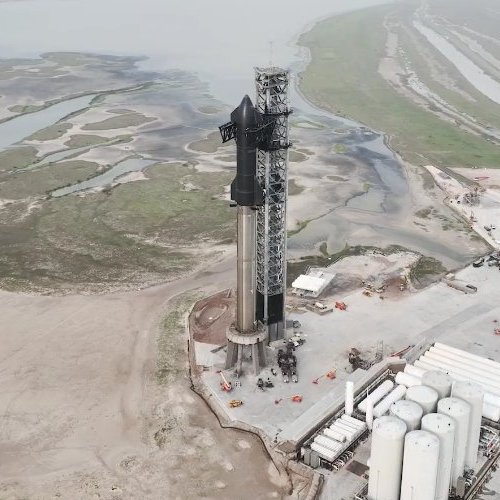
Starship stacked on top of Superheavy

In preparation for a final wet dress rehearsal countdown followed by its first launch, Starship has now been stacked on top of Superheavy at SpaceX’s launchpad at Boca Chica, Texas.

The picture to the right is a screen capture from a short video Elon Musk posted on Twitter. SpaceX had also tweeted that its “Team is working towards a launch rehearsal next week [April 10-11] followed by Starship’s first integrated flight test ~week later pending regulatory approval.”

At this time the FAA has still not issued the launch license. By announcing its plan to launch the week of April 17th, Musk and SpaceX puts pressure the government bureaucracy to get a move on.

23 comments

Venezuela agrees to join China’s lunar base project

During a visit to a new Chinese space facility in China, the head of Venezuela’s space agency announced that it has agreed to join China’s lunar base project.

Marglad Bencomo, executive director of the Bolivarian Agency for Space Activities (ABAE), visited China’s new, national Deep Space Exploration Laboratory (DSEL) March 30 to discuss cooperation and exchanges. She was met by Wu Yanhua, former deputy director of the China National Space Administration (CNSA) and now executive vice chairman of DSEL. The two sides exchanged in-depth views on international cooperation in the field of deep space exploration, according to a DSEL statement.

Bencomo said that Venezuela was willing to sign a China-Venezuela Memorandum of Understanding as soon as possible to jointly promote the construction of international lunar research stations, according to the DSEL statement.

If this partnership agreement is signed, Venezuela would be the first nation outside of Russia to join China’s project. China has offered a similar partnership deal to Brazil, which will likely not agree because it is a signatory to the Artemis Accords and working with China will threaten any work it does with the U.S. For example, the UAE recently ended a project to fly a rover on a Chinese rocket for these very reasons.

This deal with Venezuela is largely empty blather, since Venezuela is presently a bankrupt communist state, barely able to feed its own people.

6 comments

Axiom sets date for next commercial manned flight to ISS

Axiom and NASA yesterday announced May 8, 2023 as the launch date for the private company’s second commercial flight to ISS, this time carrying three passengers out of a crew of four, two from Saudi Arabia and the third, John Shoffner, completing his second paid flight with Axiom.

Two of its crewmates are Rayyanah Barnawi and Ali AlQarni, members of the first Saudi Arabian astronaut class. Barnawi will become the first Saudi woman ever to reach space, and she and AlQarni will be the first people from the kingdom to travel to the ISS.

Retired NASA astronaut Peggy Whitson will command the mission for Axiom. The Dragon capsule used will be Freedom, making its second flight, lifting off on a Falcon 9 rocket with a new first stage. The plan is to be docked to ISS for ten days, which means for that time period ISS will have three Arab astronauts on board, including the UAE’s astronaut, Sultan Al Neyadi, who is in the middle of a six month mission and is about to do his first spacewalk.

0 comments

Chinese pseudo-company succeeds in reaching orbit again after three straight failures

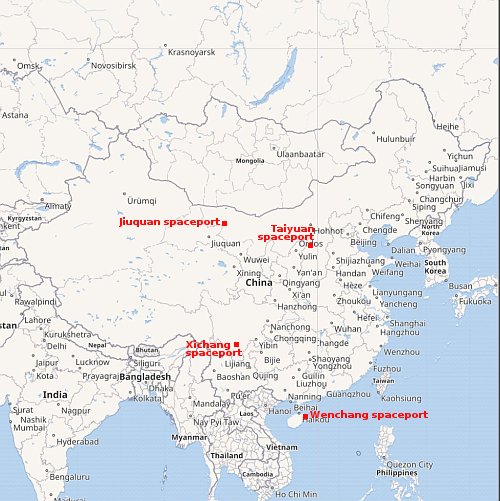
China's spaceports
China’s spaceports

The Chinese pseudo-company I-space has finally reached orbit again with a launch today of its Hyperbola-1 (SQX-1) solid-fueled rocket, lifting off from China’s Jiuquan inland spaceport in the Gobi Desert.

After an initial launch success in 2019, the company had failed three straight times until today. No word on whether the first stage landed near habitable areas in China. Nor did the pseudo-company reveal whether the rocket carried an actual satellite into orbit.

Jiuquan is presently the only spaceport where China permits these pseudo-companies to launch, and has been expanding its facilities for these commercial operations. This also means China will be experiencing more first stages dropping on their heads of its people, which is why it is also building a commercial launchpad at the Wenchang spaceport on the coast.

The leaders in the 2023 launch race:

23 SpaceX
15 China
6 Russia
3 Rocket Lab

American private enterprise now leads China 26 to 15 in the national rankings, and the entire world combined 26 to 25. SpaceX now trails the rest of the world combined, including American companies, 23 to 28.

UPDATE from BtB’s stringer Jay: Video of the launch can be found here. Jay also notes the lack of any mention of I-space in the official Chinese press, announcing this launch. Adds weight to the conclusion that these companies are not really real, but simply divisions of the Chinese government.

0 comments

SpaceX successfully launches Intelsat communications satellite

SpaceX tonight successfully used its Falcon 9 rocket to launch an Intelsat communications satellite into orbit, lifting off from Cape Canaveral.

The first stage completed its fourth flight, landing on a drone ship in the Atlantic. The two fairings completed their second and eighth flights.

The leaders in the 2023 launch race:

23 SpaceX
14 China
6 Russia
3 Rocket Lab

American private enterprise now leads China 26 to 14 in the national rankings, and the entire world combined 26 to 24. SpaceX now trails the rest of the world combined, including American companies, 23 to 27.

0 comments
1 143 144 145 146 147 196