Tennessee House expels two of three representatives who aided rioters

The Tennessee House today successfully voted to expel two of the three Democrat representatives who aided the gun control rioters attempting to take over the statehouse on March 30, 2023.

This is an update of my blacklist column yesterday. Justin Jones and Justin Pearson were expelled, while the vote to expel Gloria Johnson fell one vote short.

Both representatives could be reappointed to their seats, and can also run in the special election to fill the now-empty seats. Both made it clear before the vote that they do not consider anything they did was wrong, and intend to return.

All power to them. They just better realize that using a bullhorn to take over the statehouse, when they have not been given the floor to speak, is wrong, and if they do it again they will be expelled again.

3 comments

April 6, 2023 Quick space links

Courtesy of BtB’s stringer Jay.

  • China invites Brazil to participate in its lunar base project
  • There is no indication Brazil accepted the offer. The offer took place during a meeting between officials of the Brazil Space Agency and one of China’s pseudo-companies, China Great Wall Industry Corporation (which according to Jay “is the international launch service subsidiary” for China). Thus, this could be an effort by that pseudo-company to gain launch access to Brazil’s recently reactivated Alcântara spaceport.


1 comment

Pushback: Missouri school libraries sue to keep porno on their shelves; Missouri lawmakers zero out library budget

Cody Smith
Missouri House Republican Cody Smith

Bring a gun to a knife fight: In 2022 the Missouri legislature passed a law that made it illegal to provide any student with books containing images “‘showing human masturbation, deviate sexual intercourse,’ ‘sexual intercourse, direct physical stimulation of genitals, sadomasochistic abuse,’ or showing human genitals.” The aim of the law was to put reasonable limits on the kind of material available in school libraries, and was passed in response to the recent nationwide effort by teachers and librarians to include such smut in these places.

A normal person’s response should be, “Gee, why do we need a law? What sane adult would ever give this stuff to kids? Isn’t that why we have a movie rating system?” A normal person would also note that anyone who did want to distribute this kind of porno to kids is really nothing more than a pedophile.

Well, it looks like the Missouri Association of School Librarians, the Missouri Library Association, and the ACLU are all pedophiles, when you get right down to it. These organizations immediately banded together to sue to overturn the law. They want to give kids porno.

On March 28, 2023 the Missouri House responded in turn to these pedophiles by passing a budget that cuts the entire $4.5 million budget for all public libraries. The cut was put forth by the House budget chairman Cody Smith, who said this:
» Read more

7 comments

Exploring the cratered southern highlands of Mars, part 2

Overview map

Dune-bedrock contact in Rabe Crater
Click for original image.

Our travels in the cratered southern highlands of Mars continues. Today we visit 67-mile-wide Rabe Crater, as indicated on the overview map above. The picture to the right, cropped and reduced to post here, was taken on January 27, 2023 by the high resolution camera on Mars Reconnaissance Orbiter (MRO).

Rabe Crater is significant for several reasons. First, it was one of the first places on Mars where sand dunes were identified, by one of the Viking orbiters in the late 1970s [pdf]. Second, the pits and sand in its interior, are unusual and puzzling. The inset on the overview map provides a closeup look at the crater. The yellow mound in the central south of the crater floor is all dunes, which are surrounded by the pit with steep cliffs more than a 1,000 feet high.
» Read more

1 comment

University of Arizona opens major facility for building and launching satellites

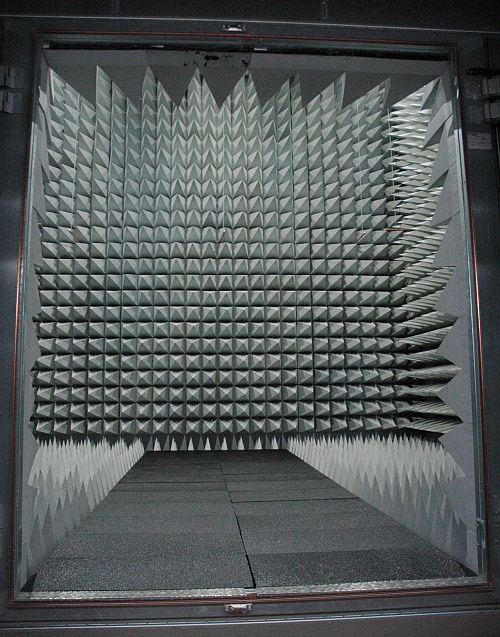
anechoic chamber at UA's Applied Research Building
ARB’s anechoic chamber

Yesterday I attended the grand opening of the University of Arizona’s (UA) new Applied Research Building (ARB), designed to provide satellite builders as well as its students an almost completely comprehensive facility for the assembly, testing, and launching of satellites. From this event announcement:

To keep the university at the forefront of space science and exploration, ARB will serve as a world-class test and integration center for satellites, probes, and spacecraft, including:

  • A 40-foot tall high-bay payload assembly area used for constructing high-altitude stratospheric balloons and nanosatellites also known as “CubeSats.”
  • A thermal vacuum chamber that simulates environmental conditions in space to test balloon and satellite performance that is the largest of its kind at any university in the world.
  • A non-reflective, echo-free room called an anechoic chamber to test antennae for command, control, and data relay purposes.
  • A large lab for testing the performance of a range of objects, from airplane wings to sensors.

The anechoic chamber is pictured above. For scale, if a person was standing in the middle of the chamber their height would reach about six rows up. The carbon-infused styrofoam pyramids are designed to dampen reflections of radio signals in order to simulate the space environment while testing the antennas on a satellite. This is apparently is of the largest such chambers in the United States.
» Read more

8 comments

Global warming scientists whine about India defunding climate research center

According to this Nature article, scientists worldwide are outraged by the decision of the Modi government in India to suspend all foreign funding to its Centre for Policy Research (CPR) for the next 180 days.

Why might the Modi government have done this? First, this is how Nature describes CPR’s work:

The CPR conducts research into public policy in India, including climate change, social and economic policy, governance and infrastructure. Last year it received about three-quarters of its grant funding from influential global organizations such as the Bill & Melinda Gates Foundation and the World Bank. Its domestic researchers have contributed to high-profile international studies such as the reports of the Intergovernmental Panel on Climate Change.

…The CPR “has played an enormously important role in informing public policy debate in India and internationally”, says Frank Jotzo, an environmental economist at the Australian National University in Canberra. Jotzo says that CPR, established in 1973, has a long and esteemed history in providing objective and honest analysis of government policy in India, and has at times criticized Indian government policy and plans. “That is invariably the case with any independent, impartial think tank or organization anywhere in the world,” he says. [emphasis mine]

In other words, CPR routinely advocates leftist policy positions. When a leftwing government is in power, its policy papers will glow with pride about the achievements of government. When a rightwing government is in power — such as the Modi administration — its policy papers will be suddenly “objective and honest” and hard-hitting, attacking the government for daring to challenge its assumptions about “climate change, social and economic policy, governance and infrastructure.”

This is typical political garbage from Nature and the leftist culture it routinely represents. CPR appears to have violated Indian law with its foreign funding, using the “funds for purposes other than those permitted under its licence.” Moreover, Modi is the elected head of India’s government. CPR works for him and the Indian public who elected him. If he decides this agency should be defunded, then so be it. For far too long leftists worldwide have claimed a permanent right to government funds. This needs to stop, and it is refreshing to see the Modi government is willing to take action in this regard.

If only Republicans in America has as much courage.

2 comments

Webb snaps infrared picture of Uranus

Uranus as seen in the infrared by Webb
Click for original Webb false-color image.

In a follow-up to a recent Hubble Space Telescope optical image of Uranus, scientists have now used the Webb Space Telescope to take a comparable picture in the infrared of the gas giant.

Both pictures are to the right, with the Webb picture at the top including the scientists’ annotations.

On the right side of the planet there’s an area of brightening at the pole facing the Sun, known as a polar cap. This polar cap is unique to Uranus – it seems to appear when the pole enters direct sunlight in the summer and vanish in the fall; these Webb data will help scientists understand the currently mysterious mechanism. Webb revealed a surprising aspect of the polar cap: a subtle enhanced brightening at the center of the cap. The sensitivity and longer wavelengths of Webb’s NIRCam may be why we can see this enhanced Uranus polar feature when it has not been seen as clearly with other powerful telescopes like the Hubble Space Telescope and Keck Observatory.

At the edge of the polar cap lies a bright cloud as well as a few fainter extended features just beyond the cap’s edge, and a second very bright cloud is seen at the planet’s left limb. Such clouds are typical for Uranus in infrared wavelengths, and likely are connected to storm activity.

The Webb image also captures 11 of Uranus’s 13 rings, which appear much brighter in the infrared than in the optical.

Unlike all other planets in the solar system, Uranus’s rotation is tilted so much that it actually rolls as it orbits the Sun, a motion that is obvious by comparing these pictures with Hubble’s 2014 optical picture.

3 comments

China tests vertical landing of small rocket from barge at sea

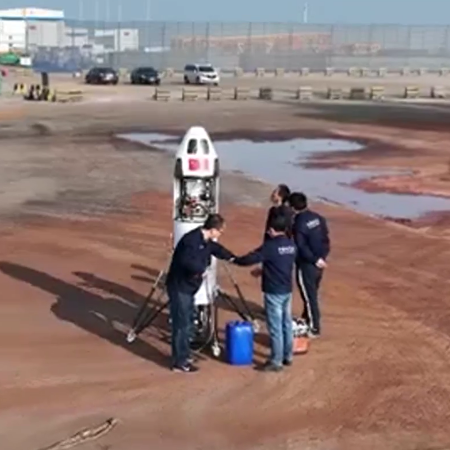
China's own version of SpaceX's Grasshopper

A commercial division of the Chinese Academy of Sciences (CAS) has successfully test flown its own a very small version of SpaceX’s Grasshopper, doing a vertical lift off from a barge at sea and then landing vertically on that barge.

The rocket prototype flew at an altitude of more than 1,000 meters, descended in a smooth hovering fashion and then decelerated thanks to the engine reverse thrust. The landing speed was reduced to less than two meters per second at the final stage before the rocket touched down steadily with a landing precision of under 10 meters.

The landing test took about 10 minutes, the CAS institute revealed.

The small scale of the rocket, as shown by the screen capture above, taken from the short video CAS produced of the flight, shows that CAS is a long way yet from using this technology in an orbital flight. Nonetheless, it demonstrates that at least two Chinese pseudo-companies are working hard to copy SpaceX’s reusable Falcon 9 first stage. With this test CAS has demonstrated it now has the software and fine engine control for vertical rocket landings. Based on the image of its proposed rockets at this tweet, this prototype will eventually lead to the development of larger orbital versions that look remarkably similar to what SpaceX produces.

4 comments

Spaceplane startup flies small-scale prototype for the 1st time using new rocket engine

The startup Dawn Aerospace, based in New Zealand, has now successfully flown a small-scale prototype of its proposed spaceplane using for the first time the company’s Aurora rocket engine.

Mk-II Aurora, a scaled down version of the spaceplane Dawn is developing for commercial operations, took to the skies March 29, 30 and 31 from New Zealand’s Gentanner Aerodrome. The initial test campaign validated key flight systems and demonstrated the benefit of rapid reusability, Dawn CEO Stefan Powell told SpaceNews.

During the first flight, the Mk-II Aurora consumed more fuel than anticipated due to a leak in the propellant system. The next day, Dawn engineers removed the Mk-II Aurora engine, took out the oxidizer tank and found the leak.

These rocket-powered test flights are a follow-up of an earlier test program in 2021 using jet engines. You can get a sense of the scale of the prototype from a picture at this article.

The company plans to fly this prototype to as high as twelve miles later this year before moving on to a larger test version. Eventually it hopes to develop a two-stage orbital system. The details however remain vague. The 2021 release suggested it was building a two-stage-to orbit version that will take off from a runway and then launch small satellites into orbit. These new stories suggest it are presently targeting the suborbital unmanned research market, with the eventual ability to do frequent flights to 70 miles altitude. Launching orbital satellites is presently only a distant goal.

0 comments

April 5, 2023 Quick space links

Courtesy of BtB’s stringer Jay.


  • Tianzhou freighter will fly in formation with China’s Tiangong-3 space station
  • The plan is to periodically redock the freighter to the station “when inventories stored inside are needed.” Jay wonders whether this is a test of the similar formation flying that will be required when China’s space telescope arrives next year to orbit near the station for periodic maintenance and repair. I think he is correct.

3 comments
1 144 145 146 147 148 196