
Frank Rubio’s flight to ISS will exceed a year, setting a new American record

Frank Rubio
Frank Rubio

Initially, Frank Rubio’s first flight in space was intended to be a standard six month mission on ISS. Launched on September 21, 2022 on a Soyuz-2 rocket inside a Soyuz capsule, the plan was for him and his two crewmates to return in March, 2023.

Then their Soyuz capsule developed a leak in its coolant system in December 2022. Not knowing if it was safe to use this capsule with humans inside, a replacement unmanned Soyuz capsule was launched by the Russians to ISS in February 2023, with the leaking Soyuz capsule brought back unmanned earlier this week.

The Russians however decided that this new capsule, designed for a six month mission, would stay in orbit for six months, so that it would be used to its planned capability. This decision also hinged on the lack of a new crew arriving on this new capsule. If it brought Rubio and his crew home earlier, ISS would be short three crew members for at least several months.

The planned return date, September 27, 2023, now means that Rubio’s mission will be at least 371 days long, making him the first American to fly a full year in space. Previously NASA falsely touted Scott Kelly’s 340-day mission as a year-long mission, when it never was. Later, Mark Vande Hei’s mission, also launched on a Soyuz, was extended to 355 days, still just short of a year, because the Russians wanted to send a film crew to ISS and return them on the capsule which Vande Hei was intended to come home on.

Whether Rubio truly does spend a year in space however remains uncertain. Two different Russian spacecraft — the Soyuz and a Progress freighter — have developed this coolant leak in the past three months. If this problem is a systemic manufacturing error, which Russia is now investigating, the decision might be to return the new capsule sooner than planned, out of fear it will develop its own leak. We shall likely find out sometime in the next three months.

If Rubio does end up in space for a full year, however, it will likely be a dream come true, having become an astronaut in 2017 but waiting six years for his first flight.

6 comments

New startup unveils 3D printer for making rocket tanks and fairings

Rosotics, a new startup focusing on providing manufacturing components for rocket companies, has now unveiled a prototype of its proposed 3D printer, dubbed Mantis, for making rocket tanks and fairings.

Mesa, Arizona-based Rosotics plans to begin delivering the Mantis in the third quarter of 2023 to customers who place $95,000 deposits and sign hardware-as-a-service contracts. After delivery, Rosotics β€œwill install, maintain and upgrade your hardware over time without any cost to you,” LaRosa said.

While the Mantis can be configured for various tasks, the starting point is a one printhead to additively manufacture aluminum or steel structures ranging in size from 1.5 to 8 meters in diameter.

The idea is sell this manufacturing capability to rocket companies as well as other manufacturers who need large structures built. Rather than machining these large structures themselves, or have outside machining companies do it for them, the companies would buy Mantis to do it in-house instead.

Whether this model will work depends on price and operations. Is it cheaper and quicker to use this 3D printer to make large rocket parts, or traditional methods? Obviously, Rosotics thinks it is. We will find out if others think so if Rosotics survives.

1 comment

H3 failure delays Japan’s entire space program

According to one official of Japan’s space agency JAXA, the failure of the first launch of its new H3 rocket in early March now threatens the schedule of much of Japan’s entire space program, even those missions being launched on the older H2A rocket.

The investigation into the launch failure, when the upper stage of the H3 rocket failed to ignite, remains unfinished with no word when it will be completed.

The H3 upper stage uses an engine designated LE-5B-3 developed by MHI [Mitsubishi Heavy Industries] and similar to the LE-5B engine used on the existing H-2A rocket. That is putting launches of the H-2A on hold while the investigation continues.

That may delay the upcoming launch of two science missions sharing an H-2A. The X-Ray Imaging and Spectroscopy Mission (XRISM), an X-ray astronomy spacecraft, and the Smart Lander for Investigating Moon (SLIM), a lunar lander, were scheduled to launch together as soon as May on an H-2A.

The article notes that XRISM replaces a 2016 Japanese X-ray telescope that failed immediately after launch. That failure then was bad, but just as bad is the seven years it has taken JAXA to have a replacement ready.

The H3 failure also threatens a JAXA Mars mission scheduled for launch in 2024, during the next launch window to Mars.

Japan’s space program more and more resembles Russia’s. It is controlled entirely by the government, which it appears does not allow competition within Japan, as all major rocket work is apparently confined to Mitsubishi. There have been unending quality control problems, within many probes as well as in the development of both the H3 and the Epsilon rockets. And the pace of operations is slow, much slower than other nations or companies.

It seems a major reform is needed, and it should start with Japanese government officials reading Capitalism in Space. They need to open up competition and release their space program from the control of JAXA, especially because JAXA is not doing a very good job. Like NASA, it would be better if JAXA stopped being a designer and builder, and become merely a customer obtaining products from many different competing private companies.

4 comments

Russia’s Soyuz-2 rocket launches classified military satellite

Russia today successfully launched a classified military satellite, using its Soyuz-2 rocket lifting off from Plesetsk spaceport in northern Russia.

The rocket traveled north over the Arctic Ocean, so its first stage fell harmlessly into the ocean.

The leaders in the 2023 launch race:

21 SpaceX
11 China
6 Russia
3 Rocket Lab

American private enterprise still leads China 24 to 11 in the national rankings, and the entire world combined 24 to 21. SpaceX now trails the rest of the world, including other American companies, 21 to 24.

0 comments

In U.S. sales of dumb phones are up

It appears that American users of mobile phones are shifting every so slightly away from smart phones, with sales of simple flip-phones lacking a screen rising in the past year.

In the U.S., feature flip phone sales were up in 2022 for HMD Global, with tens of thousands sold each month. At the same time, HMD’s global feature phone sales were down, according to the company.

In 2022, almost 80% of feature phone sales in 2022 came from the Middle East, Africa and India, according to Counterpoint Research. But some see that number shifting, as a contingency of young people in the U.S. revert back to dumb or minimalist phones. “In North America, the market for dumb phones is pretty much flatlined,” said Moorhead. “But I could see it getting up to 5% increase in the next five years if nothing else, based on the public health concerns that are out there.”

Companies like Punkt and Light are catering to the trend, selling devices geared toward those with a desire to spend less time on their phones and social media. On YouTube, you will find a slew of influencers touting these phones.

It is not clear if this is a real trend, or merely a bit of press release salesmanship by HMD and others. If it is however I think it is a good trend. Smart phones do very little to make people smarter. Instead, they foster a shallow thinking process focused on emotion. The more people who get away from them the better.

13 comments

Psyche asteroid mission now scheduled for October 2023 launch

After a year delay because certain flight software was not ready on time for its first launch window in the fall of 2022, the science team for the Psyche asteroid mission are now aiming for an October 2023 launch.

The launch period will open Oct. 5 and close Oct. 25. The asteroid, which lies in the outer portion of the main asteroid belt between Mars and Jupiter, may be the remains of a core of a planetesimal, a building block of a rocky planet.

Due to the new launch date, Psyche has a new mission plan, which includes a flyby of Mars for a gravity assist and arrival at the asteroid in August 2029. The mission then will enter its 26-month science phase, collecting observations and data as the spacecraft orbits the asteroid at different altitudes.

Meanwhile, the two Janus probes that were to launch with Psyche last year remain in limbo, as this new Psyche launch date is useless to that mission’s plan to fly past a different asteroid.

1 comment

Boeing & NASA; 1st Starliner manned mission to now launch on July 21

In a update posted by NASA today, agency and Boeing officials announced that they are now aiming to launch Boeing’s Starliner capsule on July 21, 2023 on its first manned mission to ISS.

The new target date provides NASA and Boeing the necessary time to complete subsystem verification testing and close out test flight certification products and aligns with the space station manifest and range launch opportunities.

The specifics behind this somewhat meaningless press release jargon can be found at this twitter thread. Apparently Boeing & NASA want to do more ground tests of the capsule’s parachute system as well as its flight software. There also appears to be some issue relating to the capsule’s batteries.

Boeing is also mulling a redesign of Starliner’s batteries for after this delayed crewed flight test. It also expects to redesign Starliner’s smart initiator system, which separates the crew from service module. NASA’s paying $24 million for that redesign amid added requirements

Though Boeing has a fixed price contract with NASA, if NASA demands redesigns or changes it has to pay for them. That Boeing and NASA are finding these issues at this late date, four years after Starliner was first supposed to launch, does not speak well of Boeing’s workmanship and quality control systems.

3 comments

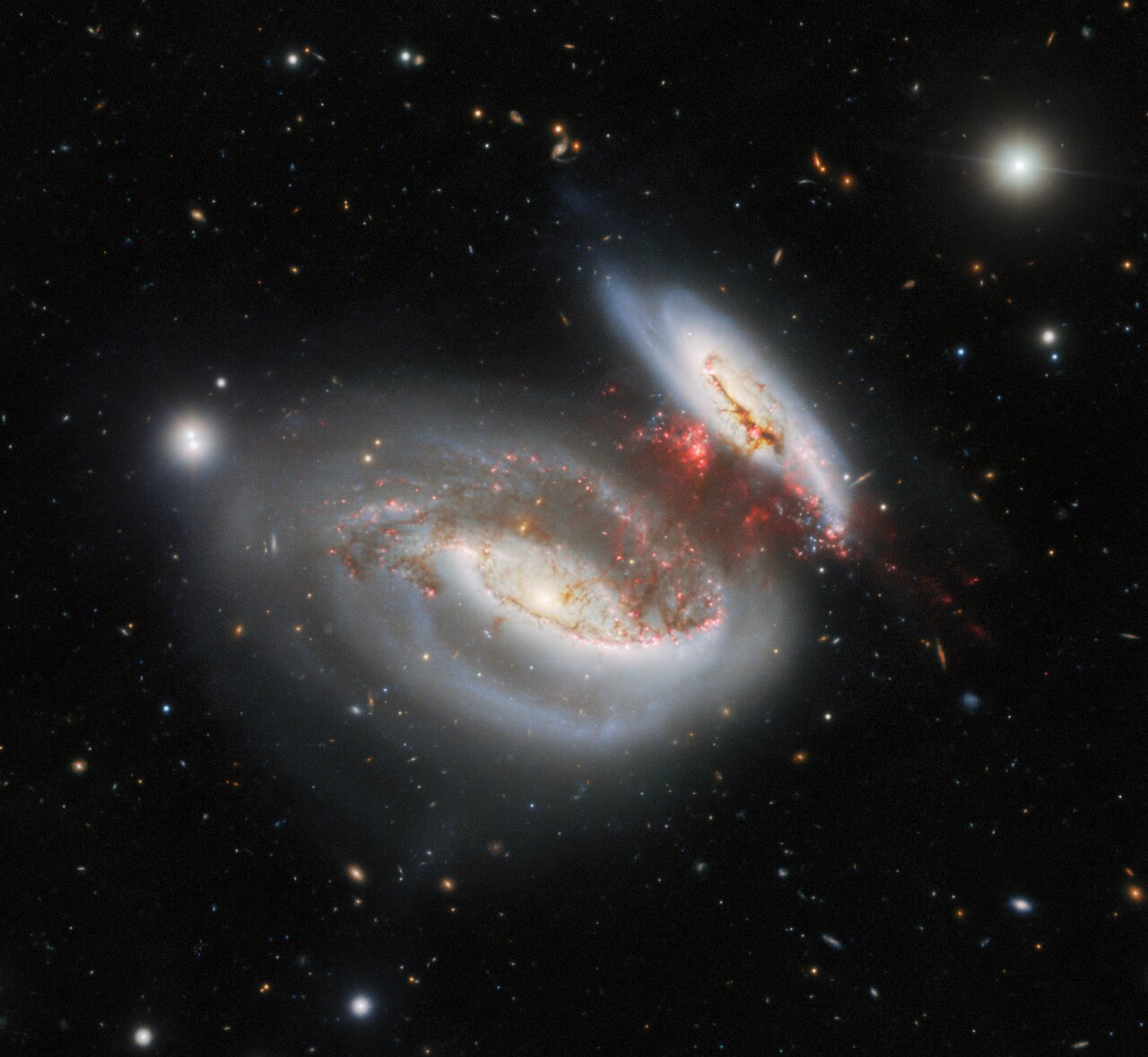
The chaos between galaxies following their head-on collision

The chaos between galaxies following their head-on collision
Click for original image.

Cool image time! The picture to the right, cropped, reduced, and sharpened to post here, was taken using the Gemini North ground-based 8-meter telescope in Hawaii. It shows two spiral galaxies about 180 million light years away following a head-on collision about 25 million years ago, in which the smaller spiral moved through the larger from the bottom to the top.

Upon exiting, the smaller spiral trailed behind it the reddish stream of material, while its outside arms on the right were bent downward. That trailing material is why astronomers have dubbed these the “Taffy Galaxies.” Imagine pulling two clumps of taffy apart. The stretched material linking the two clumps is the bridge of trailing material between these two galaxies. From the caption:

When the Taffy Galaxies’ collided, their galactic disks and gaseous components smashed right into each other. This resulted in a massive injection of energy into the gas, causing it to become highly turbulent. As the pair emerged from their collision, high-velocity gas was pulled from each galaxy, creating a massive gas bridge between them. The turbulence of the stellar material throughout the bridge is now prohibiting the collection and compression of gas that are required to form new stars.

The evolution of galaxies is incredibly slow, from the perspective of human existence. For example, this first collision 25 million years ago seems like it took a long time, but it will likely be followed by many more over the next billion years, eventually resulting in a single spherical elliptical galaxy. On the time scale of the universe, collisions every 100 million years or so means galaxies like this can mix and collide many times, and do so well within the existence of the theorized lifespan of the universe itself.

To us short-lived humans, however, this process just seems so slow it can’t possibly happen as described. But it does.

Sidebar: It appears this image was released to herald the repair of Gemini North’s primary mirror, which was damaged in two places on its edge during a recoating operation on October 20, 2022. Since then the telescope has been shut down as repair operations were undertaken. That repair is now complete, and it is expected the telescope will resume science observations in a few weeks.

2 comments

SpaceX launches another 56 Starlink satellites

SpaceX today successfully launched another 56 Starlink satellites, using its Falcon 9 rocket lifting off from Cape Canaveral, Florida.

The first stage successfully completed its fourth flight, landing on a drone ship in the Atlantic.

Russia was also launching at almost the exact same time a classified military satellite, using its Soyuz-2 rocket lifting off from Plesetsk spaceport in northern Russia, but at the moment there is no word on whether that launch was a success.

For the moment then the leaders in the 2023 launch race are as follows:

21 SpaceX
11 China
5 Russia (with a planned launch today)
3 Rocket Lab

American private enterprise now leads China 24 to 11 in the national rankings, and the entire world combined 24 to 20. SpaceX now trails the rest of the world, including other American companies, 21 to 23.

0 comments

Zhurong: Small polygons on light curved dunes indicate regular atmospheric water interaction

Zhurong's full journey on Mars

A paper published this week in Geophysical Research Letters by the science team for China Zhurong Martian rover has revealed the discovery of small polygon cracks on the surface of the many curved light-colored small dunes found in the region where Zhurong landed, suggesting the possibility of relatively recent water activity between the atmosphere and the dune surfaces.

Those dunes, dubbed transverse aeolian ridges (TARs) by the science team, are the many light curves visible in the labeled Mars Reconnaissance mosaic to the right. The blue arrows indicate Zhurong’s path south from its landing spot at the top and ending near the bottom of the picture after traveling about 1,400 feet.

According to the paper, the TARs were formed by the prevailing winds over many eons, coming first from the north and then from the northwest. The edges of the ridges, being smaller, are pushed ahead quicker, thus creating the curved shape. The polygons were small, never larger than 4 inches in size, with five to six sides. The scientists theorize that they were formed when atmospheric water interacted with the dune crust, causing fractures “due to temperature/moisture changes or deliquescence/dehydration cycling of salts”. This process could be slow or fast, and could actually be occurring in relatively recent times, as the scientists say it requires only a little water in the atmosphere.

More likely however we are seeing evidence of water from the past, from tens of thousands to several million years ago.

Zhurong meanwhile remains in hibernation, and might never come out of that condition. Orbital images indicate that its solar panels are dust-covered, the result of the heavy winter dust storm season. The project team however is hopeful that with time and the arrival of Martian summer the dust will be blown off and they can reactivate the rover. This hope however entirely depends on the arrival of a dust devil acoss the top of Zhurong, a random event that cannot be predicted. With both the Spirit and Opportunity rovers, such events happened regularly, allowing those missions to last years instead of only 90 days. With InSight it never happened, and the lander died after two-plus years on Mars.

Zhurong’s future fate thus remains unknown, but not promising at this moment.

0 comments
1 148 149 150 151 152 196