New map of the volcanoes of Venus

Map of Venus' volcanoes
Click for original image.

Using the archival radar data from the Magellan orbiter that circled Venus in the early 1990s, scientists have produced a new map of the volcanoes of Venus.

That map is to the right, and is publicly available for download.

Byrne and Hahn’s new study includes detailed analyses of where volcanoes are, where and how they’re clustered, and how their spatial distributions compare with geophysical properties of the planet such as crustal thickness. Taken together, this work provides the most comprehensive understanding of Venus’ volcanic properties — and perhaps of any world’s volcanism so far … because, although we know a great deal about the volcanoes on Earth that are on land, there are still likely a great many yet to be discovered under the oceans. Lacking oceans of its own, Venus’ entire surface can be viewed with Magellan radar imagery.

Although there are volcanoes across almost the entire surface of Venus, the scientists found relatively fewer volcanoes in the 20-100 km diameter range, which may be a function of magma availability and eruption rate, they surmise.

This new map catalogs about 85,000 volcanoes, but is also considered incomplete because the resolution of the Magellan data makes identifying volcanoes smaller than 1 kilometer impossible. It will require new orbiters to spot these volcanoes.

0 comments

Looking back from the foothills of Mount Sharp

Panorama looking back across Gale Crater, March 29, 2023
Click for original image.

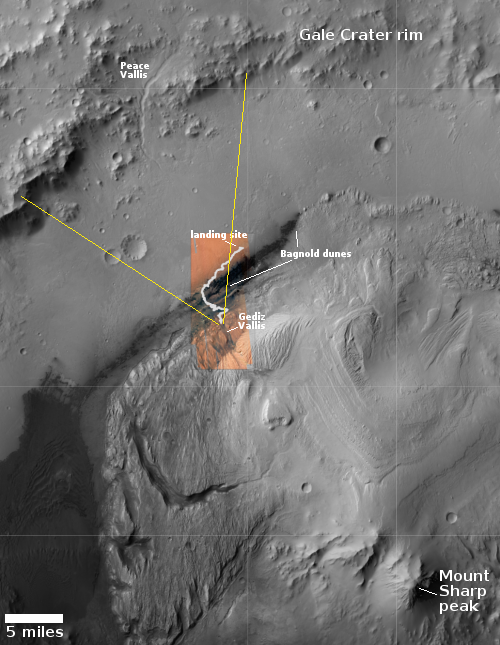
Overview map
Click for interactive map.

The panorama above, cropped to post here, was taken today by the left navigation camera on the Mars rover Curiosity. It looks back at the rover’s previous travels, though only the terrain traveled in the past few months is visible, the rover having reached this point through the notch to the left of the distinctly dark mesa in the center of the picture. The lower flanks of Mount Sharp the rover traversed to get here are now blocked from view.

Instead, the image provides a spectacular example of the views north from Curiosity’s present position. The overview map to the right provides us the full context of the entire ten-plus year journey since Curiosity landed safely on Mars on August 5, 2012. The white squiggly line indicates the rover’s route. The yellow lines mark the approximate area covered by the panorama. The rim of Gale Crater is about 20-25 miles away.

As you can see, as spectacular as this view is, the journey up Mount Sharp has barely begun. Mount Sharp’s peak is about 18,000 feet high. The rover at this point has only climbed about 4,600 feet from the floor of Gale Crater.

0 comments

Hakuto-R1 snaps first picture of Moon from lunar orbit

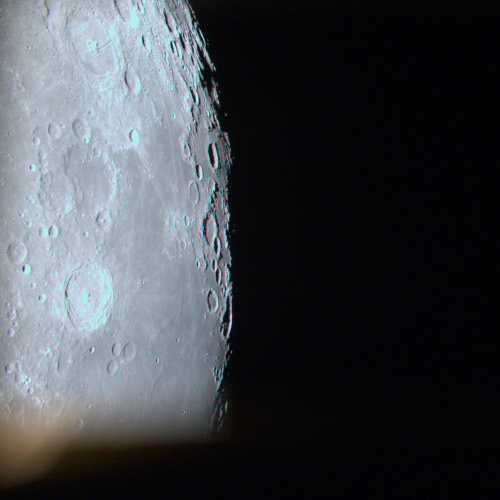
Hakuto-R1's first released image from lunar orbit
Click for original image.

The science team for Ispace’s Hakuto-R1 privately-built lunar orbiter/lander earlier this week released the spacecraft’s first picture of the Moon since entering lunar orbit on March 20, 2023.

That image is to the right, cropped and reduced to post here. The photo resolution is quite good. It also demonstrates that the spacecraft’s attitude control systems for pointing the camera are working correctly.

Launched on December 11, 2022 by a Falcon 9 rocket, Hakuto-R1 will land in Atlas Crater on the northeast quadrant of the Moon’s visible hemisphere sometime in April, making it the first successful private commercial planetary lander to reach another world. If successful, it will then release the United Arab Emirates Rashid rover, that nation’s first planetary lander but its second planetary mission, following the Mars orbiter, Al-Amal, now circling Mars.

6 comments

Israel launches spy satellite

Israel yesterday successfully launched a radar reconnaissance satellite using its Shavit-2 solid-fueled three-stage rocket.

This was Israel’s first launch since 2020. It took place from Israel’s coastal launchpad, and traveled west over the Mediterranean so that its stages would not fall on habitable areas. This retrograde orbit, opposite of the Earth’s rotation, is costly in terms of fuel and the size of payload put in orbit, which is why the satellite weighed only 661 pounds.

The leader board for the 2023 launch race remains the same:

20 SpaceX (with a planned launch later today)
11 China
5 Russia (with a planned launch later today)
3 Rocket Lab

American private enterprise still leads China 23 to 11 in the national rankings, and the entire world combined 23 to 20. SpaceX now trails the rest of the world, including other American companies, 20 to 23.

3 comments

Midnight repost: Genocide is coming to America

Rick, stating the truth in Casablanca
Will the murder and mutilation of innocent children
finally wake Americans up?

Considering the recent horrible murders of three young school children as well as three adults at Covenant School, a Christian elementary school in Nashville, merely because some sexually confused woman (not a “trans-person” as the insane insist we call her) decided it was her right to murder people, I thought it might be worthwhile to post my essay below from July 2020. In it I predicted that mass murder by the left was only around the corner, if the good people of America did not finally wake up and take seriously the madness that is taking over that part of the political spectrum.

I am still unsure whether ordinary decent Americans have finally awakened, but it appears the recent school violence might finally be providing the spark. We shall see.

————————-
Genocide is coming to America

In my last visit to Israel in 2018, my brother and sister-in-law took me sight-seeing to the northern parts of Israel near the Sea of Galilee. On our first night, we stayed at the home of one of their older friends, a man in his seventies.

That night we sat around their kitchen table so that they could catch up on family matters. At one point in the conversation our host reminisced about an older woman, now gone, who he had known in his childhood in the 1950s who had lived in Germany before and during World War II and had survived a concentration camp.

To paraphrase the story he told us, what this woman always remembered most starkly about that time, especially in the 1930s, was how difficult it was to get German friends who were not Jewish to believe the horrors she and other Jews were going through. To her, their calm nonchalant dismissal of the Nazi bigotry and oppression of Jews — too unbelievable to take seriously — was what had horrified her the most. Even twenty years later, it was this dismissal that appalled her the most, despite her time in a concentration camp and the death she had seen around her.

As he told us this story, what struck me was how similar my own experience has been. Time after time for the past four decades my liberal friends and relatives have refused to believe anything I say to them — always based on actual events — about politics and the growing corruption and bigotry within the Democratic Party. Like those decent Germans in the 1930s, these decent Americans find reasons to quickly dismiss what I say, without making any effort to find out if there is any merit to it.

In fact, less than two days after this very conversation it happened again. » Read more

7 comments

Mars’ largest mountain region

Mars' largest mountain region
Click for original image.

The picture to the right, rotated, cropped, reduced, and enhanced to post here, was taken on September 21, 2015 by the context camera on Mars Reconnaissance Orbiter (MRO). I originally was going to post a high resolution image of some of these mountains, taken on January 1, 2023 that showed some slope streaks, but quickly realized that a wider view of this mountain region was a much more interesting story.

This picture covers an area about 50 by 50 miles. As you can see, it is endless series of random hills ridges and peaks, with only a vague hint of a northeast to southwest alignment. Ground travel through this region would be slow and twisty, immediately reminding me of my many trips to West Virginia, where the hills and valleys are almost as random and never ending.

The overview map below however suggests the scale of this region exceeds West Virginia many times over.
» Read more

0 comments

NASA goes woke!

NASA yesterday announced that it has named two individuals, based on their race and gender, to lead the agency’s effort to promote the Marxist and racist Diversity, Equity, and Inclusion (DEI) movement.

NASA Administrator Bill Nelson announced Monday he is taking additional steps forward to advance diversity, equity, inclusion, and accessibility (DEIA) at the agency. Nelson named Steve Shih to serve in a new position as the agency’s first Diversity Ambassador and selected Elaine Ho as the next associate administrator for the Office of Diversity and Equal Opportunity at NASA Headquarters in Washington, effective immediately.

…As diversity ambassador, Shih will further NASA’s DEIA initiatives by building key strategic alliances with external partners, enabling NASA to continue being a model agency and leader for DEIA. In this role, Shih will engage NASA’s partners – including across the government, private sector, academia, and non-governmental organizations – to learn and promote best practices for NASA to recruit, hire, engage, and retain the most talented individuals from all backgrounds and life experiences. With his experience leading the Office of Diversity and Equal Opportunity since 2017, Shih will build on his three decades of federal expertise and help NASA continue to enable everyone to contribute inclusively to NASA and to the United States.

As Shih transitions to the role of diversity ambassador, Ho will bring extensive DEIA expertise to the Office of Diversity and Equal Opportunity. She most recently has served as the deputy associate administrator for NASA’s Office of STEM Engagement, leading a wide-ranging portfolio of projects benefiting students, universities, and educational institutions across the country to inspire, engage, and educate the Artemis Generation.

To further prove NASA’s commitment to favor some races over others, the agency also announced yesterday that it is committing $3 million to support “seven Historically Black Colleges and Universities (HBCUs) and one Predominantly Black Institution (PBI).”

Note the focus on race, not achievement. While it is nice to help the disadvantaged, these programs are not really aimed at that goal. Instead, this entire DEI movement is designed to give power to specific races, to the detriment of others. Or to put it more bluntly, it is a race-based apartheid system that encourages race hatred and resentment.

It is also probably illegal, based on the Civil Rights Act of 1964. Of course, the law is now irrelevant when it comes to the new racism. Supporters of DEI are allowed to break it whenever they want, because clearly they are superior to all others and have that right.

Finally, this stuff has absolutely nothing to do with NASA’s fundamental purpose, which is to help American industry more successfully explore space. It is instead a return to the Obama administration’s policy of making NASA’s most important priority that of helping minorities. Then it was Muslims, now it is the alphabet soup of LBGQTBIPOCZXYZ (and so on).


8 comments

Webb finds Earth-sized exoplanet likely too hot to have atmosphere

The uncertainty of science: Using the infrared Webb Space Telescope, scientists have measured the temperature of the Earth-sized exoplanet, dubbed Trappist-1b, and found its temperature is probably too hot to have atmosphere.

The red dwarf star Trappist-1is about 40 light years from Earth, and in 2017 was found to have a solar system of seven exoplanets, all rocky terrestrial planets like the inner planets of our solar system. Trappist-1b is the innermost exoplanet. To measure its temperature, Webb observed the star while the planet was eclipsed by the star as well as when it was not, and measured the tiny difference in infrared light.

The team analyzed data from five separate secondary eclipse observations. “We compared the results to computer models showing what the temperature should be in different scenarios,” explained Ducrot. “The results are almost perfectly consistent with a blackbody made of bare rock and no atmosphere to circulate the heat. We also didn’t see any signs of light being absorbed by carbon dioxide, which would be apparent in these measurements.”

As this was the innermost of the star’s solar system, it is also the one most likely to lack an atmosphere. Webb’s observations of the system continue, so there is a chance that data about the other exoplanets will eventually tell us more about them.

1 comment

Virgin Orbit extends pause in operations, having failed to get new financing

Virgin Orbit has extended its worker furlough and pause in operations now that a $200 million deal with a Texas investor has fallen through.

Reuters reported last week that Texas-based Matthew Brown had been in talks to invest $200 million in the company. Those talks have collapsed, said two people familiar with the discussions who asked not to be identified. Brown declined to comment on Monday.

Virgin Orbit, teetering on bankruptcy after a January rocket failure and struggles to raise funds, furloughed nearly all its 750 employees on March 15 while it sought a financial lifeline that would allow it to focus on upgrading its launch business.

This is very bad news for the company, because it indicates that there might not be a financial savior for it.

6 comments

Leaking Soyuz capsule returns unmanned to Earth

The Soyuz capsule with a leaking coolant system successfully landed in Kazakhstan today, returning to Earth unmanned because of that leak.

Russian engineers will now analyze whether a crew would have been able to come home safely in that spacecraft, despite its damaged coolant system, which will provide information for future such problems. They will not be able to study the leak itself, however, as it was part of the capsule’s service module, which separates upon return and burns up in the atmosphere.

0 comments

German rocket startup raises $168 million in private investment capital

The German rocket startup Isar Aerospace has raised $168 million in new private investment capital, bringing the total it has raised to $310 million.

At present the company is targeting the second half of this year for the first launch of its Spectrum rocket, lifting off from a new spaceport in Norway.

Isar is one of three German rocket startups, with the other two Rocket Factory Augsburg and HyImpulse Technologies. Both Isar and Rocket Factory are getting close to launch.

0 comments
1 149 150 151 152 153 196