Japanese startup enters the high altitude balloon space tourism business

A Japanese startup, Iwaya Giken, announced yesterday that it is building a two-person capsule that will carry two persons, a pilot and passenger, on high-altitude stratospheric tourist balloon flights for about $180K per ticket.

The company, Iwaya Giken, based in Sapporo in northern Japan, has been working on the project since 2012 and says it has developed an airtight two-seat cabin and a balloon capable of rising up to an altitude of 25 kilometers (15 miles), where the curve of the Earth can be clearly viewed. While passengers won’t be in outer space — the balloon only goes up to roughly the middle of the stratosphere — they’ll be higher than a jet plane flies and have an unobstructed view of outer space.

The company teamed up with major Japanese travel agency JTB Corp., which announced plans to collaborate on the project when the company is ready for a commercial trip. Initially, a flight would cost about 24 million yen ($180,000), but Iwaya said he aims to eventually bring it down to several million yen (tens of thousands of dollars).

No date for the first launch was mentioned. This company now joins two American balloon companies as well as a Spanish balloon company, all planning to offer rides to the edge of space.
4 comments

Despite a complete lack of any customers, Spaceport America in New Mexico now plans to build a “reception center.”

The New Mexico Spaceport Authority has decided it needs to build another building at Spaceport America, even though that spaceport has seen no significant business in its almost two decades of operation, and has little indication of any future business to come.

The Spaceport Technology and Reception Center’s mission “will be to become the welcoming face to staff, visitors, and prospective customers visiting or working at Spaceport America. The proposed 30,000 square foot STARC building will be a multi-use facility; it will house the Spaceport’s core IT server center, staff offices and conference rooms, an Auditorium, food preparation and dining area, virtual experience center, and 2nd and 3rd floor lounge and viewing areas,” according to a request for proposals (RFP) issued by the New Mexico Spaceport Authority (NMSA). “The new building will provide modern, comfortable work and meeting spaces for NMSA staff and a means to receive, entertain and educate groups of visitors and/or potential customers,” the document added.

The article goes on to detail how NMSA has spent millions of tax dollars for years, with the promise of billions of revenue from space launches and thousands of local jobs, all of which have turned out to be pie in the sky. Other than Virgin Galactic, which remains a very questionable customer, no major rocket companies have shown any interest in launching from this spaceport.

To propose spending more on another building that will likely sit empty most of the time is absurd. As the article notes, New Mexico has many much more compelling issues to spend its taxpayer money. This boondoggle should be shut down.

1 comment

February 21, Quick space links

Courtesy of BtB’s stringer Jay, who I must also thank for sending me the Twitter links showing the Russian Progress freighter hole.


0 comments

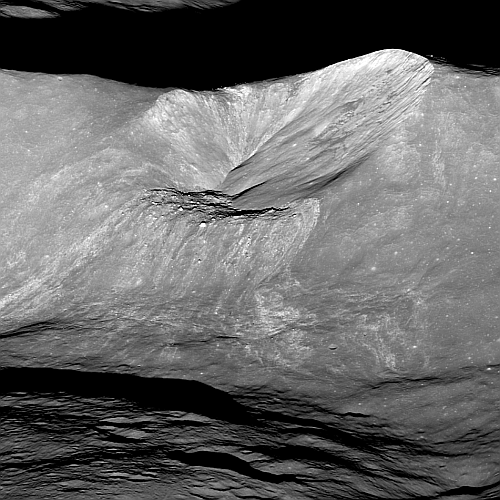
A lunar lava avalanche three miles wide and one mile long

A lunar lava avalanche three miles wide and one mile long

Cool image time! The picture to the right, cropped, reduced, and sharpened to post here, was taken October 16, 2016 and released today by the Lunar Reconnaissance Orbiter (LRO) science team. It shows a three-mile-wide unnamed crater that impacted on the rims of two other lunar impacts, one larger but the other monumental.

The trio of impact events that resulted in this spectacular corner of the Moon occurred over nearly four billion years of lunar history; first, the Orientale basin (>3.7 billion years), Lowell W (one to three billion years), and finally, this unnamed crater (likely <100 million years).

The Orientale Basin is about 500 miles wide, and is one of the most distinct large features on the lunar surface, a gigantic bowl with three concentric rings surrounding it. Because it is near the eastern limb of the near side, it wasn’t until the space age before a good overhead view of this major lunar geological impact basin was seen. Lowell W is about 11 miles wide.

The overview map below shows the context between Lowell W and this small crater, with the yellow lines indicating the area covered by the picture above.
» Read more

0 comments

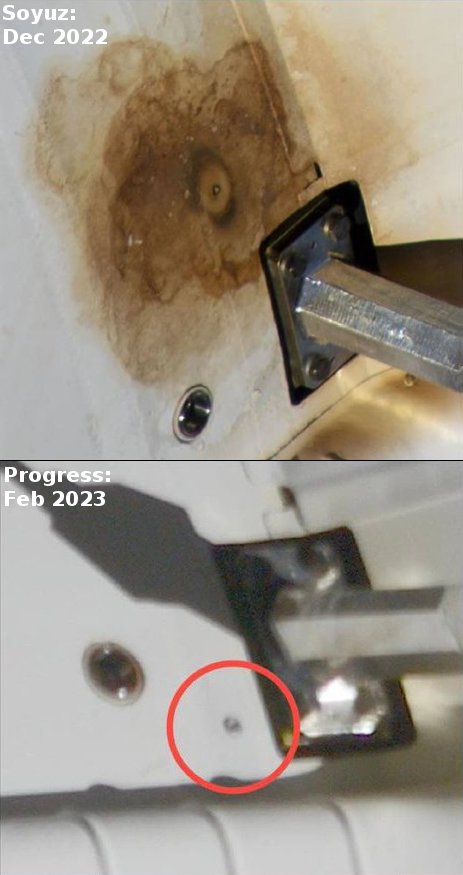
Russians release image of coolant system hole in Progress

Comparing holes in Soyuz and Progress spacecraft

Roscosmos officials today released a close-up image taken on February 17, 2023 of what they think is the hole in the Progress freighter that caused a leak in its coolant system on February 11th.

The picture was taken shortly after the freighter undocked from ISS to be de-orbited over the Pacific. To the right is a comparison of pictures taken of that Progress hole and the hole that occurred in December on the Soyuz spacecraft docked to ISS. The comparison was first created by this Twitter user but rearranged by me to post here. The red circle in the bottom image marks what the Russians identify as the Progress hole. The top image shows the hole that caused an almost identical leak in a Soyuz capsule in December. The Russians say the Progress hole is about 12 millimeters in diameter, and to their mind was caused “by an external influence,” same as the Soyuz hole.

This conclusion however is suspect. If you look at the best resolution version of the picture of the Progress hole (available here), there appears to be material surrounding the hole, as if the hole broke from the inside, not from an outside impact. (Because the resolution is poor, however, this conclusion is uncertain.)

More telling is that, as both pictures show, the two holes are almost in the exact same place on these two spacecraft. As noted by the Twitter user who first made this picture comparison, “I can’t even calculate the odds of 2 spacecraft being struck in almost the same place, within weeks of each other.”

That the Soyuz leak caused so much staining and the Progress leak has none is also puzzling.

Were these leaks both caused by the impact of a micrometeoriod or piece of space junk, as the Russians now claim? Or was one by sabotage or sloppy production work on the ground? Or were both? One impact might make sense, but two at almost the same spot? It defies logic or the percentages for two impacts so similar to occur so close together in time.

Sabotage however in the same area is very conceivable, especially considering that the Russians have never explained the cause of the hole that was drilled in a Soyuz capsule in 2018, a hole that was drilled and then patched, before launch.

13 comments

Pushback: Home appraiser sues professors who called him racist without evidence

Mott (l) and Connolly, eager to defame whites
Mott (l) and Connolly, eager to use race to
defame an innocent white man

Bring a gun to a knife fight: A home appraiser, Shane Lanham, who was publicly accused by two Johns Hopkins professors, Nathan Connolly and Shani Mott, of being a bigot and racist by valuing their home less because they are black, has now filed a countersuit, noting that the accusation was based on data so faulty “a first-year undergraduate” would immediately reject it.

[T]heir claims would fail to pass basic academic muster if treated as scholarship, Lanham argued in his counterclaim, which includes a suit for defamation. The racism claims achieved national coverage such as in ABC News. The resulting allegations have harmed Lanham’s business and reputation, according to the lawsuit.

“Dr. Connolly and Dr. Mott’s ill-conceived ‘experiment’ involving different appraisers, a seven-month gap, and intervening changes in market conditions would not withstand even basic scrutiny in the serious academic environment in which they work,” Lanham’s counterclaim stated. The lawsuit noted that the professors “failed to disclose the sale of the similar house next door to their home that sold only a month after Mr. Lanham and 20/20 Valuations’ appraisal for $7,000 less than the amount of the appraisal.”

You can read Lanham’s countersuit here [pdf]. He is requesting, at a minimum, $250K in compensatory damages and $250K in punitive damages.

This story began when Connolly and Mott asked Lanham (who is white) and his company, 20/20 Valuations, to appraise their house. When they were unhappy with his appraisal, they decided to get another appraisal, but this time do what they themselves called a ““whitewashing experiment.” For the second appraisal they removed all evidence that a black family owned the house, to the extent of having a white friend present himself as the owner instead. The second appraisal, done months later, came up with a higher price.
» Read more

41 comments

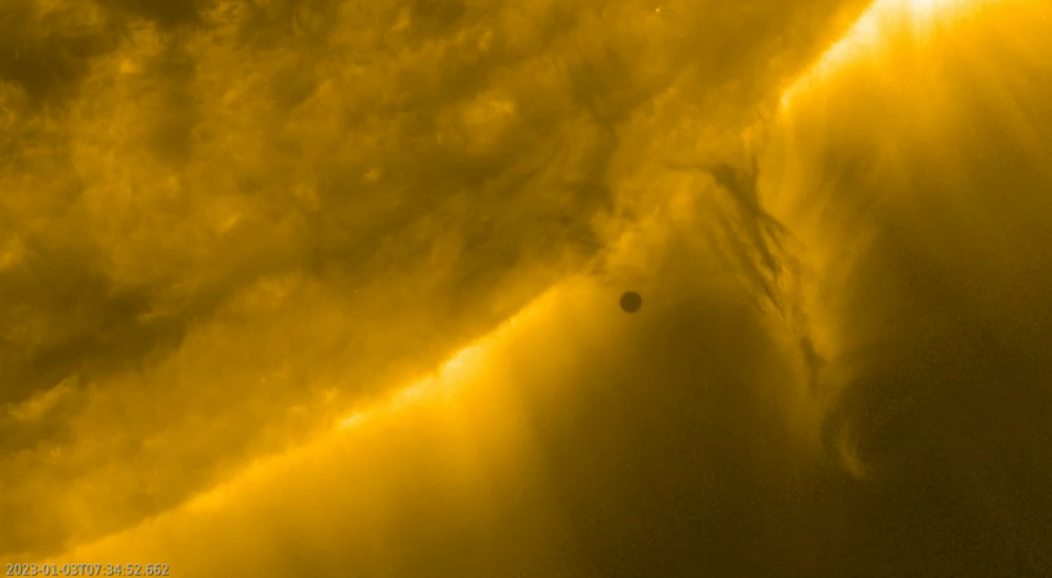
Solar Orbiter captures Mercury crossing in front of the Sun

Solar Orbiter spots Mercury in front of the Sun
Click for full movie.

The European probe Solar Orbiter successfully filmed Mercury as it crossed in front of the Sun — from the spacecraft’s perspective — on January 3, 2023.

The transit was captured by several different instruments on Solar Orbiter, as shown at the link. The picture above is a screen capture from the short movie made by its Extreme Ultraviolet Imager. The black disk is Mercury, moving from the left to the right. In the background the limb of the Sun can be seen, with a distinct feature flaring out from that limb.

For Solar Orbiter, this particular transit offered a valuable chance to calibrate the instruments. “It is a certified black object travelling through your field of view,” says Daniel Müller, Solar Orbiter Project Scientist at ESA. Thus, any brightness recorded by the instrument within Mercury’s disc must be caused by the way the instrument transmits its light, called the point spread function. The better this is known, the better it can be removed. So be studying this event, the quality of the Solar Orbiter data can be ever further improved.

If the transit also produced some spectacular images, so much the better.

1 comment

VLT takes picture of exoplanet

VLT's picture of exoplanet
Click for original image.

The ground-based Very Large Telescope (VLT) in Chile has successfully taken a picture of an exoplanet four to six times larger than Jupiter that is circling its star at about the same distance as Saturn.

That picture, cropped to post here, is to the right. Other data from other observatories had suggested the star AF Leporis, 87.5 light years away, might have an exoplanet, so astronomers decided to focus VLT on it to see if it could spot it.

AF Leporis is about as massive and as hot as the sun, ESO wrote in the statement, and in addition to its one known planet the star also has a disk of debris similar to the solar system’s Kuiper Belt. AF Leporis is, however, much younger than the sun. At 24 million years old, it is about 200 times younger than our star. This young age makes AF Leporis and its planetary system especially intriguing for astronomers as it can provide important insights into the evolution of our own solar system.

To snap this picture, the VLT had to use adaptive optics to smooth out the fuzziness produced by the Earth’s atmosphere, while also blocking out the star’s own light (as shown by the black disk in the image).

1 comment

China’s continued silence about Zhurong suggests Mars rover is dead

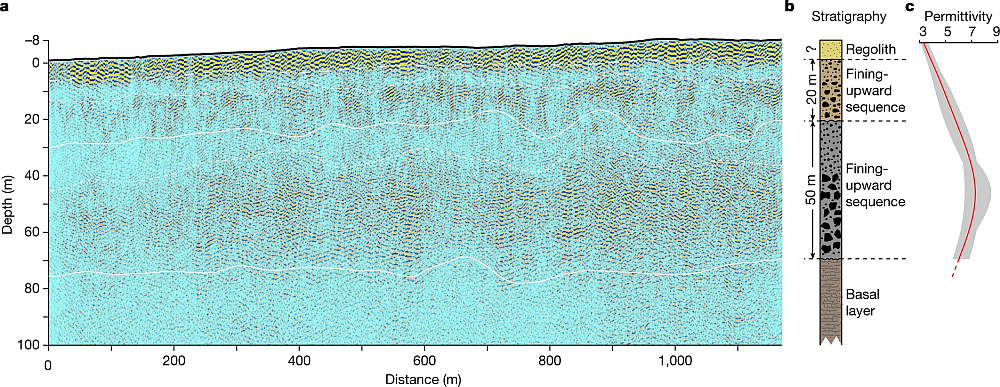
Zhurong's ground-penetrating radar data
The data from Zhurong’s ground-penetrating radar instrument.

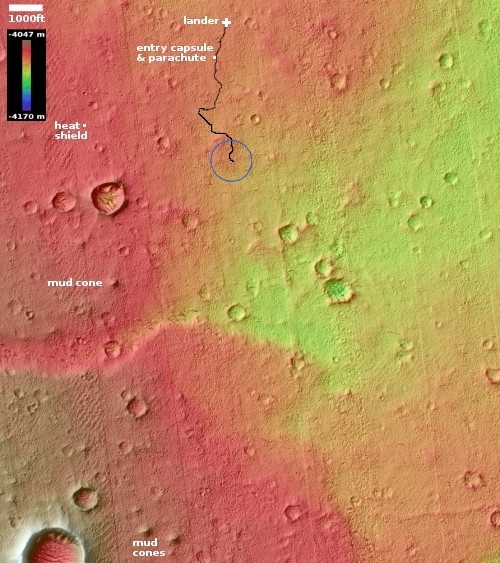
Overview map
Zhurong’s final location is somewhere in the blue circle.

China’s continued silence about Zhurong — which should have come out of hibernation sometime in late December-early January — suggests the Mars rover did not survive the Martian winter, which this year was also lengthened near the end by some additional dust storms.

Zhurong went into hibernation in May 2022, at the start of winter, with plans to awaken in December. Like the helicopter Ingenuity and the lander InSight, it depends on solar power, and had to contend with a very relatively severe winter dust season this Martian year.

Even though the Chinese press has loudly touted Tianwen-1’s first two years in Mars orbit, it has made little or no mention of Zhurong, a silence that is deafening.

The silence is also foolish, because China has nothing to be ashamed of concerning Zhurong. The mission was only supposed to operate for 90 days. Instead it lasted more than a year, traveling much farther than planned. Most important, the data from its radar instrument (shown above) showed that, at this location at 25 degrees north latitude, there is no underground ice to a depth of 260 feet. That data confirmed that the Martian equatorial regions below 30 degrees latitude are very dry, with any underground ice existing rarely if at all. The icy regions above 30 degrees latitude do not appear to extend much farther south than that latitude.

0 comments

February 20, 2023 Quick space links

Courtesy of BtB’s stringer Jay.


3 comments
1 168 169 170 171 172 196