A galaxy’s structure of gas and dust, as seen in the infrared by Webb

NGC 1433 as seen in the infrared
NGC 1433 as seen in the infrared. Click for original image.

Scientists have now released 21 papers on the gas and dust structures in nearby galaxies, based on infrared images from the Webb Space Telescope, used in collaboration with other telescopes looking in other wavelengths.

The largest survey of nearby galaxies in Webb’s first year of science operations is being carried out by the Physics at High Angular resolution in Nearby Galaxies (PHANGS) collaboration, involving more than 100 researchers from around the globe. The Webb observations are led by Janice Lee, Gemini Observatory chief scientist at the National Science Foundation’s NOIRLab and affiliate astronomer at the University of Arizona in Tucson.

The team is studying a diverse sample of 19 spiral galaxies, and in Webb’s first few months of science operations, observations of five of those targets – M74, NGC 7496, IC 5332, NGC 1365, and NGC 1433 – have taken place.

The image to the right is Webb’s infrared image of NGC 1433, estimated to be 46 million light years away. The bright areas extending outward in the spiral arms are believed to be star-forming regions. From the caption:

At the center of the galaxy, a tight, bright core featuring a unique double ring structure shines in exquisite detail with Webb’s extreme resolution. In this case, that ‘double ring’ is actually tightly wrapped spiral arms that wind into an oval shape along the galaxy’s bar.

NGC 1433 is a Seyfert galaxy, which are typically relatively close to Earth and has a supermassive black hole at the center eating material at a high rate. The brightness and lack of dust in the MIRI image of NGC 1433 could hint at a recent collision with another galaxy.

When comparing Webb’s infrared view with Hubble’s optical view, taken in 2014 and found here, the differences are definitely striking. Webb sees the gas and dust that is dark in Hubble’s images, while Hubble sees things at much higher resolution and thus sees more fine detail.

0 comments

China releases data sets from Chang’e-4 lander

China today released another set of data from the instruments on the Chang’e-4 lander, which landed on the far side of the Moon on January 3, 2019, bringing with it China’s Yutu-2 rover.

The datasets include 3,991.1 MB of 803 data files obtained by the four scientific payloads on the Chang’e-4 lander and rover between December 26, 2021 and January 10, 2022.

The data was posted on the official website of the Lunar and Planetary Data Release System, though none of the press reports from multiple China’s state-run press sources include it. All are simply the same three paragraph story, word for word. That site however is here, though it is entirely in Chinese and the English pages fail to load.

0 comments

For only 7th time, searchers find meteorite immediately after fall

For only 7th time, searchers on February 15th found a fragment of a meteorite that had only fallen to Earth three days before, and was furthermore only discovered mere hours before it entered the Earth’s atmosphere.

From the tweet of the discoverers:

FRIPON/Vigie-Ciel finds a fragment of asteroid 2023CX1 in Seine Maritime!!! The discovery was made by Loïs Leblanc, an 18-year-old student, part of the field research team.

Vigie-Ciel (“Sky Watchers”) and FRIPON are a volunteer project that searches for meteorites. The asteroid itself was discovered by Hungarian astronomer Krisztián Sárneczky while doing routine survey scan for near Earth asteroids.

The find was the second time Sárneczky has spotted an asteroid just hours before it broke apart in Earth’s atmosphere as a fireball, following an incredible find in March 2022.

By finding meteorites this quickly after arrival scientists get a more pristine sample, since the asteroid has not been exposed to the Earth’s environment for any extended length of time.

3 comments

The February 2023 Behind the Black fund-raising campaign-THANK YOU

My annual February fund-raising campaign is now over. I decided to shorten it by two weeks because I was tired of begging my readers for money. As expected, this will likely make this a much smaller campaign then previous years. So be it.

Nonetheless, I sincerely and with deep gratitude thank all those who donated. Without your support I could not keep doing this, not so much because of the need for income to pay the bills, but because it tells me that there are people out there who want me to do this work.

For those who did not contribute during the campaign, the tip jar is still somewhere on this webpage. Please consider adding your vote of support to Behind the Black.

11 comments

First launch of Japan’s H3 rocket aborts at T-0

In its first attempt to launch its new H3 rocket today the rocket’s main liquid-fueled engines ignited, but then the two strap-on solid rockets failed to ignite at T-0, causing that main engine to shut down to protect the rocket and payload.

I have embedded the live stream below, cued to about T-39. At the end of the broadcast the rocket appeared in good condition, though it was still unclear what the caused the problem.

At the moment there is no word when JAXA, Japan’s space agency, will attempt another launch. The H3 is years behind schedule, and was developed in the hope it would be more efficient and cost less to launch than the H2A rocket Japan presently uses.
» Read more

5 comments

Ingenuity completes 43rd flight on Mars, the longest in almost a year

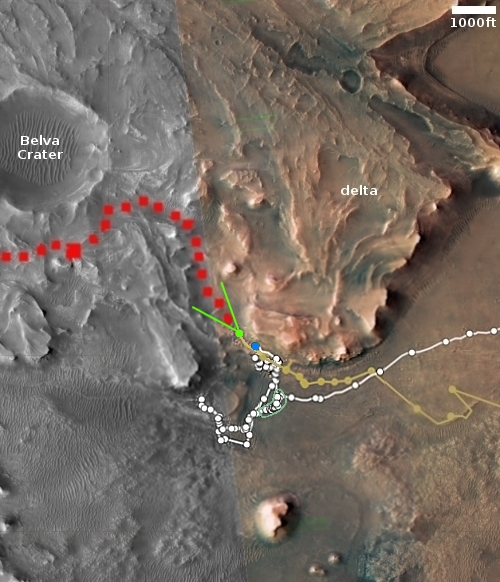
Overview map
Click for interactive map.

The Mars helicopter Ingenuity today successfully completed its 43rd flight on Mars, traveling 1,280 feet for 2 minutes and 26 seconds.

The green dot on the map to the right marks Ingenuity’s position before the flight, with the green lines marking the approximate direction and distance flown. The Perseverance/Ingenuity team has not yet updated its interactive map, so the precise landing spot is not yet available.

This flight was the helicopter’s longest since April 2021, just before the onset of the long six-month-long Martian winter. At that time Ingenuity completed its 28th flight, traveling 1,371 feet. Since then engineers struggled to keep Ingenuity alive during the dark winter, a task made more difficult due to an unexpected higher winter dust storm season.

Winter however is over, the helicopter is now fully charging with no problem, and has new flight software that allows it to go higher and over rougher terrain. In fact, like the last flight, Ingenuity flew farther and longer than planned, as it had been programmed to go 1,235 feet for 2 minutes and 17 seconds. That extra 45 feet and 9 seconds were likely used by the helicopter to locate a safe landing spot.

For perspective, Ingenuity’s total mission was originally planned to last only 30 days, and complete about a half dozen test flights merely to prove the concept of flight on Mars was possible. It has now lasted two years, completed 43 flights, and traveled almost five and a half miles. An amazing engineering achievement by JPL’s engineering team.

4 comments

Today’s blacklisted American: Rhode Island still pushing racist hiring practices despite civil rights complaint

Providence's racist hiring practices
The flyer for Providence’s most recent hiring event. Click for
original flyer.

They’re coming for you next: Despite a civil rights complaint filed back in November 2022 against Rhode Island’s Providence Public School District for offering only “educators of color” a $25,000 loan forgiveness, that school district has continued to offer this discriminatory and racist benefit to only certain races, including a hiring event that occurred just yesterday.

The flyer for yesterday’s event is to the right. Note the circled text.

You can read the complaint here [pdf], filed by the Legal Insurrection Foundation. According to this news report a week ago, the federal Office of Civil Rights “…was making a formal referral of the Complaint to the Equal Employment Opportunity Commission (EEOC) for investigation. EEOC already has assigned an investigator to the case.”

Yet, despite its clear bigoted illegality and the existence of a legal action against it, the Providence Public School District doesn’t care. » Read more

5 comments

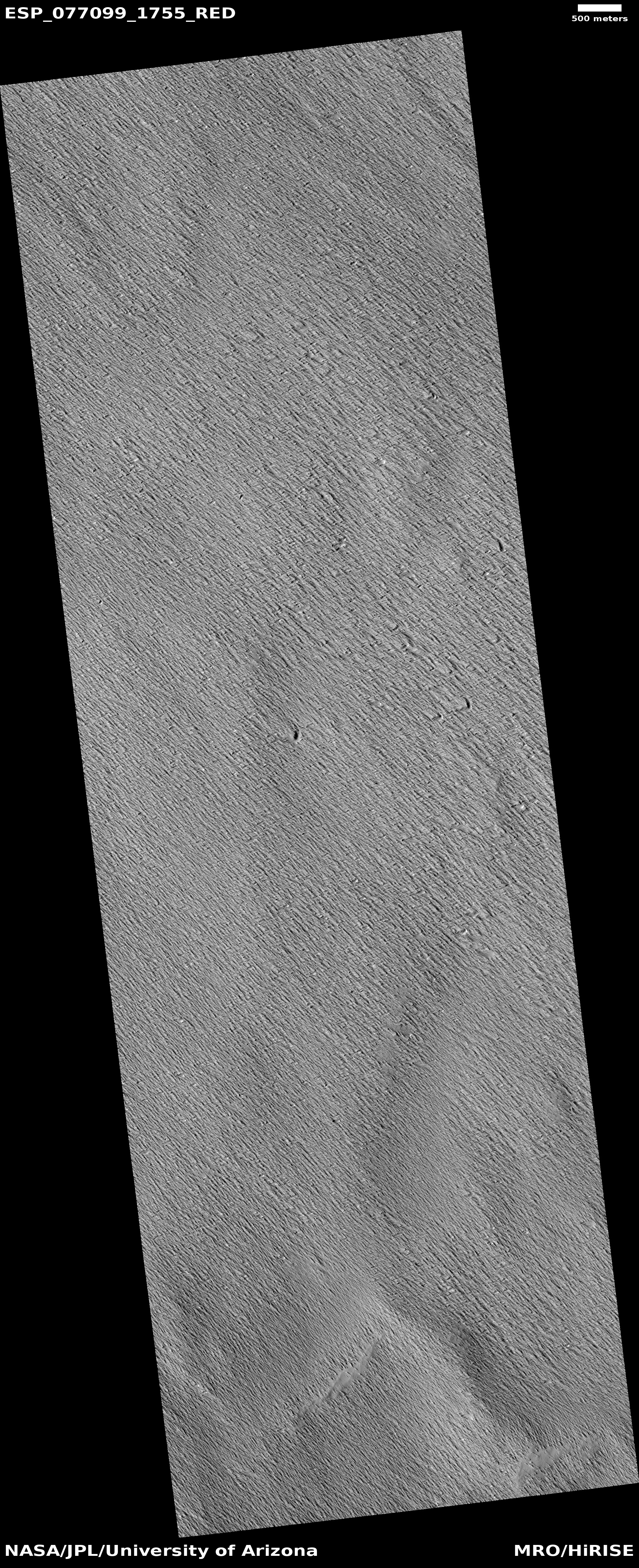
The endless volcanic ash of Mars’ Medusae Fossae Formation

The endless volcanic ash of Mars' Medusae Fossae Formation
Click for original image.

Cool image time! The picture to the right, cropped, reduced, and enhanced to post here, was taken on January 6, 2023 by the high resolution camera on Mars Reconnaissance Orbiter (MRO), and shows a small but typical area of the Medusae Fossae Formation, what is thought to be the largest volcanic ash deposit on Mars.

The picture itself was a “terrain sample,” taken by the MRO science team not as part of any specific research but to fill a gap in the camera’s schedule so as to maintain its temperature. The terrain itself looks like a field of sand that someone had run a fine comb across. In this case, the comb was the winds of Mars, prevailing from the southeast to the northwest. The crescent-like divots in the picture’s lower right are probably caused by some hard underground feature that the winds cannot blow away. Instead, it blows around, like water in rapids flowing around a rock, and takes the ash with it as it does so.
» Read more

1 comment

NASA outlines its expected needs as a space station customer

NASA has now published an updated detailed specification of what it will want to do on the four private space stations being built to replace ISS.

NASA published two white papers Feb. 13 as part of a request for information (RFI) for its Commercial Low Earth Orbit Destinations effort to support development of commercial stations. The documents provide new details about how NASA expects to work with companies operating those stations and the agency’s needs to conduct research there.

One white paper lists NASA’s anticipated resource needs for those stations, including crew time, power and volume, broken out for each of the major agency programs anticipated to use commercial stations. Companies had been seeking more details about NASA requirements to assist in the planning of their stations.

,,,The second white paper outlines the concept of operations NASA envisions for its use of commercial space stations. The 40-page document described in detail what it expects from such stations in terms of capabilities, resources and operations, as well as what oversight the agency anticipates having.

At the moment NASA has contracts with four different space station companies or partnerships, Axiom, Blue Origin, Nanoracks and Northrop Grumman, each of which is building its own station. Because NASA will initially be the biggest customer for these stations its requirements will help shape those stations significantly, which is why this information is of critical importance for the private companies.

At the same time, NASA is not dictating specific designs. The agency remains the customer, buying time on private facilities that will be owned privately and be free to sell their product to others. Thus, the designs of these stations might not match exactly what NASA desires, since even now there are other customers interested in buying space station time and space.

2 comments
1 170 171 172 173 174 196