
Alabama roadside rest stop about to lose its Saturn-1B rocket

Due to decay and rust, an Alabama roadside welcome center is about to lose the Saturn-1B rocket that has greeted visitors for the past 44 years.

The Welcome Center opened in 1977. In 1979, the U.S. Space and Rocket Center donated the Saturn 1B rocket, 168 feet high and 22 feet in diameter, to stand as a symbol of Huntsville’s role in the space program. The rocket was painted in 2006 and more maintenance was done starting in 2014, but it has steadily deteriorated since then.

“It was starting to fall apart,” [said Lee Sentell, director of the Alabama Tourism Department.] “We’ve gotten complaints for years about it.”

The cost to refurbish it appears to be too high. Maybe Sentell can get NASA to donate an SLS rocket for display, since it is very possible that several of those will become available at some point in the future when SpaceX’s much more efficient and cheaper Starship/Superheavy begins flying.
12 comments

A review of Boeing’s struggling space effort

Link here. [now fixed] The article, entitled “As Boeing Struggles To Fix Its Airliner Business, Elon Musk Is Eating Its Lunch In Space,” is a remarkably accurate overview of Boeing’s space effort, considering it comes from a mainstream press outlet. This paragraph will give you its flavor:

New competition could also threaten Boeing’s lucrative Space Launch System. Nicknamed the “Senate Launch System” for its origins in 2010 as a pork-barrel program to preserve jobs with the Space Shuttle winding down, NASA procured the rocket with “cost-plus” contracts – totaling $13.8 billion for Boeing so far – which means the contractor is guaranteed its expenses will be covered, plus a profit. Critics say that’s encouraged cost overruns. NASA’s inspector general has pegged the cost of a single Artemis launch at $4.1 billion, which he characterized last year as “unsustainable,” with total spending on the program projected to top $90 billion by 2025. For reference, NASA’s budget this year is $25 billion.

“This is a sucking chest wound on NASA and their ability to actually advance planetary science and lunar programs,” said Chris Quilty, founder of the space -focused financial services firm Quilty Analytics.

That $13.8 billion figure is accurate as to what NASA has paid Boeing, though it underestimates the actual cost of SLS, which is more than twice that.

Read it all. It suggests Boeing faces very tough times ahead in space.

15 comments

Oman building its own spaceport

Oman expects to begin construction this year on its own spaceport, intended to be open to commercial launches both orbital and suborbital.

Located in the port town of Duqm, the Etlaq Space Launch Complex, a project by the National Aerospace Services Company (NASCom), could see its first rocket launch early next year.

However, it will take three years to fully complete the centre. “We have two main goals with the Duqm launch land: to build a launch centre for commercial, professional and educational rocket users to assemble, test and launch from,” [officials from NASCom said]. “The launch centre will be globally accessible for expanding rocket companies, and locally available for educational research programmes.”

Though the article at the link is not clear, it appears that NASCom is government-owned.

0 comments

American astronaut seat liner shifted to Dragon temporarily

Though NASA has not issued an update, the Soyuz seat liner used by American astronaut Frank Rubio was supposed to be shifted from the leaking Soyuz capsule to Endurance today, just in case that Soyuz needs to be used as a lifeboat. From the January 13th ISS update:

On Thursday, Jan. 12, the International Space Station mission management team polled “go” to move NASA astronaut Frank Rubio’s Soyuz seat liner from the Soyuz MS-22 spacecraft to Dragon Endurance to provide lifeboat capabilities in the event Rubio would need to return to Earth because of an emergency evacuation from the space station. The seat liner move is scheduled to begin Tuesday, Jan. 17, with installation and configuration continuing through most of the day Wednesday, Jan. 18. The change allows for increased crew protection by reducing the heat load inside the MS-22 spacecraft for cosmonauts Prokopyev and Petelin in the event of an emergency return to Earth.

Once the replacement Soyuz MS-23 arrives at the space station on Feb. 22, Rubio’s seat liner will be transferred to the new Soyuz and the seat liners for Prokopyev and Petelin will be moved from MS-22 to MS-23 ahead of their return in the Soyuz.

I expect that once this work is completed tomorrow NASA will issue an update.

10 comments

January 17, 2023 Quick space links

Courtesy of BtB’s stringer Jay. I remain on the mend, and think by tomorrow I should be fully back to normal.


1 comment

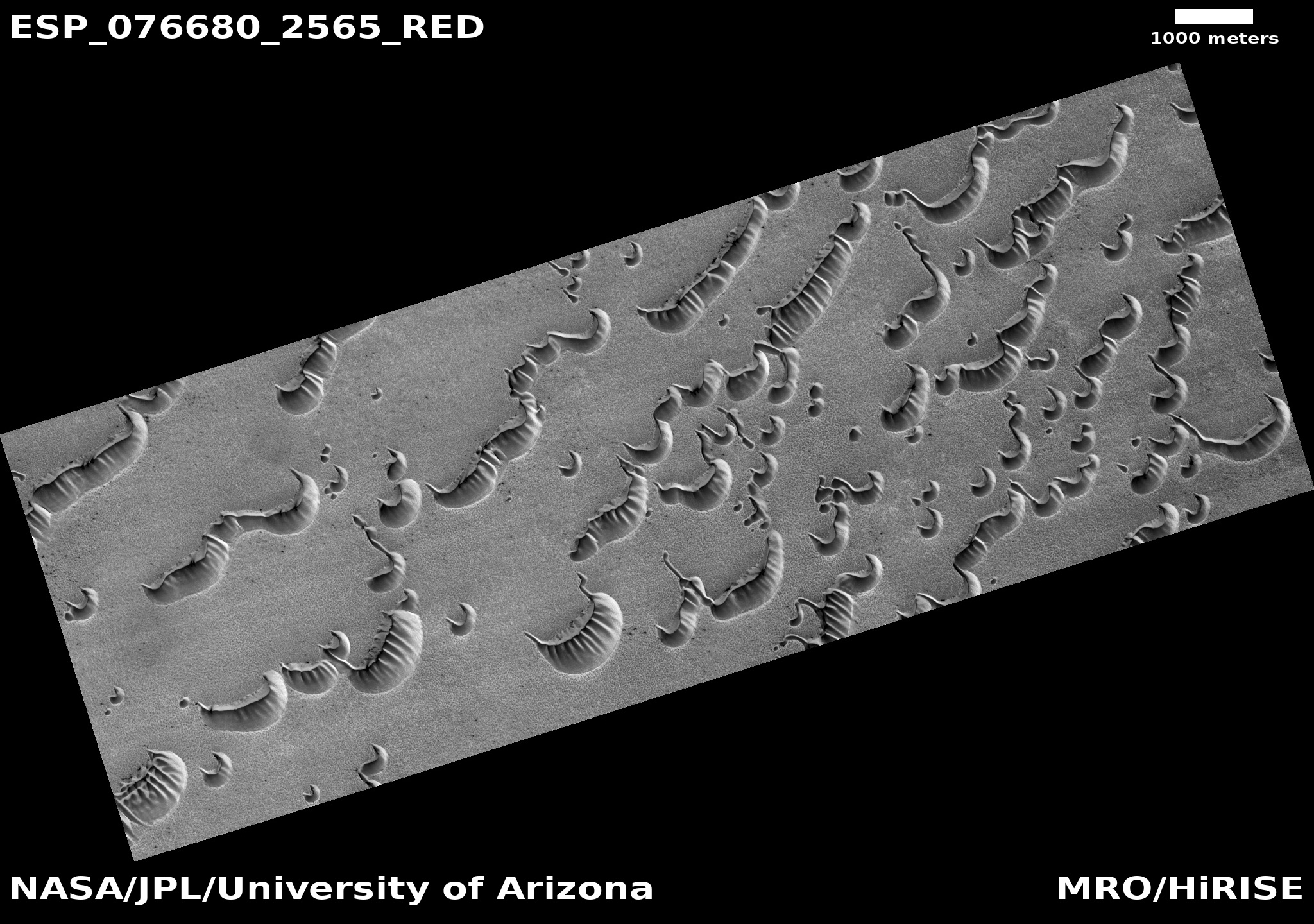
The sea of dunes surrounding the Martian north pole

The sea of dunes surrounding the Martian north pole
Click for full image.

Cool image time! The photo to the right, rotated, cropped, and reduced to post here, was taken on December 5, 2022 by the high resolution camera on Mars Reconnaissance Orbiter (MRO). It shows a collection of wormlike dunes located in the giant sea of dunes that surrounds the Martian north pole ice cap.

North is to the top. The season when this picture was taken was northern winter. The Sun is barely above the horizon, only 8 degrees high, and shining from the southeast. Because it is winter it is also dust season, making the atmosphere hazy and thus making the light soft. No distinct shadows, except that the sides of the dunes facing away from the Sun are darkly shadowed.

The consistent orientation of the dunes suggests that the prevailing winds blow from the northeast to create the steep-sided alcoves. The wind however might not be the only factor to form these dunes.
» Read more

1 comment

Hakuto-R completes five of ten milestones on test flight

Ispace’s private commercial lunar lander, Hakuto-R, has now completed five of the ten milestones the company had established before launch as its goals on this first test flight to the Moon.

The first five milestones completed are:

  • Completion of launch preparations
  • Completion of launch and deployment
  • Establishment of a Steady Operation Status
  • Completion of the first orbital control maneuver
  • Completion of stable deep-space flight operations for one month

The next five milestones involve entering final lunar orbit and landing successfully, the most difficult milestones of all.

1 comment

SpaceX to build five Starship/Superheavy prototypes in 2023

According to Elon Musk, SpaceX intends to build five Starship/Superheavy prototypes in 2023 for flight testing.

Assuming they can get launch permits, these five rockets should provide the company ample launch testing capability for at least the next two years, especially if it succeeds in landing these units and can consider reusing them in test flights.

At this moment, the launch permits from the federal government appears the main obstacle to getting this heavy lift reusable rocket tested and operational.

9 comments
1 186 187 188 189 190 196