Animation of Jupiter’s clouds

Cool video time! Using a photo taken by Juno during its 2018 fly-by of Jupiter, citizen scientist Thomas Thomopoulos has created a short animation showing the flow of Jupiter’s clouds. He also added some 3D relief by assigning elevation to the image’s greyscale, with lighter regions assigned higher altitudes.

I have embedded the animation below. Run it at the slowest speed for the best effect. It is quite spectacular, though it is also important to note that it is not reality. Thomopoulos is simply giving us a hint of the natural evolution of the cloud structures, both in elevation and in time.

You can see another equally impressive animation by Thomopoulos here of several of Jupiter’s polar storms, using AI technology to smooth out the loop.
» Read more

0 comments

First Vulcan rocket arrives at Cape Canaveral

ULA’s first Vulcan rocket has now arrived at Cape Canaveral in preparation for its planned inaugural launch before the end of March.

This first mission for Vucan will fly in a VC2S configuration. “VC” stands for “Vulcan Centaur.” The number, in this case “2,” represents the number of solid rocket boosters needed and the final letter stands for the payload fairing length.

VC2S will use a 51-foot-long Standard payload fairing. Nestled inside will be a few different payloads. This mission will send the first two Kuiper prototype satellites into Low Earth Orbit (LEO), Astrobotic’s Peregrine lunar lander to the Moon and a Celestis Memorial Spaceflight payload into deep space. The remains of several people connected to the original Star Trek series will be launched on what Celestis dubbed the “Enterprise Flight,” including show creator Gene Roddenberry along with actors Nichelle Nichols and Jackson DeForest Kelley.

This first Vulcan launch will also be the first of two flights required by the Pentagon in order to certify Vulcan for military launches. Since ULA already has contracts for seven Vulcan military launches, it very much wants to get these two launches off this year, as soon as possible. According to the article at the link, ULA is thus aiming to fly this year those two test flights, followed quickly by the first military launch.

Whether it can complete three Vulcan launches in 2023 is quite uncertain. For example, it will need to get four more BE-4 engines from Blue Origin for the second and third launches, and there is no indication at this time that Blue Origin is close to delivering.

Then there is the delays and risks involved with this first launch. Though ULA has decades of experience building and launching rockets, the first launch of a rocket almost always experiences delays during testing. We should expect the same with Vulcan.

Assuming this schedule holds, however, this means ULA is targeting 10 launches in 2023, five Atlas-5 launches, two Delta Heavy launches, and three Vulcan launches. That would be the most launches by this company in a year since 2016.


0 comments

First launch from Shetland Islands predicted for the fall

According to an official at the SaxaVord spaceport in the Shetland Islands in Scotland, its first orbital satellite launch is now expected before the end of this year.

Scott Hammond, director of operations at SaxaVord spaceport, acknowledged there is often uncertainty around timetables for private space launches. However, he said a recent agreement with a German company, Rocket Factory Augsburg, would see them begin testing their engines in the summer ahead of a launch later in the year.

He told the Press Association: “Probably in July, we’re going to start full stage testing. That will be the full, first stage, nine engines all firing for about three minutes. So that’ll be really, really impressive. I expect about four months or so of that depending on success. And then we’re looking with Rocket Factory to launch towards the end of the year, for the orbital launch.”

I would not bet a lot of money on this schedule. Rocket Factory is a German rocket startup that has never launched before, and the first launch from such startups are routinely delayed months to years. What Hammond is really doing is creating buzz for SaxaVord, even as a rival spaceport in Sutherland, Scotland, is getting built.

0 comments

January 20, 2023 Quick space links

Courtesy of BtB’s stringer Jay.


5 comments

The youngest flood lava on Mars, flowing past a crater

Crater with lava flow
Click for full image.

Cool image time! The photo to the right, rotated, cropped, reduced to post here, was taken on December 3, 2022 by the high resolution camera on Mars Reconnaissance Orbiter (MRO).

The title given to this image by the MRO science team is “Upstream Edge of Crater in Athabasca Valles.” The crater itself is a pedestal crater, uplifted from the surrounding terrain because it was more resistant to erosion.

The material to the east of the crater’s rim definitely appears to have flow characteristics, but is it wet mud, glacial ice, or lava?

To figure this out we need as always some context. The latitude, 8 degrees north, immediately eliminates mud or glacial material. This location is in the dry equatorial regions of Mars, where no near surface ice has yet been found. Thus, the flow features are likely hardened lava.

What direction however was the flow? Was it flowing to the north, widening as it moved past the pedestal crater? Or was it to the south, narrowing as it pushed past that crater? To answer this question we need to widen our view.
» Read more

0 comments

Today’s blacklisted American: Minnesota to blacklist all Christians, Jews, or Muslims from teaching

The new Marxist rules for teaching in Minnesota

They’re coming for you next: Minnesota’s unelected education bureaucracy is about to impose new licensing requirements for teachers that will essentially blacklist all Christians, Jews, or Muslims by requiring teachers to teach the queer agenda as well as the critical race theory to young children.

Minnesota’s Professional Educator Licensing and Standards Board (PELSB), a division of the state Department of Education, has been working to change teacher certification requirements since 2019. Its latest public draft, which is finalized save for a few tweaks that don’t affect the content, includes multiple requirements that licensure candidates publicly support critical race theory and transgender ideology and include both in their teaching. Teachers must receive state licensure to be employed in Minnesota public and many private schools. [emphasis mine]

You can read the new licensing rules here [pdf]. The screen capture above shows the language requiring teachers to agree to the queer agenda. It also hints at full approval of the Marxism program of critical race theory, whereby all western civilization and America in particular is seeped in bigotry and hate, and must be condemned at all times.

Only a few paragraphs later the hints go away, and the licensing requirements make it clear that all teachers must from now on condemn the heritage of the United States.
» Read more

20 comments

Ingenuity completes 40th flight

Overview map
Click for interactive map.

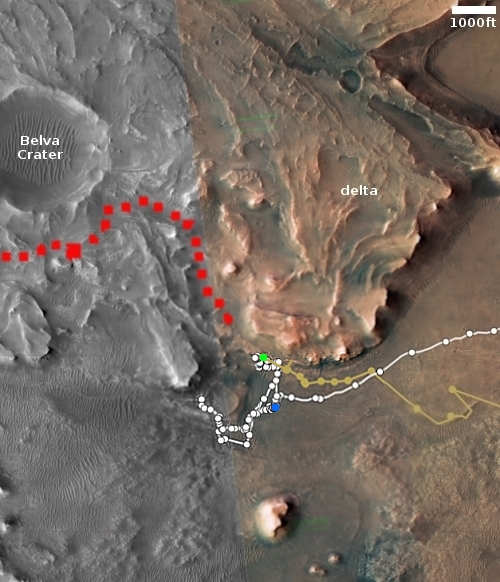
As predicted by the Ingenuity engineering team on January 17, 2023, the Mars helicopter yesterday completed its 40th flight, flying approximately 92 seconds and 584 feet to the northwest to place it at the head of the hollow that Perseverance will travel to climb up onto the delta that flowed into Jezero Crater sometime in the past.

The green dot on the overview map to the right shows the helicopter’s position, post flight. The blue dot shows Perseverance’s present position. The red dotted line indicates the rover’s future route.

At the moment, only eleven images have been returned from the flight, and these only show the first 20 seconds of flight. The flight however has been added to the helicopter’s flight log, which shows that Ingenuity actually flew about 23 feet farther and 7 seconds longer than expected. This extra distance was likely because the helicopter needed to find a good landing site, using its upgraded software that allows it to fly over rougher terrain.

1 comment

The only rocket stage recovered during the 1960s space race returns to Florida

A section of the Gemini 5 Titan rocket first stage that was recovered by chance right after its launch on August 21, 1965 has now been moved from storage in Alabama to be put on display at the Cape Canaveral Space Force Museum.

The artifact, which encompasses the upper portion of the Titan II rocket’s first stage, flew with the vehicle from Launch Complex 19 at Cape Kennedy (today Cape Canaveral) in Florida for the first two and a half minutes of flight, reaching about 50 miles high (80 kilometers) before its two-nozzle engine exhausted its propellant supply. Unlike most rockets, which jettison their first stage before firing their second stage engine(s), Gemini-Titan “fired in the hole,” igniting the upper stage before separating from the first.

The Titan II first stage then plunged back to Earth, impacting the Atlantic Ocean off the coast of Bermuda with no plans for its recovery. It was only by happenstance that a U.S. Air Force plane spotted the segment floating in the water, which led to a U.S. Navy destroyer, the U.S.S. Du Pont, hauling it out of the ocean and back to shore.

Whether the surviving segment, which housed the booster’s oxidizer tank, tore apart from its fuel tank and engine section during the tumble back to Earth or on contact with the ocean is unknown. The lower section of the stage presumably sank to the seafloor.

Until the shuttle started flying in 1981, this booster section was the only first stage recovered from any American rocket launch. The rocket itself had lifted Gordon Cooper and Pete Conrad into orbit, where they spent a then record eight days, proving humans could survive in space long enough to get to and from the Moon.

Lots of pictures at the link. More pictures here.

2 comments

Investment in space dropped 58% in 2022

According to a new report by Space Capital, a New York venture capital firm, overall investment in space dropped 58% in 2022, dropping from the $47.4 billion peak in 2021 to $20.1 billion in 2022.

Space Capital, a New York-based venture capital firm, published its Space Investment Quarterly Jan. 19 for the fourth quarter of 2022. The report notes that early-stage startups fared better than later-stage and growth companies.

One exception was SpaceX, which raised $2 billion in 2022, or 32 percent of the total 2022 private investment in space infrastructure. SpaceX was also in the minority because it raised capital in both 2021 and 2022. Only 38 percent of the space infrastructure companies that raised capital in 2021 sought additional funding in 2022.

Essentially, if you remove SpaceX from the picture, major investment in space startups largely came to a halt in 2022. Furthermore, the report states that it also expects further investment in 2023 to be parsimonious. Apparently the venture capital community has realized how risky many of these space startups are (as seen by the loss of stock value for companies like Virgin Galactic, Astra, and Virgin Orbit), and is becoming more careful where it puts its money.

4 comments

Lucy team suspends efforts to complete deployment of unlatched solar panel

Lucy's planned route
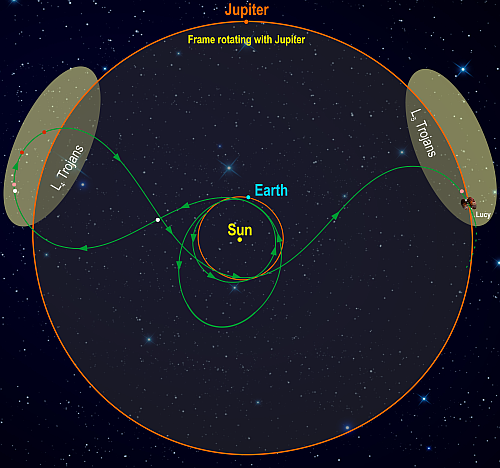
Lucy’s planned route to explore the Trojan asteroids

The Lucy science team has decided to suspend its efforts to complete the deployment of the unlatched solar panel that failed to fully open shortly after launch, having determined that little can be accomplished while the spacecraft is so far from the Sun.

A series of activities in 2022 succeeded in further deploying the array, placing it into a tensioned, but unlatched, state. Using engineering models calibrated by spacecraft data, the team estimates that the solar array is over 98% deployed, and it is strong enough to withstand the stresses of Lucy’s 12-year mission. The team’s confidence in the stability of the solar array was affirmed by its behavior during the close flyby of the Earth on Oct. 16, 2022, when the spacecraft flew within 243 miles (392 km) of the Earth, through the Earth’s upper atmosphere. The solar array is producing the expected level of power at the present solar range and is expected to have enough capability to perform the baseline mission with margin.

The team elected to suspend deployment attempts after the attempt on Dec. 13, 2022, produced only small movement in the solar array. Ground-based testing indicated that the deployment attempts were most productive while the spacecraft was warmer, closer to the Sun. As the spacecraft is currently 123 million miles (197 million km) from the Sun (1.3 times farther from the Sun than the Earth) and moving away at 20,000 mph (35,000 km/hr), the team does not expect further deployment attempts to be beneficial under present conditions.

The spacecraft will do another Earth fly-by on December 12, 2024, which will send it to the Trojans on the left side of the map above. Before that Lucy will do a mid-course correction in February 2024, at which time the engineers will reassess whether to try again to latch the panel, when Lucy is closer to Earth and thus also closer to the Sun.

1 comment
1 184 185 186 187 188 196